
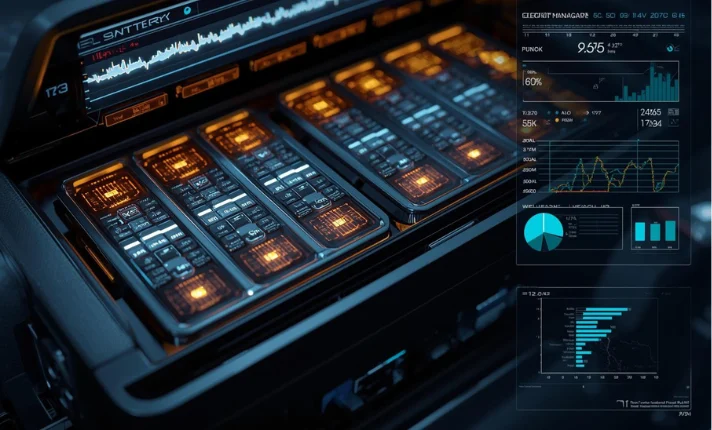
Electric vehicle battery management systems are the backbone of modern EV performance, safety, and longevity. If you’ve ever wondered how electric cars maintain battery health, prevent overheating, and deliver consistent power, the answer lies in the BMS (Battery Management System). In this complete 2026 guide, you’ll learn how electric vehicle battery management systems work, their core components, advanced algorithms, safety features, and future innovations—explained in a clear, practical way that goes far beyond basic explanations.
What Is an Electric Vehicle Battery Management System (BMS)?
An electric vehicle battery management system (BMS) is an intelligent electronic system that monitors, controls, and protects a battery pack in an electric vehicle.
Why BMS Is Critical in EVs
Without a BMS:
- Batteries can overheat or explode
- Cells degrade faster
- Performance becomes unstable
- Charging becomes unsafe
Think of the BMS as the “brain of the battery”—it ensures everything runs safely and efficiently.
How Electric Vehicle Battery Management Systems Work
Core Functions Overview
A modern electric vehicle battery management system performs:
- Real-time monitoring
- Data analysis
- Decision-making
- Safety control
Data Monitoring
The BMS continuously tracks:
- Voltage (per cell & pack)
- Current flow
- Temperature
- Charge/discharge cycles
Control Algorithms Explained
It uses algorithms to:
- Estimate battery charge
- Predict failures
- Optimize performance
These calculations happen thousands of times per second.
Key Components of a Battery Management System
1. Battery Control Unit (BCU)
The central processor that makes decisions.
2. Sensors
- Temperature sensors
- Voltage sensors
- Current sensors
3. Communication Interface (CAN Bus)
Allows communication between:
- Battery
- Motor controller
- Vehicle ECU
4. Power Management Circuitry
Controls:
- Charging
- Discharging
- Protection systems
Types of Electric Vehicle Battery Management Systems
Centralized BMS
- Single control unit
- Lower cost
- Complex wiring
Distributed BMS
- Multiple controllers
- Better scalability
- Higher cost
Modular BMS
- Balanced approach
- Used in modern EVs
Pros & Cons Summary:
| Type | Advantage | Disadvantage |
|---|---|---|
| Centralized | Simple | Wiring complexity |
| Distributed | Scalable | Expensive |
| Modular | Flexible | Medium complexity |
Core Functions of EV Battery Management Systems
1. State of Charge (SOC) Estimation
Indicates how much battery is left (like fuel gauge).
2. State of Health (SOH) Monitoring
Tracks battery aging and degradation.
3. Cell Balancing
Ensures all cells charge evenly:
- Passive balancing (resistors)
- Active balancing (energy transfer)
4. Thermal Management
Maintains safe temperature range:
- Cooling systems
- Heat dissipation
5. Fault Detection & Safety
Detects:
- Overvoltage
- Undervoltage
- Short circuits
Battery Chemistry and BMS Optimization
LFP vs NMC Batteries
| Feature | LFP | NMC |
|---|---|---|
| Safety | High | Medium |
| Energy Density | Lower | Higher |
| Lifespan | Longer | Moderate |
Impact on BMS Design
- LFP requires accurate SOC algorithms
- NMC needs strict thermal monitoring
Charging Profiles
Different chemistries require:
- Different voltage limits
- Different safety thresholds
Advanced Algorithms in Modern BMS
Kalman Filters
Used for precise SOC estimation by combining:
- Sensor data
- Mathematical models
Machine Learning
Modern electric vehicle battery management systems use AI to:
- Predict battery failure
- Optimize charging patterns
Digital Twin Technology
A virtual model of the battery:
- Simulates real-time behavior
- Predicts long-term performance
Real-World Applications in Electric Vehicles
Passenger EVs
- Cars rely heavily on BMS for range optimization
Electric Buses & Trucks
- Require high-capacity battery control
Two-Wheelers & E-Bikes
- Simpler BMS but still critical
Safety Features in Electric Vehicle Battery Management Systems
Overcharge Protection
Stops charging before dangerous levels.
Thermal Runaway Prevention
Prevents chain reactions that cause fires.
Short Circuit Detection
Instantly disconnects faulty circuits.
Real-World Scenario
Battery fires in early EV designs highlighted the need for:
- Better thermal sensors
- Faster response algorithms
Modern systems significantly reduce these risks.
Challenges in Battery Management Systems
Accuracy vs Cost
High-accuracy sensors increase system cost.
Battery Aging
Tracking degradation over the years is complex.
Scalability
Managing thousands of cells efficiently is difficult.
Future Trends in Electric Vehicle Battery Management Systems (2026 & Beyond)
AI-Powered Smart BMS
- Self-learning systems
- Predictive maintenance
Cloud-Connected Batteries
- Remote diagnostics
- OTA (Over-the-Air) updates
Solid-State Batteries
- Safer but require new BMS designs
Wireless BMS
- Reduces wiring
- Improves reliability
How to Choose the Right Battery Management System
Key Factors:
- Battery type
- Voltage range
- Safety features
- Communication protocol
Performance vs Budget
- High-end BMS = better safety
- Budget BMS = limited features
Compatibility
Ensure:
- EV type compatibility
- Charging system integration
Installation and Maintenance Best Practices
Common Mistakes
- Poor wiring
- Ignoring thermal design
- Incorrect calibration
Maintenance Checklist
- Regular diagnostics
- Software updates
- Sensor verification
EV BMS vs Traditional Battery Systems
Key Differences:
| Feature | Traditional | EV BMS |
|---|---|---|
| Monitoring | Minimal | Advanced |
| Safety | Basic | High |
| Intelligence | None | AI-driven |
EVs require much more advanced systems due to high energy density.
People Also Ask
What does a battery management system do in an EV?
It monitors, protects, and optimizes the battery to ensure safety, efficiency, and long life.
Can an EV run without a BMS?
No. Without a BMS, the battery would quickly become unsafe and unusable.
How long does a BMS last?
Typically 8–15 years, depending on usage and quality.
FAQs
Is BMS the same for all EVs?
No, different vehicles use different BMS designs based on battery type and size.
Can a faulty BMS damage a battery?
Yes, it can lead to overcharging, overheating, and permanent damage.
How does BMS improve battery life?
By controlling charge cycles, temperature, and balancing cells.
Is AI really used in BMS today?
Yes, advanced EVs already use AI-based predictive systems.
What is the cost of a BMS?
It varies widely—from $50 (simple systems) to $1000+ (advanced EV systems).


KEEP READING

Autonomous vehicles use three core sensor types — LiDAR, cameras, and radar — to perceive the road. Each technology has hard physical limits that the other two partially compensate for. [...]
Advanced driver assistance system integration (ADAS integration) has become a cornerstone of modern automotive innovation. By merging sensors, cameras, radar, software, and connectivity, ADAS transforms vehicles into intelligent co-pilots that [...]
The impact of robotaxi services on urban mobility is already reshaping how people move in cities, from first/last-mile trips to curbside design and transit planning. This article gives city planners, [...]
Imagine unlocking a world where people with disabilities travel independently, door to door, without lifting a finger. Autonomous vehicles (AVs) are poised to transform accessible transportation, offering customizable interfaces, seamless [...]
Automotive diagnostics have come a long way from the early days of manual inspection. In 2025, the integration of artificial intelligence (AI) is transforming how vehicles are diagnosed, maintained, and [...]