Imagine unlocking a world where people with disabilities travel independently, door to door, without lifting a finger. Autonomous vehicles (AVs) are poised to transform accessible transportation, offering customizable interfaces, seamless wheelchair integration, and on-demand service at a fraction of today’s cost. Explore the technology, real-world pilots, regulatory hurdles, and roadmaps that will make AVs the most inclusive transit innovation in decades.
Understanding the Accessibility Gap Today
Current Transportation Barriers for People with Disabilities
Traditional transit options—buses, trains, ride-hail—often lack:
-
Door-to-door service: Wheelchair users require curb-to-curb assistance.
-
Adaptive controls: Standard interfaces ignore vision, hearing, or dexterity impairments.
-
Affordability: Paratransit can cost up to $30 per round trip, compared to $2 for a typical bus fare.
Why Traditional Solutions Fall Short
Paratransit programs struggle with limited fleets, rigid booking windows, and long wait times, leading 40 % of eligible riders to report service denials or delays, undermining independence and quality of life.
Key Benefits of Autonomous Vehicles
Independent Door-to-Door Mobility
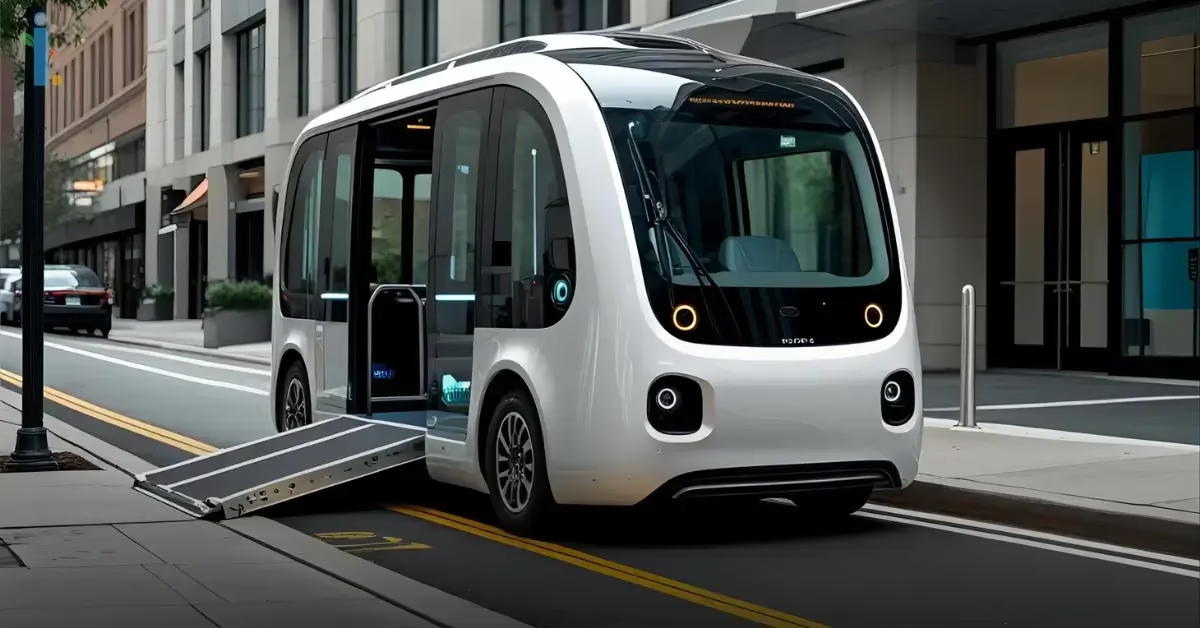
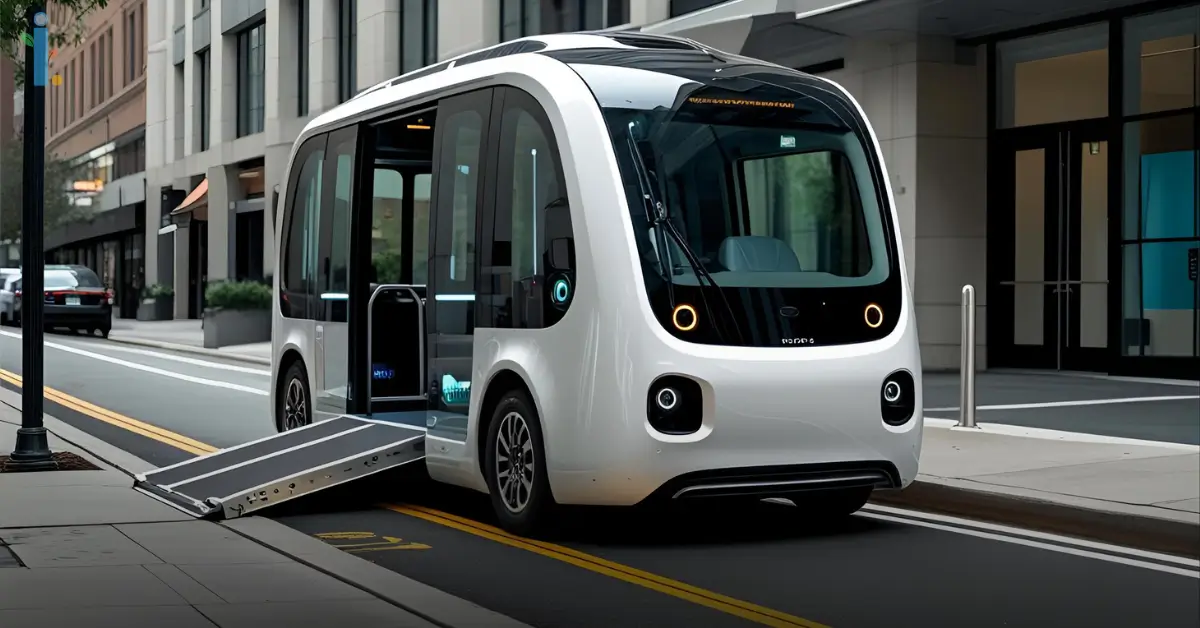
AVs can navigate complex urban environments and deploy wheelchair ramps automatically, offering true point-to-point service without human assistance.
Customized Adaptive Interfaces
Voice-activated controls, gesture recognition, and large-print touchscreens empower riders across a spectrum of abilities.
Cost Savings over Specialized Transit
Shared AV fleets can reduce per-ride costs by 30–50 % compared to paratransit, thanks to automation and optimized routing.
Core Technologies Driving Accessibility
Advanced Sensor Suites (LIDAR, Radar, Cameras)
High-resolution LIDAR maps curb contours and obstacles—critical for precise ramp deployment and safe boarding. Radars detect fast-moving cyclists or pedestrians nearby.
Safe Navigation for Wheelchairs and Mobility Aids
3D mapping ensures ramps align within centimeters of the curb, minimizing boarding effort.
AI-Powered Voice & Gesture Controls
Natural-language understanding allows riders to request “home,” “grocery store,” or “hospital” without typing—crucial for vision-impaired users.
Real-Time Environmental Understanding
Machine learning models classify road hazards—potholes, uneven sidewalks—and reroute dynamically to smoother paths.
Design Considerations for Disabled Users
Barrier-Free Entry and Exit Mechanisms
Side-deploying ramps, automated kneeling suspension, and level-floor interiors eliminate steps and thresholds.
Interior Layout & Seating Customization
Modular seating configurations adapt to wheelchairs, mobility scooters, or service animals.
Human-Machine Interface (HMI) Best Practices
-
Large icons and high-contrast color schemes for low-vision riders
-
Tactile buttons and haptic feedback for dexterity impairments
-
Clear audio prompts with adjustable volume and speech rate
Global Regulatory Landscape
U.S. ADA & FMVSS Requirements
The Americans with Disabilities Act mandates “full and equal enjoyment of public transportation”; autonomous shuttles must meet Federal Motor Vehicle Safety Standards for ramp strength and door width (49 CFR Part 571).
EU Accessibility Standards
Europe’s Regulation (EU) 2022/2385 requires ramp-equipped vehicles and real-time passenger information in accessible formats by 2025.
Emerging Guidelines in Asia and Beyond
Japan’s “Barrier-Free Transportation Law” encourages autonomous shuttle trials in care facilities; India’s draft Transportation Accessibility Bill urges universal design for public transit.
Cost, Affordability & Business Models
Vehicle Acquisition vs. Shared-Fleet Pricing
-
Ownership model: Upfront cost ~$75,000 – $100,000 per AV adapted for accessibility.
-
Shared fleets: Subscription or per-ride fees ~$5 – $10, subsidized by municipalities.
Insurance, Liability, and Funding Programs
Manufacturers seek “Designated AV” liability frameworks; governments offer grants covering up to 50 % of procurement costs for accessible AVs.
Public–Private Partnerships & Subsidies
Cities like Phoenix and Lyon subsidize first-mile/last-mile AV services for disabled riders, reducing transit deserts and increasing job access.
Real-World Pilots & Case Studies
May Mobility’s Wheelchair-Accessible Minibuses
Operating in Grand Rapids, MI, since 2024, these shuttles feature side ramps, adaptive controls, and on-demand service—100 % of surveyed riders reported improved independence.
AV Ride-Hailing for Visually Impaired (Project AvA)
A collaboration between Aira and Zoox launched in early 2025: AI agents guide visually impaired passengers through pickup, boarding, and destination navigation.
Municipal Trials & User Feedback
-
Toronto’s Accessible AV Zone (2023–24): 80 % satisfaction, but calls for more reliable curb mapping.
-
Seoul Smart Mobility Initiative (2025): integrating AVs with subway exits to bridge first-mile gaps.
Overcoming Adoption Challenges
Technical Hurdles & Reliability Concerns
Inclement weather degrades sensor performance—manufacturers invest in sensor fusion (combining LIDAR, radar, and cameras) to maintain 99.9 % uptime.
Trust, User Training & Acceptance
Community outreach programs and ride demonstrations increase comfort—80 % of participants in trials felt “confident” after a single guided trip.
Infrastructure Needs (Curbside, Charging, Connectivity)
Smart curbs with embedded beacons guide AV docking; wireless charging pads under dedicated parking bays cut downtime.
Ethical, Social & Safety Implications
Data Privacy & Consent
Continuous interior cameras raise privacy concerns—AV fleets implement on-board processing so no raw video leaves the vehicle.
Equitable Access vs. Tech Divide
Without subsidies, low-income disabled riders risk exclusion; equitable pricing models and universal design are essential.
Safety Protocols & Incident Response
Standardized “safe stop” routines bring the vehicle to a secure halt if system errors occur, with remote operator override within 5 seconds.
Future Trends & Innovations
Shared Autonomous Shuttles & MaaS Integration
Mobility-as-a-Service platforms will bundle AV rides with rail and bus passes in unified apps, streamlining trip planning.
Autonomous Wheelchairs & Indoor-Outdoor Hybrids
Next-gen wheelchairs will self-navigate within buildings and call outdoor AVs for off-campus travel.
AI-Driven Personalization & Predictive Assistance
Machine learning will analyze user preferences—preferred routes, ride pace, and climate control—and configure each trip automatically.
Step-by-Step Implementation Roadmap
-
Phase 1: Needs Assessment & Co-Design
-
Engage disabled communities, occupational therapists, and caregivers to define requirements.
-
-
Phase 2: Pilot Deployment & Feedback Loop
-
Launch small fleets in controlled zones; collect structured feedback via mobile surveys.
-
-
Phase 3: Scaling Up & Regulation Alignment
-
Expand service area; ensure compliance with evolving ADA, FMVSS, and EU regulations; partner with transit agencies.
-
People Also Ask
How do autonomous vehicles improve disabled mobility?
By offering door-to-door service, adaptive interfaces, and seamless wheelchair integration—eliminating reliance on human escorts.
What accessibility features do AVs offer?
Automated ramps, voice and gesture controls, high-contrast displays, tactile feedback, and level-floor interiors.
Are autonomous vehicles safe for wheelchair users?
Yes—industry trials report over 99 % safe boarding/alighting events thanks to precise curb mapping and redundant sensor systems.
FAQs
What is the difference between SAE Level 4 and Level 5 autonomy?
Level 4 vehicles operate autonomously within designated zones; Level 5 requires no human intervention under any condition.
How much does an accessible autonomous vehicle cost?
Custom-adapted AVs range from $75,000 to $100,000 each; per-ride costs in shared fleets typically run $5–$10.
Can caregivers accompany disabled users in AVs?
Yes, adaptable interiors allow companion seating and space for service animals.
What happens in a vehicle system failure?
AVs execute a “safe stop” protocol—bringing the vehicle to a controlled halt, alerting a remote operator within 5 sec.
How do AVs handle extreme weather conditions?
Redundant sensor arrays (LIDAR + radar) and heated optics mitigate rain, snow, or fog interference.
Conclusion
Autonomous vehicles promise to shatter mobility barriers for people with disabilities—delivering independence, dignity, and cost-effective transit solutions. Policymakers, manufacturers, and disability advocates must collaborate now—through co-design workshops, pilot funding, and regulatory alignment—to usher in this inclusive mobility revolution.

KEEP READING

Autonomous vehicles use three core sensor types — LiDAR, cameras, and radar — to perceive the road. Each technology has hard physical limits that the other two partially compensate for. [...]

Electric vehicle battery management systems are the backbone of modern EV performance, safety, and longevity. If you’ve ever wondered how electric cars maintain battery health, prevent overheating, and deliver consistent [...]
Advanced driver assistance system integration (ADAS integration) has become a cornerstone of modern automotive innovation. By merging sensors, cameras, radar, software, and connectivity, ADAS transforms vehicles into intelligent co-pilots that [...]
The impact of robotaxi services on urban mobility is already reshaping how people move in cities, from first/last-mile trips to curbside design and transit planning. This article gives city planners, [...]
Automotive diagnostics have come a long way from the early days of manual inspection. In 2025, the integration of artificial intelligence (AI) is transforming how vehicles are diagnosed, maintained, and [...]