
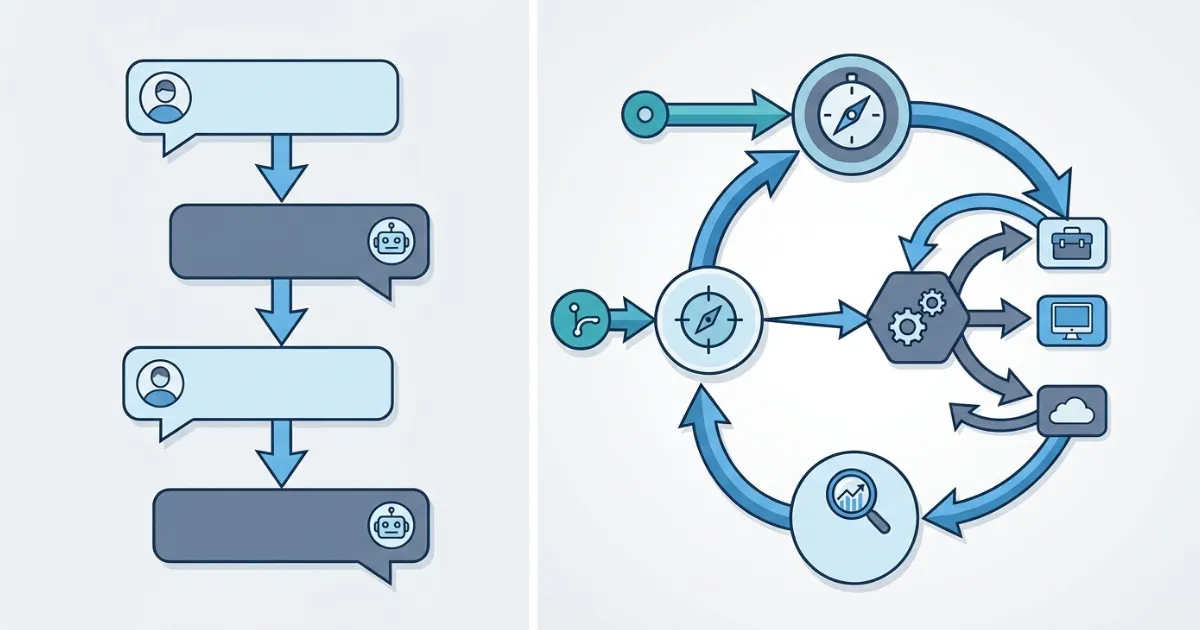
AI agents and chatbots get sold as the same thing, and that’s costing companies money before they’ve deployed anything. A chatbot matches what you type to a pre-written answer and stops. An AI agent runs a model in a loop: it plans a step, calls a tool, checks what came back, and decides what to do next, on its own, until the goal is done or it hits a stopping condition. That architectural gap, not marketing language, decides which one actually finishes your task.
What Makes an AI Agent Different From a Chatbot
An AI agent, per Anthropic’s December 2024 engineering post on agent design, runs a language model in a loop that plans, calls tools, and checks its own results. A chatbot matches input to a pre-written response and stops there.
That’s not a matter of degree. A chatbot’s job ends the moment it replies. An agent’s job ends when the goal is met, which might take one tool call or forty.
The Loop Chatbots Don’t Have
A support chatbot can tell a customer the refund policy. It cannot process the refund, because processing a refund means writing to a billing system, and a chatbot has no loop that lets it try an action, look at the result, and adjust. An agent built for the same task calls the billing API, checks the response code, retries or escalates if it fails, then confirms the refund back to the user. Same conversation. Different amount of work actually happening behind it.
Where the Line Blurs
Vendors know “agent” sells better than “chatbot” right now, so plenty of products marketed as agents are chatbots with one extra API call bolted on. A single tool call inside a fixed script is still a workflow, not an agent, because the control flow still belongs to the developer, not the model. The test isn’t whether a tool gets called. It’s whether the model decides when and whether to call it.
AI Agents vs. Chatbots, Side by Side
| Dimension | Traditional Chatbot | AI Agent |
|---|---|---|
| Decision logic | Decision tree or intent-matching against a fixed list | Model reasons step by step and chooses its own next action |
| Tool and API access | Usually one connected system, if any | Multiple tools, APIs, and databases in a single task |
| Memory across turns | Resets when the session closes | Holds context and state across the full task |
| Typical unit of work | One question, one answer | A multi-step task with several dependent actions |
| What happens when it’s confused | Loops back to a menu or hands off to a human | May take a wrong autonomous action if unchecked |
| Governing 2026 security framework | Not addressed | OWASP Top 10 for Agentic Applications, published December 2025 |
Chatbots are still cheaper to build, test, and audit, which is the reason most FAQ widgets haven’t gone anywhere.
Why 40% of Agentic AI Projects Get Canceled, and It’s Rarely the Model
More than 40% of agentic AI projects will be canceled by the end of 2027, according to a Gartner press release from June 2025. Gartner’s Anushree Verma attributed most of that to projects that started as proofs of concept and never got a real cost or ROI case built underneath them.
Most teams don’t fail because the model can’t reason. They fail because nobody scoped what “done” means for the agent, so it keeps calling tools past the point of usefulness. A support team we’d expect to see this in: an agent with no iteration cap will happily re-check the same order status five times if its planning step gets stuck in a loop, and every one of those calls costs tokens.
That’s the gap between the demo and the invoice. A demo runs once, on a clean example, with someone watching. Production runs thousands of times a day, on messy input, with nobody watching each one.
The Security Gap Most Teams Skip
Chatbots read and reply; agents read, decide, and act, which is exactly why the OWASP GenAI Security Project’s Top 10 for Agentic Applications, published in December 2025, exists as a separate document from older LLM security guidance. The list was built from actual production incidents and reviewed by more than 100 security practitioners, and its top risk is what OWASP calls agent goal hijacking: an attacker plants instructions inside a document, email, or webpage the agent later reads, and the agent follows them because it can’t reliably tell an instruction from data.
A chatbot with read-only access to an FAQ page has almost nothing an attacker can hijack. An agent with a valid API key to your CRM, your billing system, and your inbox has a lot of it. That’s not a reason to avoid agents. It’s a reason the access an agent gets should be scoped as tightly as the task requires, not as broadly as the vendor demo suggests.
If your team is choosing between a chatbot and an agent right now, that access question is worth answering before the pricing question.
When a Chatbot Is Still the Better Buy
A chatbot wins when the task has a small, stable set of answers and no system needs to change state. Store hours, password reset links, order-status lookups, appointment booking against one calendar: all of these are single-turn, script-friendly jobs where an agent adds cost and failure surface without adding capability.
Most teams implementing agentic support tools discover the mismatch the same way: they route 100% of traffic to an agent, watch token spend triple, and find that 80% of the conversations were FAQ-shaped anyway. A cheaper, more reliable fix is a chatbot that handles the scripted majority and hands off to an agent only for the multi-step cases that actually need one.
Treat “AI agent” as a tool selection, not an upgrade you apply everywhere by default.
The Agent-Washing Test: How to Tell What You’re Actually Buying
Ask a vendor five questions before you believe their product is an agent, not a chatbot with a new label. Does it decide, on its own, whether to call a tool, or does a developer’s script decide for it? Does it hold state across more than one turn? Can it try a step, see that it failed, and pick a different approach without a human re-prompting it? Does it have a real stopping condition, or does someone just watch it and pull the plug? Can you name the specific systems it’s allowed to write to, not just read from?
A product that fails two or more of those isn’t lying, exactly. It’s a chatbot wearing agent branding, and Gartner’s own estimate puts the number of vendors offering genuine agentic capability at around 130 out of thousands claiming it.
People Also Ask
Is an AI agent just a smarter chatbot?
No. The difference is architectural, not a matter of degree. A chatbot matches input to a scripted reply and stops. An agent runs in a loop, deciding what tool to call next based on the result of the last one, until the task is finished.
Can a chatbot become an AI agent?
Yes, if you add tool access, memory across turns, and a planning loop that lets the model decide its own next step instead of following a fixed script. Without all three, it’s still a chatbot with extra features.
Do AI agents replace chatbots?
Not for most tasks. Chatbots stay cheaper and more predictable for narrow, single-turn questions like store hours or password resets. Agents earn their cost on multi-step tasks that require reading, deciding, and writing to systems.
Why do so many AI agent projects fail?
Gartner’s June 2025 forecast points to unclear ROI, rising costs, and weak risk controls, not model quality. Most canceled projects were proofs of concept that never got a real production scope or a defined stopping condition.
Is every chatbot vendor now calling their product an “agent”?
Many are. Gartner estimates only around 130 vendors, out of thousands claiming agentic capability, actually deliver it. Ask whether the model decides its own next action or whether a script does; that answer tells you which one you’re buying.
Frequently Asked Questions
What’s the single biggest technical difference between an AI agent and a chatbot?
An agent maintains a loop: it takes an action, observes the result, and decides the next action based on that result, without a developer having pre-mapped every branch. A chatbot has no such loop. It receives input, matches it against a fixed set of intents or rules, and returns a response. That single structural choice explains nearly every other difference on this page, from memory to tool access to why agents cost more to run per conversation.
Are AI agents more expensive to run than chatbots?
Generally, yes, because each step in an agent’s loop, planning, tool calls, and result-checking, consumes tokens, and a multi-step task can involve a dozen or more of those steps before it’s done. A chatbot answers in one pass. If your use case is a high volume of simple, repetitive questions, an agent’s per-conversation cost can run several times higher without adding value the user notices.
Do I need to worry about AI agent security differently than chatbot security?
Yes. A read-only chatbot has little for an attacker to hijack. An agent with write access to real systems, your CRM, billing, or inbox, has meaningfully more exposure, which is why OWASP published a separate Top 10 framework for agentic applications in December 2025. Before deploying an agent, scope exactly which systems it can write to, and treat any content it reads (emails, documents, web pages) as a possible source of injected instructions.
How do I know if a vendor’s “AI agent” is actually just a chatbot?
Ask whether the model itself decides when and whether to call a tool, or whether a developer’s script makes that call. A single tool bolted onto a scripted flow is still a workflow. Also ask whether it holds context across more than one turn and whether it can try a different approach after a failed step without a human re-prompting it. If the answer to either is no, you’re likely looking at a chatbot with agent branding.
Should a small business start with a chatbot or an AI agent?
Start with whichever matches the shape of the task, not the size of the business. If most incoming questions are repetitive and don’t require changing a record in another system, a chatbot handles that more cheaply and more predictably. If the work genuinely requires multiple steps across systems, an agent earns its cost. Many teams run both: a chatbot for the scripted majority, with a handoff to an agent for the cases that actually need multi-step action.


KEEP READING
AI Agents vs. Chatbots: Avoid the Costly Mismatch AI agents vs. chatbots comes down to who chooses the next step. A chatbot returns one reply per input. An AI agent [...]

Small language models (SLMs) are AI text models with roughly 1 million to 10 billion parameters, according to Hugging Face's 2025 overview, small enough to run on a phone, a [...]

AI ethics and bias mitigation mean defining fair outcomes, testing for gaps, and fixing them across the three stages in NIST's 2022 SP 1270. Those stages are pre-design, design and [...]

An AI governance framework is the set of policies, risk tiers, and approval gates that decides which AI systems your organization can ship and which ones need a human sign-off [...]

Generative AI tools for content creation now range from a general chatbot that drafts an email in ten seconds to a specialized platform that holds a brand's tone across a [...]