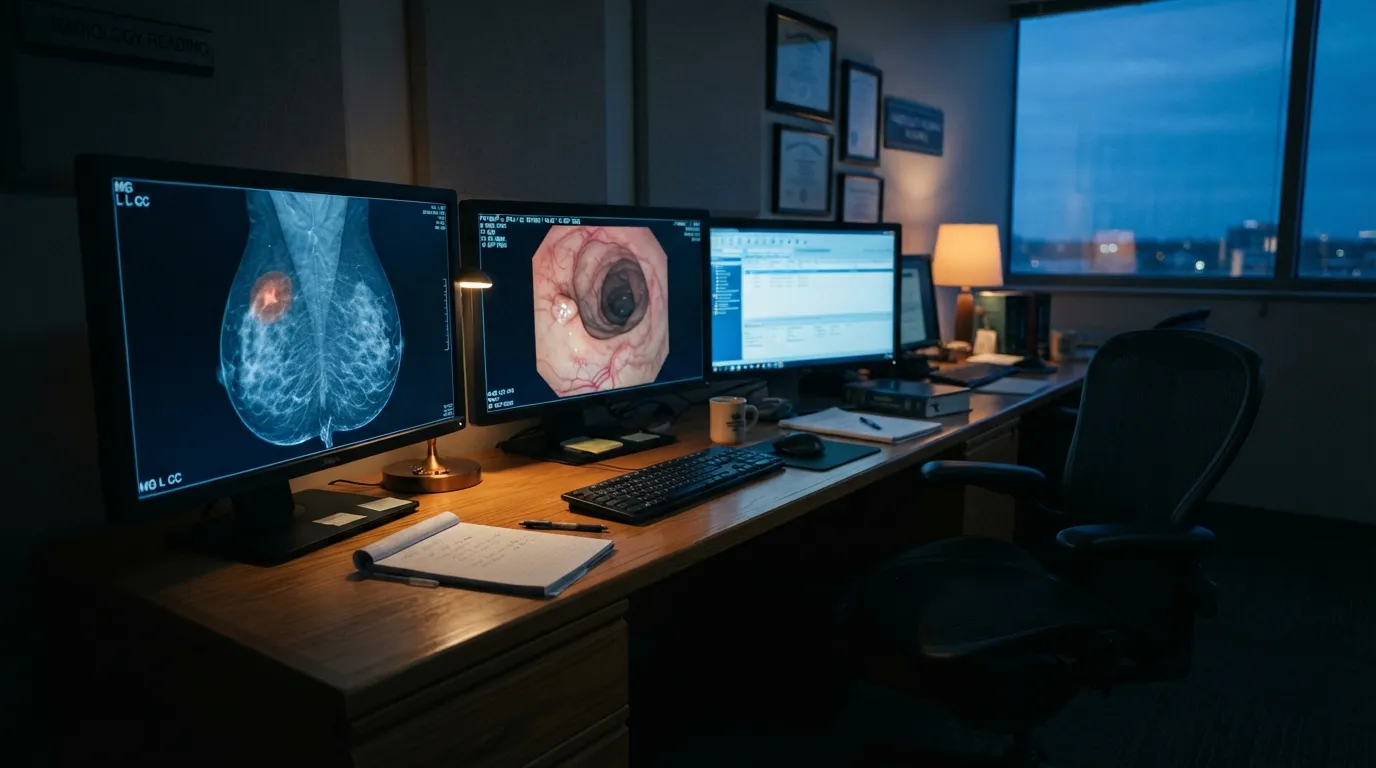
AI in healthcare diagnostics is now a regulated product category. According to the FDA, more than 1,600 AI-enabled medical devices were authorized for U.S. marketing as of September 2026. The evidence behind them is uneven. A Swedish trial reported by Lund University in 2026 found AI-supported mammography cut interval cancers by 12%. A 2025 Lancet Gastroenterology & Hepatology study found colonoscopists detected fewer precancerous growths once AI was switched off. This guide covers the tools, the trials and the skill-decay risk most articles skip. It ends with a five-point check you can run on any vendor claim.
How AI in Healthcare Diagnostics Works in Clinics Today
FDA-cleared diagnostic AI is narrow software: it reads one data type, such as a retinal photo or a mammogram, and returns a flag or a score for a clinician to review.
The FDA says it regulates medical devices, not AI as such. Its 2026 device page lists a skin cancer imaging system, software that detects diabetic retinopathy from retinal images, and a sensor that estimates heart attack probability.
The hardware feeding these tools keeps changing too. Our rundown of diagnostic medical imaging advances covers photon-counting CT and real-time MRI, both of which produce the images that diagnostic software reads.
Where FDA-Cleared Diagnostic AI Concentrates
A Cureus study published in July 2026 found that 76.5% of 1,430 FDA AI-device authorization records through December 2025 went through the radiology review panel.
That’s 1,094 records in one specialty. The Cureus authors say their analysis counts authorization records and says nothing about adoption or patient benefit. The FDA states that its device list is not comprehensive, either. A count of cleared devices therefore reveals what regulators reviewed and little about what hospitals use.
Clearance also has a boundary. The FDA’s 2026 page says it reviews each device through a pathway such as 510(k) clearance, De Novo classification or premarket approval. It weighs the intended use and the technology. A tool cleared to triage one scan type hasn’t been cleared for everything a sales deck implies.
If a vendor quotes you a clearance number, check which scan type and patient group it covers before you read anything else.
What the MASAI Mammography Trial Measured
Lund University’s 2026 report on the MASAI trial found AI-supported mammography produced 12% fewer interval cancers than standard screening, 82 cases against 93.
An interval cancer is one diagnosed between two screening rounds after a normal result. In plain terms, the screen missed it. Lund’s study lead, Kristina Lång, calls their frequency a central measure of how well a screening test works.
The trial enrolled about 106,000 women in Sweden, per Lund University’s 2026 report. The AI did two jobs. It sorted mammograms into single or double reading by risk score, and it marked suspicious areas for the radiologist. Earlier MASAI reports, cited by Lund University in 2026, found 29% more cancers detected and a 44% cut in radiologist reading workload.
Among the interval cancers that did occur, Lund reported in 2026 that the AI group had 16% fewer invasive cancers and 19% fewer large ones. That 2026 report also found 27% fewer aggressive subtypes. Sensitivity rose without an increase in false positives.
In the 2026 results, those 11 fewer interval cancers matter more than the 29% detection gain. A screening programme works when fewer cancers slip through to the next round.
The trial’s authors note in The Lancet that it ran in one country, on one mammography device type and one AI system. A different vendor in a different population could land elsewhere.
Skill Decay: What Happens When the AI Switches Off
In a 2025 Lancet Gastroenterology & Hepatology study of four Polish endoscopy centres, adenoma detection in non-AI colonoscopies fell from 28.4% to 22.4% after AI polyp detection arrived.
An adenoma is a precancerous growth in the colon. The 2025 Lancet Gastroenterology & Hepatology paper covered 1,443 colonoscopies done without AI, 795 before the tool arrived and 648 after. That 2025 gap came to 6.0 percentage points, with a 95% confidence interval of 1.6 to 10.5 and p=0.0089.
Side by side, the two studies differ in design before they differ in results.
| Comparison point | MASAI mammography trial | Polish colonoscopy study |
|---|---|---|
| Journal and year | The Lancet, 2026 | The Lancet Gastroenterology & Hepatology, 2025 |
| Design | Randomized controlled trial | Retrospective observational study |
| Sample | About 106,000 women | 1,443 colonoscopies done without AI |
| Setting | Swedish screening programme | 4 endoscopy centres in Poland |
| Measured outcome | Interval cancers after 2 years of follow-up | Adenoma detection rate with AI switched off |
| Result | 82 cases with AI, 93 without | 28.4% before AI, 22.4% after |
The Polish authors don’t claim proof. Their interpretation is that continuous exposure to AI might lower unassisted detection, and the study was retrospective, with before-and-after windows of three months each.
If you run an endoscopy or radiology unit, the practical question is whether anyone tracks unassisted performance, because a vendor’s accuracy figure can’t reveal it.
In the 2025 data, six fewer adenomas turned up per 100 exams. Each one is a growth left in place.
When AI in Healthcare Diagnostics Struggles Outside Big Hospitals
A January 2026 umbrella review in Cureus, covering studies from 2010 to April 2025, found AI diagnostics promising for rural care but dependent on infrastructure and local context.
Across 26 included studies, the reviewers reported faster turnaround and better access through mobile and telehealth tools. They also listed limited digital infrastructure, gaps in provider training, data privacy concerns and regulatory uncertainty as common barriers.
Connectivity decides whether the tool runs at all. The same review notes that AI diagnostics often rely on cloud platforms for real-time data sharing, so an unreliable rural connection weakens the system. If you test a cloud-based reader on a clinic line that drops, expect delays that an accuracy benchmark won’t show.
Ask where the model runs, on local hardware or in the vendor’s cloud, before you compare accuracy figures. Rural clinics also lean on tests that run on site. Our guide to point of care testing covers how those devices work and how their accuracy has improved.
What Patients Notice, and What They Don’t
Patients in Sweden’s MASAI trial saw no change at the mammography appointment, because Lund University says the AI acts afterwards, when radiologists read the images.
That invisibility has a consequence. If your clinic uses AI on your scans, ask whether your images stay inside the hospital’s systems or travel to the vendor. Our guide to AI in healthcare data privacy covers consent, privacy safeguards and regulation, which is the place to start before you agree to anything.
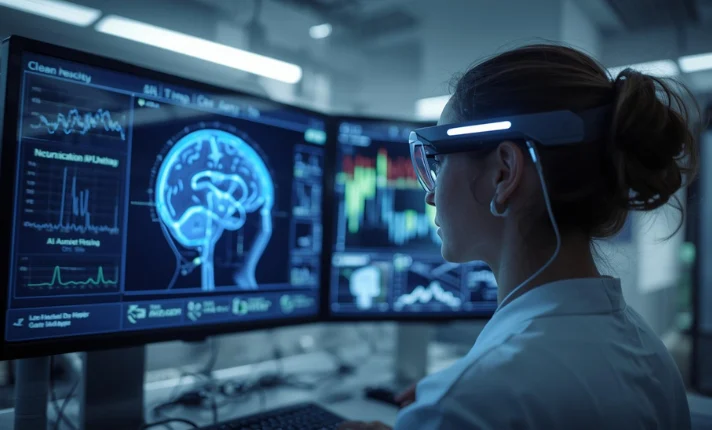
If your concern is the brain rather than the breast, the toolset changes. Our breakdown of early detection technology for neurological disorders covers imaging, biomarkers and wearables.
Three Myths About AI Diagnosing Disease
Three myths mislead readers of diagnostic AI news: that it replaces doctors, that FDA clearance proves benefit in your hospital, and that higher detection always means better care.
Start with replacement. In the 2026 MASAI trial, AI risk scores decided whether one or two radiologists read each mammogram, which cut reading workload by 44%, per Lund University. Radiologists stayed in the loop, and Lund notes that breast radiologists are in short supply, so the workload cut targets a real bottleneck.
Clearance is narrower than it sounds. The FDA regulates devices for a stated intended use, and its list is not a full inventory. A clearance tells you a regulator reviewed a specific product for a specific job. Whether it works on your patients, with your scanners, is a local question.
Then there’s detection. A tool that raises detection with AI on says nothing about detection with AI off. The 2025 Polish colonoscopy study shows why that gap matters.
A Five-Point Check for AI in Healthcare Diagnostics Claims
Five questions drawn from the MASAI and colonoscopy studies separate trial-backed diagnostic AI claims from marketing ones.
- Ask which outcome was measured. The MASAI trial counted 82 interval cancers with AI against 93 without, per Lund University in 2026. That outcome matters to patients directly, which a detection rate alone can’t claim.
- Ask about the design. MASAI was a randomized controlled trial, while the 2025 Polish colonoscopy study was observational, and the two deserve different levels of trust.
- Ask who the study covered. The MASAI authors report one country, one mammography device type and one AI system, so check how closely your population and equipment match.
- Ask for the unassisted baseline. In the 2025 Polish study, detection without AI fell from 28.4% to 22.4%, which only a before-and-after comparison could expose.
- Ask who paid. Lund University lists MASAI’s funders as the Cancer Foundation, Lund University/ALF, RCC Samverkan and MAS Cancer. Any vendor claim should come with a similar disclosure.
If a deck quotes sensitivity but never mentions the unassisted baseline, question four is still open.
People Also Ask
How is AI being used in diagnosis or treatment?
AI is used in diagnosis mainly to read medical images, with 76.5% of FDA AI-device authorization records through 2025 sitting in radiology, per a July 2026 Cureus analysis. The FDA’s 2026 device page also lists skin cancer imaging, diabetic retinopathy detection from retinal photos and a heart attack probability sensor. Treatment uses exist too, such as automated insulin dosing from glucose monitor readings.
What are the benefits and potential risks of using AI in health care?
The documented benefit of diagnostic AI is higher cancer detection, and the documented risk is weaker clinician skill when the AI is off. Lund University’s 2026 MASAI results show 12% fewer interval cancers with AI, while a 2025 Lancet Gastroenterology & Hepatology study found colonoscopy detection fell from 28.4% to 22.4% when AI was off. Another limit is that MASAI used one AI system in one country.
Will AI replace the human doctor?
In Lund University’s 2026 MASAI trial, AI changed how many radiologists read each mammogram but didn’t remove radiologists from the process. That cut reading workload by 44% in 2026. The Polish colonoscopy study points to a different open question: whether clinicians keep their unassisted skill, which matters more than headcount.
What role does machine learning play in healthcare diagnostics?
Machine learning is the technique that lets diagnostic software learn patterns from labeled medical data, such as scans marked as cancerous or normal. The FDA regulates the resulting software as a medical device tied to an intended use. Some devices can change after authorization, so the FDA publishes guidance on predetermined change control plans that set update rules in advance.
What if the AI makes a mistake that would hurt me?
A clinician still reviews diagnostic AI output in the studies cited here, so errors should be caught by a human reader. The risk the Polish colonoscopy study raises is that reviewers get less sensitive over time: detection fell from 28.4% to 22.4% when AI was off, per a 2025 Lancet Gastroenterology & Hepatology paper. Ask your provider how they track unassisted accuracy.
Frequently Asked Questions
Is AI more accurate than doctors at diagnosis?
The trials cited here test AI plus clinicians, not AI alone, so the question compares two workflows. In the 2026 MASAI trial, per Lund University, AI-supported screening found 29% more cancers than standard double reading without more false positives, and it cut reading workload by 44%. In the 2025 Polish colonoscopy study, clinicians found fewer adenomas once AI had been in use and was then switched off. Accuracy depends on the task, the tool, and whether clinicians keep their unassisted skill.
What should a hospital track after it deploys diagnostic AI?
Track clinician performance with the AI off, not only the tool’s own accuracy. The 2025 Polish study found adenoma detection fell from 28.4% to 22.4% in non-AI colonoscopies, a gap a vendor’s accuracy figure wouldn’t show. Track interval cancers too, as MASAI did in 2026. Log which device version produced each result. The FDA’s 2026 AI device page says careful management across the product life cycle, including monitoring and modification, supports continued safety.
Does AI in healthcare diagnostics work in rural clinics?
It can, but results depend on infrastructure and local context. A January 2026 Cureus umbrella review of studies from 2010 to April 2025 found considerable promise for reducing rural inequities, and it also found that successful rollout needs sustained infrastructure investment and strong ethical and regulatory oversight. If you run a clinic with unreliable internet, ask whether a tool runs on local hardware or in the vendor’s cloud before you compare accuracy figures.
Does diagnostic AI increase false positives?
In the 2026 MASAI trial it didn’t: Lund University reports that sensitivity rose without more false positives. Lund defines a false positive as a woman recalled for further assessment who doesn’t have breast cancer. That result comes from one country, one mammography device type and one AI system, according to the trial’s authors in The Lancet, so another tool on another population could behave differently. Ask any vendor for false-positive rates in a population like yours.
How can I tell if a diagnostic AI tool is FDA-cleared?
Search the FDA’s AI-Enabled Medical Devices List, which records each device’s decision date, submission number, company and specialty. The FDA says the list is not comprehensive, so a missing device may still be authorized, and a listed one may be cleared only for a narrow intended use. Read the intended-use statement in the device’s summary, then check that your patient group and scan type match it.


KEEP READING
Edge AI applications are programs that run a trained AI model on the device collecting the data, whether that is a phone, a factory camera, a car or a bedside [...]
Prompt engineering techniques are repeatable ways to structure what you send a language model. The Prompt Report, a University of Maryland-led survey updated in February 2025, catalogued 58 text-based ones. [...]

How to build an AI governance framework comes down to four written decisions for every AI system: who owns it, which risk tier it sits in, what approval it needs, [...]
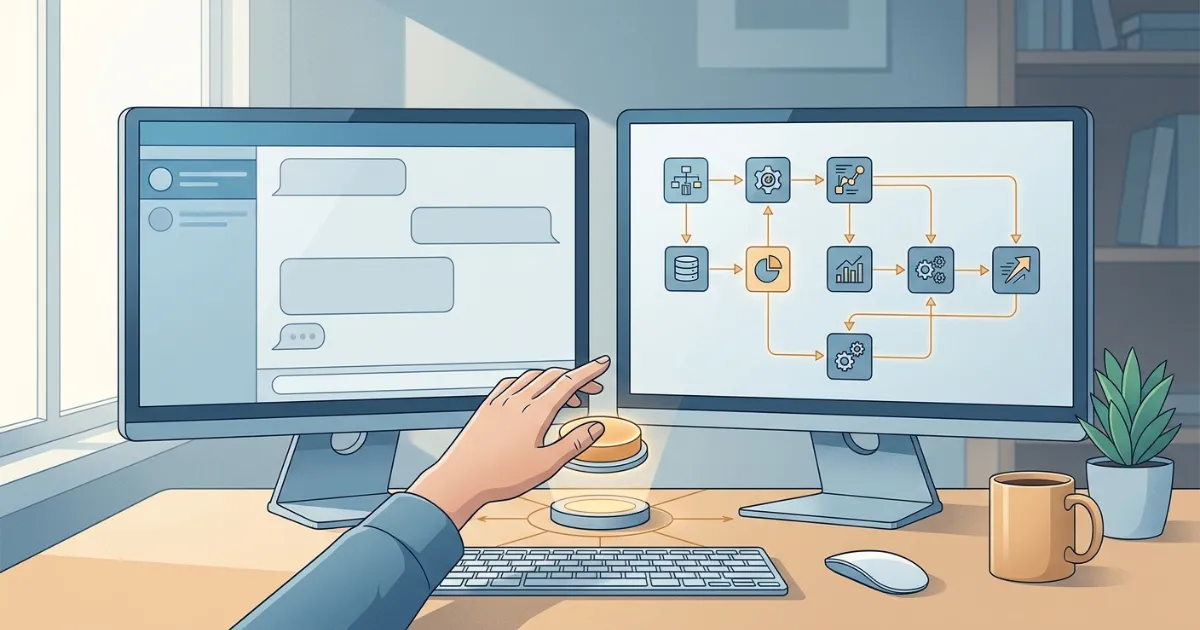
AI agents vs. chatbots comes down to who chooses the next step. A chatbot returns one reply per input. An AI agent runs a model in a loop, picks its [...]

Small language models (SLMs) are AI text models with roughly 1 million to 10 billion parameters, according to Hugging Face's 2025 overview, small enough to run on a phone, a [...]