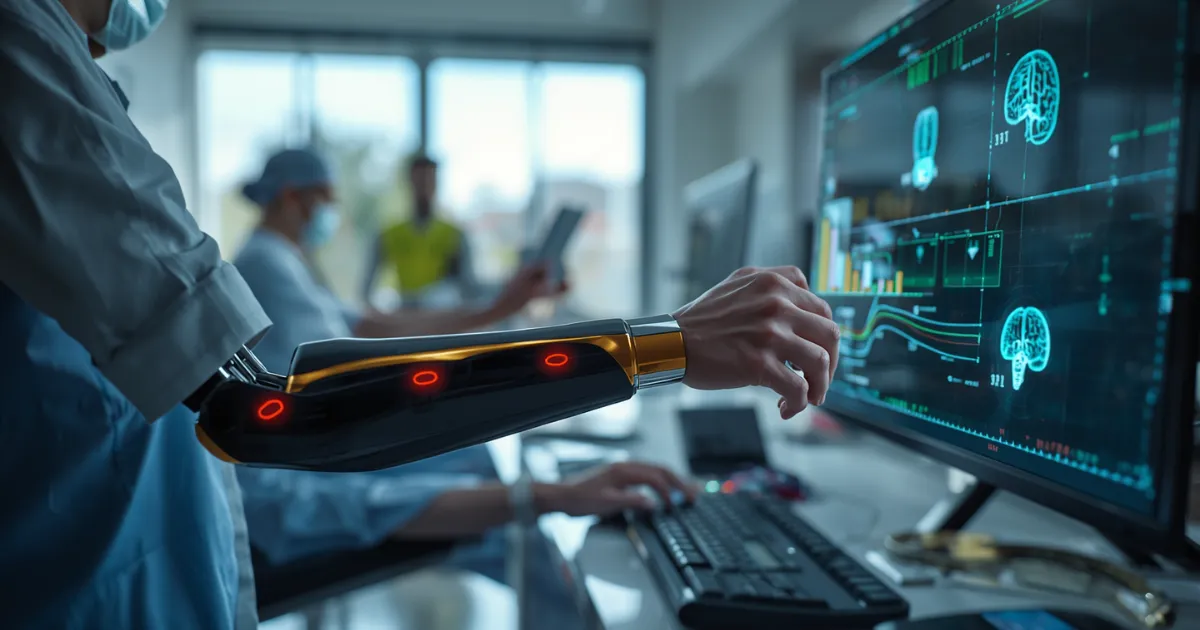
Brain computer interfaces (BCIs) allow amputees to control prosthetic limbs using signals generated by the nervous system. These systems detect brain activity, nerve signals, or muscle-related electrical patterns, convert them into digital commands, and send those commands to robotic limbs. Modern BCI-controlled prosthetics can perform tasks such as grasping objects, rotating wrists, walking with powered legs, and even restoring a limited sense of touch. Progress in artificial intelligence, neural decoding, and sensory feedback has moved these systems from research laboratories into real-world clinical use, although significant technical challenges remain.
What Is a Brain Computer Interface?
A brain computer interface is a system that creates a direct communication pathway between the nervous system and an external device.
For amputees, the external device is usually a robotic arm, hand, leg, or exoskeleton. The BCI captures electrical activity generated by neurons, processes that activity using software, and translates it into movement commands.
A typical BCI system contains:
- Signal acquisition hardware
- Signal processing software
- Machine learning algorithms
- Prosthetic control systems
- Feedback mechanisms
The goal is simple: when a person intends to move a missing limb, the prosthetic performs the intended action.
How Do Brain Computer Interfaces Work to Control Prosthetic Limbs?
The process follows a sequence of steps that occur within fractions of a second.
Step 1: The Brain Creates a Movement Intent
When a person decides to move a hand, neurons inside the motor cortex become active.
Even after an amputation, the motor cortex often continues producing signals associated with the missing limb. Researchers call this preserved neural representation.
For example, an amputee may think about closing a hand that no longer exists. The brain still generates the command.
Step 2: Neural Signals Are Recorded
The next step involves capturing those signals.
Several technologies are used:
| Method | Location | Invasiveness | Signal Quality |
|---|---|---|---|
| EEG | Scalp | Non-invasive | Moderate |
| ECoG | Brain surface | Semi-invasive | High |
| Intracortical Arrays | Inside brain tissue | Invasive | Very High |
| Peripheral Nerve Interfaces | Remaining nerves | Surgical | High |
| Muscle Interfaces | Residual muscles | Minimally invasive | High |
Each method balances safety and performance differently.
Step 3: Signal Processing Removes Noise
Raw neural recordings contain unwanted electrical activity.
Common sources of interference include:
- Eye movements
- Muscle contractions
- Environmental electronics
- Electrode movement
- Wireless transmission noise
Signal processing software filters and cleans the data before interpretation.
Without this step, prosthetic control becomes unreliable.
Step 4: Artificial Intelligence Decodes Intent
Machine learning models examine patterns in neural activity.
The software learns relationships between brain signals and intended movements.
Examples include:
- Open hand
- Close hand
- Point finger
- Rotate wrist
- Lift arm
- Flex elbow
The decoder predicts what movement the user intends to perform.
Step 5: Commands Reach the Prosthetic Limb
The decoded instruction is transmitted to motors inside the prosthetic.
The robotic system then performs the movement.
Modern prosthetic hands may contain:
- Multiple electric motors
- Force sensors
- Pressure sensors
- Joint position sensors
- Embedded microcontrollers
These components allow movements that resemble natural hand function.
Brain Signals Used in Prosthetic Control
Not every prosthetic relies on direct brain implants.
Different systems use different biological signals.
Electroencephalography (EEG)
EEG uses electrodes placed on the scalp.
Advantages:
- No surgery
- Lower cost
- Safer deployment
Limitations:
- Lower accuracy
- Reduced precision
- More susceptibility to noise
EEG works best for simple commands.
Electrocorticography (ECoG)
ECoG electrodes rest directly on the brain’s surface.
Benefits include:
- Better signal quality
- Faster response times
- Improved movement accuracy
The drawback is the need for surgery.
Intracortical Implants
Tiny electrode arrays are implanted within the motor cortex.
These systems can record individual neuron activity.
Benefits:
- Extremely detailed signals
- Fine finger control
- Greater precision
Challenges:
- Surgical risks
- Long-term stability concerns
- Higher cost
Peripheral Nerve Interfaces
Many researchers now focus on nerves outside the brain.
Electrodes connect to surviving nerves in the residual limb.
Advantages include:
- Strong control signals
- Lower surgical complexity
- More natural movement intent
This area has shown promising results in recent clinical studies.
The Ignored Angle: Phantom Limb Activity Makes BCI Control Possible
Most articles focus on computers and robotics.
A less discussed fact is that many amputees continue generating neural commands for missing limbs years after amputation.
This phenomenon allows BCI systems to function.
When users attempt to move a missing hand:
- Motor cortex regions activate
- Nerve pathways remain partially functional
- Intent signals can still be measured
Researchers frequently use phantom limb movement as a training signal.
Without these preserved pathways, advanced prosthetic control would be far more difficult.
How Machine Learning Learns User Intent
Every person’s neural activity is different.
A decoder must learn individual patterns.
Training usually follows these steps:
- User imagines specific movements.
- Signals are recorded.
- Labels are assigned.
- AI identifies patterns.
- Accuracy is tested.
- The model is refined.
Many systems require calibration sessions ranging from 15 minutes to several hours.
Over time, performance improves as both the user and algorithm adapt.
Sensory Feedback: Giving the User a Sense of Touch
Movement alone is only half of the challenge.
Natural limbs provide constant feedback.
The brain receives information about:
- Pressure
- Temperature
- Texture
- Position
- Grip force
Without feedback, users must visually monitor every movement.
Electrical Stimulation of the Brain
Some experimental systems stimulate sensory cortex regions.
This produces artificial sensations.
Users may perceive:
- Tapping
- Pressure
- Contact
- Motion
Peripheral Nerve Stimulation
Electrodes stimulate surviving nerves.
This approach often produces sensations that feel more natural.
Researchers have demonstrated:
- Object detection
- Grip force perception
- Shape recognition
These developments significantly improve prosthetic usability.
The “It Depends” Situation: More Invasive Does Not Always Mean Better
Many people assume the highest-performance implants are always the best option.
The answer depends on the user.
Factors include:
- Age
- Health status
- Surgical risk tolerance
- Lifestyle requirements
- Cost considerations
A factory worker may prioritize reliability.
A researcher may accept surgery for increased control precision.
A child may require entirely different design choices.
The best system depends on context rather than maximum signal quality alone.
Insider Knowledge From Prosthetic Development Teams
Laboratory demonstrations often look effortless.
Real-world use is more complicated.
Experienced prosthetic engineers know that users spend significant time adapting to their devices.
Common issues include:
Signal Drift
Electrode performance changes over time.
Models require recalibration.
Fatigue
Neural patterns change during long sessions.
Accuracy can decrease.
Environmental Variables
Heat, sweat, movement, and vibration affect performance.
These challenges receive less attention than headline-grabbing demonstrations.
Myth vs Reality
Myth: BCIs Read Thoughts
Reality: BCIs detect specific neural activity related to movement intent.
They do not read private thoughts, memories, or emotions.
Myth: Prosthetic Hands Already Match Human Hands
Reality: Human hands contain over 20 degrees of movement and thousands of sensory receptors.
Modern prosthetics remain less capable.
Myth: Training Is Minimal
Reality: Most users require extensive calibration and practice.
Learning can take weeks or months.
Myth: Touch Feedback Is Fully Solved
Reality: Researchers have achieved major advances, but artificial sensation remains limited compared with natural touch.
Advanced Control Systems for Experienced Users
Researchers are developing more sophisticated approaches.
Multi-Degree-of-Freedom Control
Instead of one command at a time, users control multiple joints simultaneously.
Examples include:
- Wrist rotation
- Finger movement
- Elbow bending
- Shoulder positioning
Shared Autonomy
The user and AI work together.
The BCI provides intent.
The AI assists with precision.
For example, the user intends to grab a cup while software automatically adjusts grip strength.
Vision-Assisted Prosthetics
Cameras mounted on prosthetic limbs identify objects.
The system predicts likely actions.
This reduces mental effort.
Information Gain: Long-Term Neural Stability Is the Real Bottleneck
Most articles focus on decoding accuracy.
A larger challenge is maintaining stable neural recordings for years.
Researchers continue working on:
- Electrode durability
- Scar tissue formation
- Signal consistency
- Wireless power systems
- Implant longevity
Many laboratory demonstrations achieve excellent short-term performance.
Maintaining that performance over several years remains one of the biggest engineering problems in the field.
Current Real-World Applications
BCI prosthetics are currently being used in:
- Clinical research programs
- Rehabilitation centers
- University medical trials
- Veterans’ rehabilitation initiatives
- Advanced prosthetic testing programs
Several systems already allow users to:
- Pick up objects
- Use utensils
- Operate computers
- Control wheelchairs
- Perform daily living tasks
Commercial adoption continues to expand as hardware improves.
Future Developments
Researchers are pursuing several goals:
- Wireless brain implants
- Improved sensory feedback
- Smaller electrodes
- Better AI decoders
- Longer implant lifespan
- Lower-cost prosthetic systems
The next decade will likely bring more practical devices capable of supporting daily use outside research environments.
People Also Ask
Can amputees control a prosthetic limb with their thoughts?
Yes. BCIs detect neural activity associated with movement intentions and translate those signals into commands for robotic limbs. The system does not read general thoughts. It identifies patterns related to specific actions such as grasping, lifting, or walking.
How accurate are brain-controlled prosthetic arms?
Accuracy depends on the interface type. Intracortical implants generally provide the highest precision, while EEG-based systems provide lower precision but greater safety. Many research systems achieve movement accuracy suitable for daily tasks.
Can prosthetic limbs provide a sense of touch?
Yes. Researchers have demonstrated sensory feedback using brain stimulation and peripheral nerve stimulation. Users can often detect contact, pressure, and grip strength through these systems.
FAQs
Do all brain-controlled prosthetics require brain surgery?
No. EEG systems use external electrodes placed on the scalp and require no surgery. Other approaches such as intracortical implants and ECoG systems involve surgical procedures. The choice depends on performance needs, safety considerations, and user preferences.
What is the biggest challenge facing BCI prosthetics today?
Long-term reliability remains one of the most significant obstacles. Signal quality can change over time because of electrode wear, biological responses, and environmental factors. Researchers continue working on methods to maintain stable performance for years rather than months.
How long does it take to learn a brain-controlled prosthetic?
Training times vary widely. Some users learn basic control within hours, while advanced multi-joint movements may require weeks or months of practice. Machine learning systems and user adaptation improve performance over time.
Are brain computer interfaces safe?
Non-invasive systems are generally considered low risk. Invasive systems involve surgical procedures and carry risks such as infection and device-related complications. Clinical teams evaluate these risks carefully before implantation.
Will BCI prosthetics eventually feel like natural limbs?
A: Researchers are making progress toward this goal by combining advanced motor control with sensory feedback. Current systems still fall short of natural limb function, but ongoing work in neural stimulation and AI continues to narrow the gap.

KEEP READING
Early detection technology for neurological disorders is transforming how we identify conditions like Alzheimer’s, Parkinson’s, and epilepsy long before severe symptoms appear. Instead of reacting late, these advanced tools use [...]
Emotion AI: Affective computing for mental health empowers clinicians and patients with advanced, real-time insights into emotional states. By synthesizing facial, vocal, and physiological signals, modern affective systems can detect [...]
The human brain is both spatially and temporally complex. Traditional methods like EEG offer millisecond-level temporal resolution but suffer from centimeter-level spatial coarseness, while MRI gives high spatial but low [...]
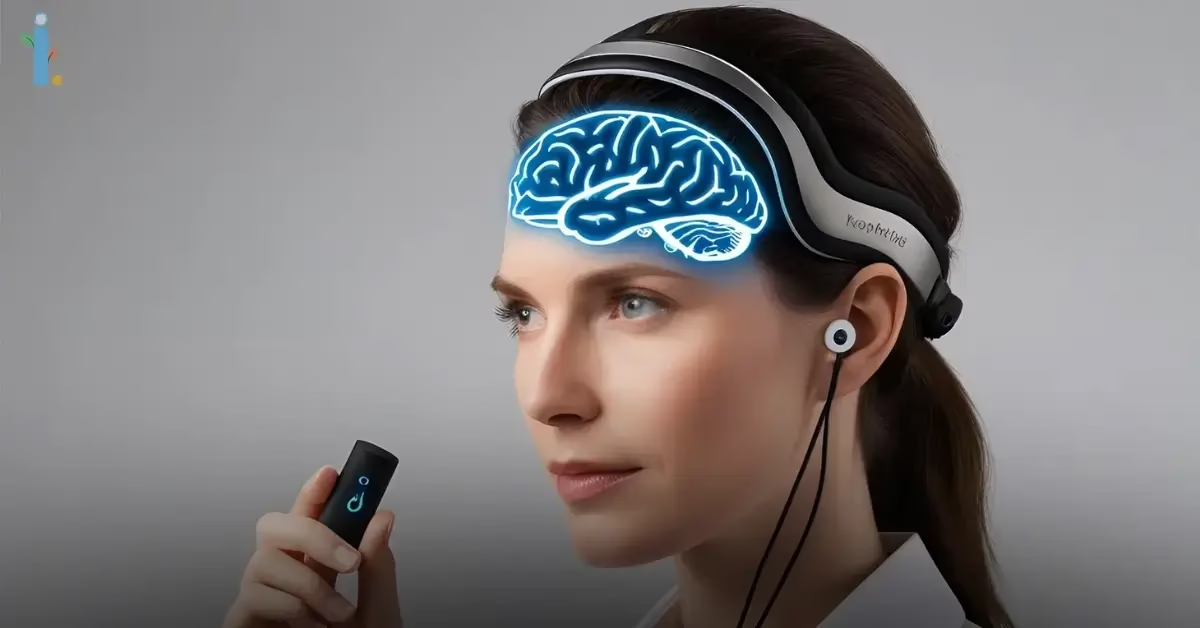
Wearable neurotechnology devices for brain activity are lightweight, non-invasive tools—like EEG headbands or neurostimulation caps—that monitor or modulate brain function in real time. These smart wearables use sensors to detect [...]