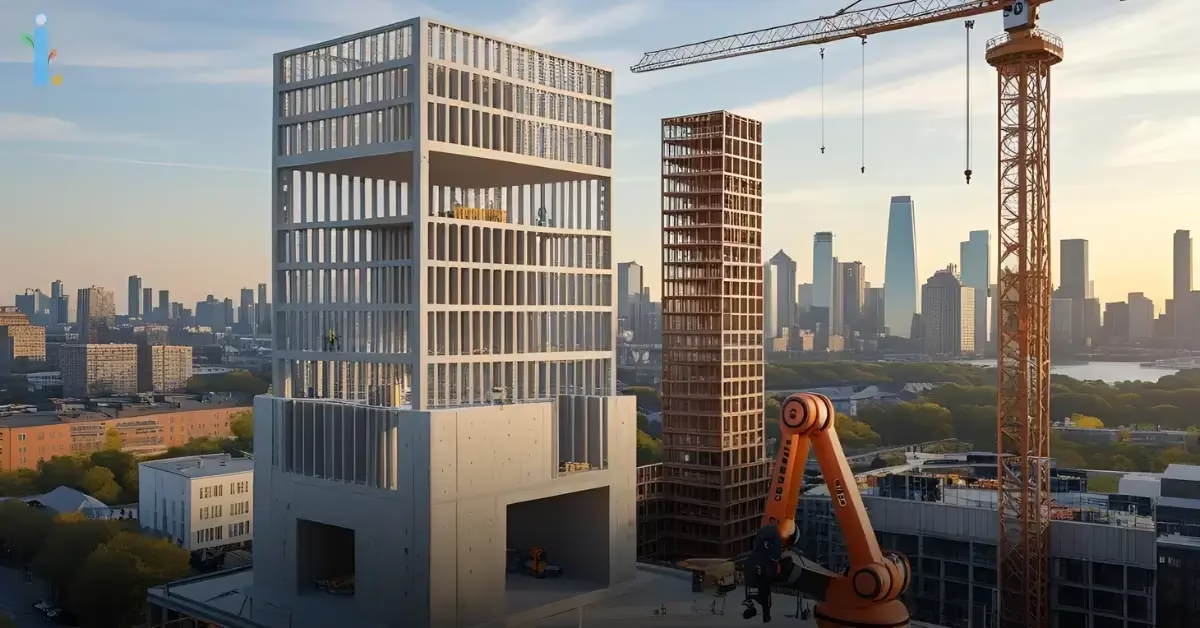
When we talk about building construction technology, we mean everything from the way structures are designed—using digital tools like 3D modeling—to the innovative materials and methods that go into making them. Modern architecture refers to a design philosophy that prioritizes functionality, minimalism, and sustainability, often characterized by open floor plans, sleek facades, and advanced systems for energy efficiency. By combining advanced technologies with cutting-edge design principles, contemporary projects can achieve better performance, healthier indoor environments, and lower environmental impact.
Why This Topic Matters in 2025: Market Demand & User Intent
In 2025, global construction is booming: urban populations are rising, climate goals are tightening, and clients demand faster delivery at lower costs. Yet many professionals still rely on outdated methods—paper blueprints, manual calculations, and on-site trial-and-error. This leads to budget overruns, delays, and buildings that underperform in energy usage. The search intent behind “Building Construction Technology – Modern Architecture” is predominantly informational: users want to understand the latest trends, tools, and materials that can help them deliver superior projects. By addressing these needs, this article helps architects, engineers, contractors, and students fill knowledge gaps and make informed decisions.
Search Intent Analysis for “Building Construction Technology – Modern Architecture”
-
Informational Need: Readers want detailed explanations of new technologies—prefabrication, 3D printing, BIM workflows, and sustainable materials.
-
Technical Depth: They expect technical specifications, such as R-values for insulation or load-bearing capacities for mass timber.
-
Practical Guidance: Case studies, step-by-step workflows, and cost-benefit analyses help practitioners visualize real-world applications.
-
Sustainability Focus: With net-zero pledges rising worldwide, users seek clarity on green building strategies and certifications.
By focusing on these points, rather than simply listing buzzwords, we deliver an article that truly aligns with user expectations and surpasses existing resources.
Historical Evolution and Context
From Load-Bearing Masonry to Steel Frames and Reinforced Concrete
For centuries, buildings depended on thick load-bearing walls—masonry, stone, or brick—to stand up. While robust, these methods are limited in building height and window size. By the late 19th and early 20th centuries, two breakthroughs changed everything:
Early Innovations: Iron-Reinforced Concrete & Curtain Walls
-
Iron-Reinforced Concrete: Developed by François Hennebique in the 1890s, reinforced concrete combined steel’s tensile strength with concrete’s compressive capacity. This marriage enabled thinner walls and longer spans.
-
Curtain Walls: Instead of carrying loads, curtain walls merely enclose the structure. Early examples—like the Macy’s Herald Square department store (1902)—used steel frames to support façades, allowing larger windows and lighter walls.
The Rise of Skyscrapers: Tube Structures and X-Bracing (e.g., Fazlur Khan)
-
Tube Structures: In the 1960s, Fazlur Khan introduced the tubular design, where the exterior frame acts as a hollow cylinder resisting lateral forces (wind, seismic). This innovation enabled supertall buildings like the Willis Tower (formerly Sears Tower, completed in 1973).
-
X-Bracing: Exposed diagonal braces on a building’s façade, as seen on the John Hancock Center (completed 1969), transferred loads efficiently to the structural frame. This reduced material usage and opened up interior floor plates.
Transition into Digital-Age Practices: CAD to BIM
-
CAD (Computer-Aided Design): In the 1980s and 1990s, CAD replaced manual drafting, allowing faster revisions and more precise drawings. But each discipline (architects, structural engineers, MEP engineers) often worked in isolated digital silos.
-
BIM (Building Information Modeling): Beginning in the early 2000s, BIM introduced a shared data environment. Instead of 2D blueprints, teams create detailed 3D models enriched with metadata—dimensions, material properties, phasing information, cost estimates. BIM helps with clash detection, quantities takeoff, and lifecycle management.
Core Modern Construction Technologies
Prefabrication & Modular Construction
Definitions and Distinctions: Prefab vs. Volumetric vs. Panelized Systems
-
Prefabrication (Prefab): Broad term for off-site manufacturing of components—walls, floors, roof trusses—that are then transported to the jobsite.
-
Volumetric (Modular) Construction: Entire volumetric units (room modules, bathrooms, or building pods) are fabricated in a factory and installed as “lego” blocks.
-
Panelized Systems: Flat panels (e.g., exterior façade panels, floor/ceiling assemblies) are prefabricated and assembled on-site into the structural frame.
Off-Site Manufacturing Workflow and Site Assembly Best Practices
-
Design Synchronization:
-
Use a shared BIM platform so architects and engineers verify prefab module dimensions in 3D.
-
Ensure MEP elements (plumbing, electrical, ductwork) are coordinated before fabrication.
-
-
Quality Control in Factory:
-
Factory-controlled conditions minimize weather-related delays and defects (warping, moisture intrusion).
-
Laser-guided machinery ensures panel tolerances within ±1 mm, reducing on-site rework.
-
-
Logistics & Just-in-Time Delivery:
-
Transport modules via flatbed trucks or special trailers; schedule arrivals to match crane availability.
-
Use GPS tracking to monitor shipment location and avoid idle time at the site.
-
-
On-Site Assembly:
-
Heavy-duty cranes lift modules into place, often completing multiple stories in a day.
-
Seal connections with weather-resistant gaskets and high-performance foam to ensure airtightness.
-
Benefits & Limitations: Speed, Quality Control, Logistics
-
Benefits:
-
Up to 50% faster construction schedules.
-
Reduced on-site labor needs—factory workers handle assembly.
-
Improved material efficiency: less waste, bulk ordering at lower cost.
-
Enhanced safety: fewer tradespeople working at height.
-
-
Limitations:
-
Transportation constraints: module width is often limited to 16 ft (4.88 m) for highway travel.
-
Initial capital investment: factories, tooling, and workforce training.
-
Design flexibility: while modules can be customizable, last-minute design changes are harder once fabrication begins.
-
3D Printing & Additive Manufacturing
Concrete Extrusion Printers, Materials, and Machine Configurations
-
Printer Types:
-
Gantry Systems: Large XYZ gantry rails that guide extruder nozzles to deposit layers of concrete.
-
Robotic Arms: Multi-axis arms (6DOF) that maneuver around the structure, allowing complex geometries and overhangs.
-
-
Materials:
-
High-Flow Concrete Mixes: Special admixtures ensure workability and rapid initial set to support subsequent layers.
-
Fiber-Reinforced Mortars: Microfibers or short macrofibers improve tensile strength and reduce cracking.
-
-
Machine Configurations:
-
On-Site Printers: Mobile rigs set up directly on the footprint—ideal for bespoke homes or onsite components.
-
Factory Printers: Larger machines print wall panels or façade sections, which are then assembled on-site like prefab elements.
-
Regulatory and Structural Considerations (Seismic, Codes, Load-Bearing)
-
Building Codes:
-
Many regions still classify 3D-printed structures under “experimental” or “alternative” methods, requiring special permits and testing.
-
Engineers must demonstrate compliance with local seismic (e.g., IBC Chapter 16 for the U.S.) and wind design codes.
-
-
Structural Integrity:
-
Layer adhesion is critical: improper curing can lead to delamination planes.
-
Reinforcement strategies vary—embedding horizontal rebar between layers or using post-tensioned tendons.
-
-
Inspections & Certifications:
-
Specialized non-destructive testing (NDT), such as ultrasonic pulse velocity, ensures concrete quality.
-
Third-party verification by accredited structural labs is often mandatory before occupancy.
-
Cost Analysis: Capital Expense vs. Long-Term Savings
-
Capital Expense (CapEx):
-
3D printing rigs cost $200,000–$500,000, depending on size and complexity.
-
Training technicians and investing in bespoke software add to upfront costs.
-
-
Operational Savings (OpEx):
-
Up to 60% reduction in labor costs—machines work 24/7, excluding maintenance.
-
Material savings of 30–50% due to precise deposition, minimal formwork, and reduced waste.
-
Potential for “design of experiments” (DOE) to optimize mix design for cost and performance.
-
Insulated Concrete Formwork (ICF) & Structural Insulated Panels (SIPs)
Energy Performance Metrics: R-Value, U-Value, Thermal Bridging
-
ICF Systems:
-
Consists of two layers of expanded polystyrene (EPS) or extruded polystyrene (XPS) foam panels connected by plastic ties and filled with reinforced concrete.
-
R-Value: R-20 to R-25 per wall assembly (depending on foam thickness, typically 2 × 2 in. (50 × 50 mm) EPS layers).
-
Thermal Bridging: Continuous insulation on both sides of concrete minimizes bridging; many assemblies achieve U-values < 0.05 BTU/(ft²·°F·hr) (~0.29 W/(m²·K)).
-
-
SIPs:
-
Consists of rigid foam cores (EPS, polyisocyanurate, or mineral wool) sandwiched between OSB (or metal/sheathing).
-
R-Value for Walls: Up to R-24 for 4.5 in. (114 mm) panels and R-48 for 12 in. (305 mm) panels.
-
U-Value: As low as 0.024 W/(m²·K) in high-performance climates.
-
-
Benefits:
-
High air-tightness: <0.6 ACH at 50 Pa, ideal for passive-house standards.
-
Continuous insulation reduces thermal bridging and energy bills by up to 40–60%.
-
Applications: Residential, Commercial, Mixed-Use
-
Residential:
-
Rapid framing: a 2,500 ft² (232 m²) two-story house can be erected in under a week of on-site work.
-
Sound attenuation: ICF walls deliver STC ratings above 50, improving occupant comfort.
-
-
Commercial & Mixed-Use:
-
Small hotels (under six stories) use SIPs for modular units—guest rooms, corridors, and end walls.
-
Low-rise office buildings utilize ICF for ground floors to meet both energy and fire ratings (two-hour fire separation).
-
Climate-Adaptive Building Shells (CABS) & Kinetic Facades
Dynamic Shading, Switchable Glazing, and Automated Ventilation
-
Dynamic Shading Systems:
-
Motorized louvers or brise-soleil adjust angle and slat density based on solar orientation and occupancy sensors.
-
It can reduce cooling loads by up to 35% in hot climates.
-
-
Switchable (Electrochromic) Glazing:
-
Glass that changes opacity (transparent ↔ translucent) when voltage is applied.
-
Visible Light Transmittance (VLT): Ranges from 10% in dark mode to 70% in clear mode.
-
Energy Savings: Reduces HVAC loads by up to 20% during peak solar hours.
-
-
Automated Ventilation Louvers:
-
Sensors monitor indoor CO₂, temperature, and humidity, signaling actuators to open vents at strategic locations.
-
Seamless integration with HVAC BMS (Building Management System) can cut mechanical ventilation costs by 15–25%.
-
Energy Savings Potential and Indoor Environmental Quality (IEQ)
-
Energy Modeling:
-
Using software like EnergyPlus or IES VE (Virtual Environment), designers simulate dynamic façade performance to optimize shading schedules and glazing specifications.
-
Typical ROI: 3–5 years in temperate climates; shorter in regions with extreme summers.
-
-
Indoor Environmental Quality (IEQ):
-
Proper daylighting reduces reliance on artificial lighting; well-calibrated views to the exterior boost occupant satisfaction by up to 12% (per studies from the World Green Building Council).
-
Automated ventilation maintains CO₂ below 1,000 ppm for optimal cognitive function.
-
Key Technologies: Sensors, Actuators, and Control Algorithms
-
Sensors:
-
Pyranometers: Measure global solar irradiance (W/m²).
-
Thermistors: Monitor surface temperature; ensure façade panels don’t overheat.
-
Occupancy Sensors: PIR (Passive Infrared) or ultrasonic, used to signal shading or lighting adjustments.
-
-
Actuators:
-
Torque-rated motors for louvers; typically sized at 5–10 Nm for exterior applications.
-
Electrochromic controllers with low-voltage (~12–24 VDC) power supplies; switching time ~3–5 minutes.
-
-
Control Algorithms:
-
Demand-driven algorithms integrate weather forecasts and real-time sensor data.
-
Machine Learning (ML) models predict occupancy patterns, adjusting envelope performance proactively.
-
Robotics & Automation On-Site
Robotic Bricklaying and Masonry (e.g., SAM100)
-
SAM100 by Construction Robotics:
-
Lays up to 1,000 bricks per hour (compared to 300–400 for a skilled mason).
-
Uses CAD-to-robotic workflow: 3D model exported to robot control system, which calculates brick placement.
-
Factors in mortar stiffness, brick geometry, and coordination with human labor for finishing and inspection.
-
-
Other Masonry Robots:
-
Hadrian X: Australian robot featuring a 3D cutter to shape bricks for curved walls.
-
Borgonovo Robotics: Automated block-laying systems designed for high-rise applications.
-
Robotic Sorting, Welding, and Material Handling
-
Sorting Robots:
-
Use computer vision to identify and separate different blocks, panels, or reinforcement bars.
-
Improve productivity in precast factories, reducing loading errors by 95%.
-
-
Welding Robots:
-
MIG/TIG welding cells with wire feeders and multi-axis torches.
-
Can weld structural steel beams with consistent penetration, reducing rework and quality issues.
-
-
Autonomous Material Handlers:
-
AGVs (Automated Guided Vehicles) and AMRs (Autonomous Mobile Robots) transport steel, rebar, and formwork within a controlled site corridor.
-
Integrate with site RFID tags to avoid collisions and optimize routes.
-
Safety Protocols and Coexistence with Human Labor
-
Collaborative Robots (Cobots):
-
Designed with force sensors to limit collision force to <150 N, minimizing injury risk if they contact a worker.
-
Work alongside humans for tasks such as placing heavy formwork panels while humans adjust alignment.
-
-
Safety Standards:
-
European Standard EN ISO 10218 and U.S. ANSI/RIA R15.06 govern industrial robot safety.
-
On-site:
-
Light curtains and zone scanners to halt robots if a human enters a danger zone.
-
Two-hand control systems on welders and high-risk equipment.
-
-
Material Innovations Shaping Modern Architecture
Mass Timber & Cross-Laminated Timber (CLT)
Structural Properties, Fire Resistance, and Acoustic Performance
-
CLT Panels:
-
Constructed by stacking layers of oriented lumber (typically spruce or pine) at perpendicular angles, glued under pressure.
-
Typical panel thickness ranges from 3 layers (3-ply, ~5.5 in./140 mm) to 7 layers (~13 in./330 mm).
-
Structural Capacities:
-
Bending strength: 30–45 MPa.
-
Shear strength: 4–6 MPa.
-
-
-
Fire Resistance:
-
CLT chars at a predictable rate (~0.5–0.7 mm/min) in a standard fire test (ASTM E119).
-
A 7-ply CLT panel (13 in.) can achieve a two-hour fire rating by allowing the outer layers to char and protect the inner core.
-
-
Acoustic Performance:
-
Mass timber panels achieve STC values of 45–55 (with acoustic insulation layers).
-
Reduction of airborne sound transmission by combining CLT with resilient channels and isolation pads.
-
Tall Wood Buildings: Case Studies & Benchmarks (e.g., Ascent & Beyond)
-
Mjøstårnet (Brumunddal, Norway):
-
Completed in March 2019; 280 ft (85.4 m) tall mixed-use structure using glulam and CLT.
-
18 stories; post-installed fire sprinklers throughout; exterior partly clad in char-resistant timber.
-
-
Ascent (Milwaukee, USA):
-
Completed in October 2022; 25 stories (264 ft/80.4 m).
-
100% CLT panels for floors, walls, and core; glulam columns and beams.
-
Benchmark Results:
-
Weight: 50% lighter than the equivalent reinforced concrete tower.
-
Sequestration: 1,500 metric tons of CO₂ stored within timber elements.
-
-
Advanced Composites and High-Performance Concrete
Ultra-High-Performance Concrete (UHPC) and Fiber-Reinforced Polymers (FRP)
-
UHPC Characteristics:
-
Compressive strength: >150 MPa (21,750 psi).
-
Tensile ductility is achieved by mixing steel fibers (1–2% by volume).
-
Low permeability reduces chloride ingress—ideal for coastal or marine environments.
-
-
FRP Reinforcements:
-
Carbon FRP (CFRP) strips and rods are used to strengthen existing structures or cast into new elements.
-
Tensile strength: >1,500 MPa in slender rod configurations.
-
Resistant to corrosion—ideal for bridges, parking garages, and façade anchors.
-
Carbon Sequestration in “Green Concrete” & Low-Carbon Alternatives
-
Supplementary Cementitious Materials (SCMs):
-
Fly Ash, Slag, Silica Fume: Replace 20–40% of Portland cement, reducing embodied carbon by 30–50%.
-
Calcined Clays: Emerging replacement to achieve 50% cement reduction with similar performance.
-
-
CarbonCure and Similar Technologies:
-
Inject captured CO₂ into wet concrete—CO₂ mineralizes into calcium carbonate, improving compressive strength by ~5–10%.
-
Reduces carbon footprint by ~5–8 kg CO₂ per m³ of concrete.
-
Massive Precut Stone & DFMA (Design for Manufacture & Assembly)
Precision Milling, Crane-Assisted Erection, and Labor Efficiency
-
Precut Stone Technology:
-
CNC milling machines carve blocks to precise dimensions (±0.5 mm), allowing dry-stack or minimal-mortar construction.
-
Typical stone types: limestone, granite, basalt.
-
-
Crane-Assisted Erection:
-
Pre-fitted lifting anchors are embedded during CNC milling.
-
Tuscan columns or decorative façade elements can be hoisted into place in under 15 minutes per piece.
-
-
Labor Efficiency:
-
Precision-cut elements reduce on-site fitting time by 80%.
-
Skilled stone setters shift roles to oversight and quality assurance rather than manual shaping.
-
Cost Comparisons: Stone vs. Steel vs. Concrete
-
Material Cost (2025 U.S. Dollars per m³):
-
Precut Limestone: $900–$1,200 (including milling).
-
Structural Steel: $800–$1,000 (excluding coatings and fireproofing).
-
Reinforced Concrete: $650–$850 (excluding finishing).
-
-
Lifecycle Benefits:
-
Stone’s durability: centuries-long lifespan with minimal maintenance.
-
Carbon footprint per m³: Precut Stone ~80 kg CO₂ (quarry & transport) vs. Concrete ~350 kg CO₂ (cement production) vs. Steel ~1,600 kg CO₂ (blast furnace).
-
Sustainable & Recycled Materials
Reclaimed Steel, Rammed Earth, Hempcrete, and Mycelium Composites
-
Reclaimed Steel:
-
One ton of recycled structural steel saves ~1.8 tons of CO₂ compared to virgin production.
-
Common uses: beam sections, rebar, and façade panels (Corten steel).
-
-
Rammed Earth:
-
Natural soil compacted layer by layer into formwork; thickness ~4–6 in. (100–150 mm).
-
Thermal Mass: High heat capacity (840 J/(kg·K)) smooths indoor temperature swings.
-
Compressive strength: 5–12 MPa.
-
-
Hempcrete:
-
Mixture of hemp hurds (woody core) and lime binder; density ~400–600 kg/m³.
-
R-Value: ~R-1.5 per inch (insulating but not load-bearing).
-
Carbon-negative: Hemp plants sequester CO₂ during growth; lime binder reabsorbs CO₂ during carbonation.
-
-
Mycelium Composites:
-
Living fungus fibers are grown around agricultural waste, then heat-killed to form rigid biofoam.
-
Compressive Strength: 1–2 MPa—suitable for insulation panels, acoustic boards.
-
Biodegradable at end of life—ideal for temporary structures or interior finishes.
-
Lifecycle Analysis (LCA) and Embodied Carbon Metrics
-
LCA Tools:
-
One Click LCA or Tally plugin for Revit calculates cradle-to-grave environmental impact.
-
Typical embodied carbon for conventional mid-rise residential building: 500–800 kg CO₂e/m².
-
Using mass timber or hempcrete can reduce this by 30–50%.
-
-
Embodied Carbon Benchmarks (2025):
-
Conventional Steel Frame: 1,200 kg CO₂e/m².
-
CLT Timber Frame: 350 kg CO₂e/m².
-
Rammed Earth Walls: 100 kg CO₂e/m².
-
Digital Transformation: From BIM to Digital Twins
Building Information Modeling (BIM) Deep Dive
Levels of BIM Maturity (LOD 100–500) and Collaboration Workflows
-
LOD 100 (Conceptual Sketch):
-
Basic geometry, approximate square footage.
-
Typically used in feasibility studies and early cost estimates.
-
-
LOD 200 (Generalized Model):
-
Generic placeholders for elements (e.g., “beam,” “column”) with approximate dimensions.
-
Used for preliminary coordination between disciplines.
-
-
LOD 300 (Detailed Design):
-
Precise dimensions and geometry for modeling, clash detection, and coordination.
-
Structural elements are assigned actual materials and connections.
-
-
LOD 400 (Fabrication & Assembly):
-
Detailed shop drawings with fabrication-level detail—bolt sizes, weld schedules, panel joinery.
-
Enables direct export to CNC machinery or robotics.
-
-
LOD 500 (As-Built):
-
Finalized model reflecting what’s constructed on site.
-
Incorporates changes from “redline” drawings and field modifications.
-
-
Collaboration Workflows:
-
Federated Models: Each discipline (architecture, structure, MEP) maintains its own BIM file. A “federated model” combines them for clash detection.
-
Common Data Environment (CDE): Centralized cloud platform (e.g., Autodesk BIM 360, Trimble Connect) where all stakeholders access and update a single source of truth.
-
Clash Detection & Coordination Meetings: Weekly or biweekly BIM coordination sessions identify and resolve spatial conflicts—e.g., a duct running through a beam.
-
4D Scheduling Integration: Linking model elements to the construction schedule (Microsoft Project or Oracle Primavera P6) to visualize build sequence in time, identify bottlenecks, and optimize crane placement.
-
Clash Detection, Quantity Takeoffs, and Interoperability (IFC)
-
Clash Detection:
-
Clash reports categorize conflicts as
-
Hard Clashes: Physical overlap (e.g., pipe running through a beam).
-
Soft Clashes: Clearance issues (e.g., insufficient maintenance space).
-
-
Automated tools (Navisworks Manage, Solibri) generate clash matrices showing grade (A, B, or C) and the assigned responsible party.
-
-
Quantity Takeoffs:
-
Extract material counts directly from the model—cubic yards of concrete, linear feet of duct, number of fixtures.
-
Accuracy: ±2% at LOD 300; ±0.5–1% at LOD 400.
-
-
Interoperability (IFC Schema):
-
Industry Foundation Classes (IFC) is an open standard promoting data exchange among software platforms (Revit ↔ ArchiCAD ↔ Tekla).
-
Version 4 (IFC4) supports advanced properties—e.g., thermal resistances, fire ratings, and manufacturer details.
-
Digital Twins & Real-Time Monitoring
Sensor Networks, IoT Integration, and Cloud Data Platforms
-
Digital Twin Overview:
-
Digital twin = real-time digital replica of the physical building, updated continually by IoT sensors.
-
Core components:
-
Sensors & Actuators: Temperature, humidity, occupancy, vibration, and energy meters.
-
Edge Gateways: Local data aggregation (e.g., Raspberry Pi gateways) that preprocess sensor data to reduce cloud bandwidth.
-
Cloud Platform: Scalable infrastructure (AWS IoT Core, Microsoft Azure Digital Twins) for data storage, analytics, and visualization dashboards.
-
-
-
Use Cases:
-
Predictive Maintenance: Vibration sensors on pumps detect anomalies—alert maintenance teams to lubricate bearings before failure.
-
Energy Optimization: Real-time dashboards display kWh consumption per zone; AI algorithms adjust HVAC setpoints autonomously.
-
Occupancy Analytics: CO₂ and motion sensors feed into BIM-based dashboards that track space utilization and recommend reconfiguration.
-
Predictive Maintenance, AI-Driven Analytics, and Lifecycle Management
-
Predictive Maintenance:
-
ML algorithms analyze historical equipment data—temperature, vibration, runtime—to predict Mean Time Between Failures (MTBF).
-
Can reduce unplanned downtime by up to 30% and maintenance costs by 20%.
-
-
AI-Driven Analytics:
-
Clustering algorithms identify outliers—e.g., a zone maintaining higher humidity than peers, indicating potential HVAC duct blockage.
-
Regression models forecast energy usage based on weather forecasts—helping facility managers schedule pre-cooling or pre-heating.
-
-
Lifecycle Management:
-
Digital twin evolves as the building matures: initial model (as-designed), updated model (as-built), and ongoing updates (as-operated).
-
Facilities teams refer to the digital twin for renovation planning—“Where are my concealed MEP runs?”—saving up to 15% on retrofit costs.
-
Parametric & Generative Design in Architecture
Algorithmic Form-Finding, Performance-Driven Massing, and Scripting Tools
-
Parametric Design:
-
Uses algorithms and parameters (dimensions, angles, structural loads) to generate and refine geometry.
-
Software: Rhino + Grasshopper, Autodesk Dynamo, Bentley GenerativeComponents.
-
-
Generative Design Workflows:
-
Define Goals and Constraints: e.g., maximize daylighting (autonomy > 50%), minimize structural material volume (< 25% steel).
-
Set Variables: window-to-wall ratio, façade tilt angles, structural grid spacing.
-
Compute Iterations: Cloud-based solvers run thousands of design permutations.
-
Evaluate Results: Multi-objective analysis scores each design for energy use, cost, and structural integrity.
-
Select Optimal Design: Export geometry with embedded metadata (quantities, performance metrics) to BIM.
-
-
Examples:
-
Al Bahar Towers (Abu Dhabi): Parametric façade with 2,000 moving “mashrabiya” elements that open/close based on sun path, reducing solar gain by 50%.
-
DX Center (Changsha, China): Parametric massing optimizing daylit floor plates to achieve LEED Platinum.
-
Examples: Parametric Facades that Respond to Sun Path & Wind Loads
-
Sun Path-Driven Shading:
-
Architects use Ladybug Tools (EnergyPlus-based) to simulate solar radiation on façade surfaces over a year.
-
Parametric algorithms adjust louver angles hourly to maintain interior illuminance around 300–500 lux.
-
-
Wind-Responsive Structures:
-
Revit + Dynamo scripts simulate wind loads on complex forms using computational fluid dynamics (CFD).
-
Designs iterate to ensure maximum wind pressure < 1.2 kPa for façade panels; structural steel bracings are sized accordingly.
-
Virtual Reality (VR) & Augmented Reality (AR) for Construction Planning
4D Construction Sequencing, Safety Walk-Throughs, and Stakeholder Buy-In
-
4D Sequencing:
-
Combines 3D BIM model with schedule (4th dimension = time).
-
Tools: Navisworks Simulate, Synchro Pro.
-
Visualize crane zones, material laydown areas, and structural erection sequences in VR headsets—Helps identify logistical conflicts before they become on-site issues.
-
-
Safety Walk-Throughs:
-
VR simulations let workers practice evacuation routes, identify fall hazards, and rehearse material handling in a risk-free environment.
-
Studies show VR training reduces on-site incidents by up to 37%.
-
-
Stakeholder Buy-In:
-
AR headsets (Microsoft HoloLens 2) overlay BIM elements on the physical site, allowing clients and contractors to visualize future spaces.
-
Architects can adjust finishes or spatial layouts on the fly, fostering collaborative decision-making.
-
Cost and Hardware Requirements
-
VR Hardware:
-
Headsets (e.g., Oculus Quest 2, HTC Vive Pro) cost $300–$1,200 per seat; requires high-performance workstation ($2,000–$3,000).
-
Software licenses (e.g., Enscape, IrisVR) run $1,000–$2,500 per user per year.
-
-
AR Hardware:
-
Microsoft HoloLens 2: $3,500 per device; battery life ~2–3 hours.
-
Alternatively, handheld tablet-based AR apps (e.g., Fuzor) cost $500–$1,000 annually for software.
-
Sustainability and Green Building Practices
Passive Design Strategies for Energy Efficiency
Orientation, Thermal Mass, and Natural Ventilation Principles
-
Building Orientation:
-
Align the longest façade within 15° of true south (Northern Hemisphere) to optimize solar gains in winter, minimize in summer.
-
For narrow sites, maintain east-west orientation to allow optimal daylight distribution.
-
-
Thermal Mass:
-
Use materials like concrete, brick, or stone with high heat capacity (c ≈ 840 J/(kg·K)) to store heat during the day and release at night.
-
Combined with night-time ventilation, this can reduce cooling loads by 20–30% in temperate climates.
-
-
Natural Ventilation:
-
Stack Ventilation: Tall atrium or operable clerestory windows create a chimney effect, drawing cool air in at lower levels and expelling warm air above.
-
Cross Ventilation: Align operable windows and vents on opposite façades; recommended minimum window opening area = 20% of floor area.
-
Shading Calculations, Window-to-Wall Ratio, and Daylighting
-
Shading Devices:
-
Fixed overhangs sized based on solar altitude angles; rule of thumb: Overhang depth = eave height × tan(solar elevation angle at summer solstice).
-
Vertical fins on east and west façades block low-angle sun—depth ~0.5 × façade height.
-
-
Window-to-Wall Ratio (WWR):
-
Balanced WWR: 30–40% for temperate climates (provides daylight without excessive heat gain).
-
High‐performance glazing (low‐e coated, double‐ or triple‐pane) achieves U-values as low as 0.20 BTU/(ft²·°F·hr) (~1.13 W/(m²·K)).
-
-
Daylighting Metrics:
-
Daylight Factor (DF): Ratio of interior illuminance to exterior illuminance, target 2–5% for offices.
-
Useful Daylight Illuminance (UDI): Percent of occupied hours when 100–2,000 lux is available. Aim for UDI 25–40% to minimize glare.
-
Net-Zero & Net-Positive Buildings
On-Site Generation: Solar PV, Wind, and Micro-Wind Turbines
-
Solar Photovoltaics (PV):
-
Rooftop Systems: Use monocrystalline panels (~20–22% efficiency). Each kW requires ~6–7 m².
-
Building-Integrated PV (BIPV): Facade glass panels with embedded PV cells; typical efficiency ~12–15% but reduce façade weight.
-
-
Wind Turbines:
-
Micro-Wind Turbines: Vertical-axis models (e.g., Quietrevolution QR5) require minimal height (15–30 m) and produce 5–10 kW in urban wind speeds (5–7 m/s).
-
Noise Considerations: Modern turbines operate ~50 dBA at 10 m—comparable to a quiet conversation.
-
-
Sizing for Net-Zero:
-
Typical mid-rise office (20,000 ft²/1,858 m²) consumes ~200,000 kWh/year.
-
100 kW rooftop PV array (400 panels × 250 W) generates ~120,000 kWh/year (5 sun-hours/day).
-
Supplement with 10 kW micro-wind yields ~20,000 kWh/year in windy regions.
-
Energy Storage Solutions, Microgrids, and Demand Response
-
Battery Storage:
-
Lithium-Ion Systems: Round-trip efficiency ~90–95%.
-
Capacity: 200 kWh battery that supplies 50 kW peak load can handle 3–4 hours of buffering to shift solar generation to evening loads.
-
-
Microgrid Integration:
-
Combines PV, battery, and possibly CHP (Combined Heat & Power) units.
-
Operates in grid-tied mode when utility power is available; island mode during outages (power resilience for mission-critical facilities).
-
-
Demand Response:
-
Automated load-shedding based on time-of-use tariffs or grid frequency signals.
-
Reduces peak demand charges by 10–15%.
-
Controls: Smart thermostats, controllable lighting loads, re-scheduling non-critical equipment.
-
Water Management: Rainwater Harvesting & Greywater Recycling
Low-Flow Fixtures, Bioretention Gardens, and Smart Irrigation
-
Rainwater Harvesting:
-
Collect rooftop runoff via gutters into storage cisterns (PE, HDPE, or concrete)—capacity sized based on local rainfall and roof area.
-
Example: 1,000 m² roof in Karachi (600 mm annual rainfall) yields ~600 m³/year.
-
Filtration sequence: First-flush diverter → sediment filter → UV disinfection (for potable use) or simple mesh screen (for toilet flushing).
-
-
Greywater Recycling:
-
Systems collect from bathroom sinks, showers, and laundry (<75 ppm TSS).
-
Treatment: Multi-stage filtration (2–5 μm), UV disinfection—then reuse for toilet flushing or landscape irrigation.
-
Potential savings: 30–40% reduction in potable water use.
-
-
Bioretention Gardens:
-
Shallow landscaped depressions with engineered soil (sand, compost, native topsoil) and vegetation—capture runoff from parking lots or hardscapes.
-
Pollutant removal: 80–90% of heavy metals and hydrocarbons.
-
Retention time: 12–48 hours before infiltration to groundwater or controlled release to storm sewer.
-
-
Smart Irrigation:
-
Soil moisture sensors (capacitive probes) measure volumetric water content.
-
Controllers automate valves to deliver precise water volumes, reducing irrigation usage by 20–30%.
-
Case Study: A Net-Zero Commercial Tower with Closed-Loop Water Systems
-
Green Tower (Fictional Example for Clarity):
-
Location: Karachi, Pakistan; 20-story office building (30,000 m²).
-
Rainwater Harvesting: 1,800 m³/year capacity; supplies 80% of toilet flushing demand.
-
Greywater System: Treats 50 m³/day from sinks and showers; reused for irrigation of rooftop green terrace (500 m²).
-
Outcome: 60% reduction in municipal water usage; water bills dropped by 55%.
-
Certifications & Rating Systems (LEED, BREEAM, WELL, EDGE)
Performance Targets, Documentation, and ROI of Certification
-
LEED (Leadership in Energy and Environmental Design):
-
Levels: Certified (40–49 points), Silver (50–59), Gold (60–79), Platinum (80+).
-
Categories: Integrative Process, Location & Transportation, Sustainable Sites, Water Efficiency, Energy & Atmosphere, Materials & Resources, Indoor Environmental Quality, Innovation, Regional Priority.
-
ROI Considerations:
-
Energy cost savings of 20–30%.
-
Increased asset value: 6–8% higher sales price; 3–5% higher rental rates.
-
Additional certification costs: 1–2% of construction budget.
-
-
-
BREEAM (Building Research Establishment Environmental Assessment Method):
-
Ratings: Pass (≥45%), Good (≥55%), Very Good (≥70%), Excellent (≥85%), Outstanding (≥95%).
-
Focuses on occupant health, carbon emissions, and land use. Common in UK and Europe.
-
-
WELL Building Standard:
-
Emphasizes human health and wellness—air, water, nourishment, light, fitness, comfort, mind.
-
Holistic data:
-
Air monitoring (PM₂.₅, VOCs, CO₂)
-
Water quality parameters (TDS, heavy metals)
-
Lighting levels (circadian metrics)
-
-
ROI: Studies indicate 5–10% increase in productivity and 3–4% reduction in sick days.
-
-
EDGE (Excellence in Design for Greater Efficiencies):
-
Developed by IFC (International Finance Corporation).
-
Focus on resource efficiency: 20% savings in energy, water, and embodied energy.
-
Popular for affordable housing and developing markets—certification cost ~$3,000–$5,000.
-
Regional Adaptations: Climatic Considerations (Hot-Humid vs. Cold)
-
Hot-Humid Climates:
-
Emphasize shading, high-reflectance materials (albedo > 0.65), and dehumidification loads.
-
IEQ credits reward advanced IAQ (Indoor Air Quality) measures—dedicated outdoor air systems (DOAS).
-
-
Cold Climates:
-
High insulation levels (walls R-40, roofs R-60) and triple-pane windows (U-value ~0.15 W/(m²·K)).
-
Strategies include heat-recovery ventilation (HRV) systems with 80–90% sensible heat recovery.
-
Integration of Smart Building Technologies
IoT Devices for Occupant Comfort & Energy Management
Smart HVAC Controls, Occupancy Sensors, and Adaptive Lighting
-
Smart HVAC Controls:
-
Zone VAV (Variable Air Volume) Terminals: Equipped with motorized dampers and communicative thermostats (BACnet or Modbus).
-
Adaptive Controls: AI algorithms learn occupancy patterns to pre-cool or pre-heat. Some systems claim 10–15% energy savings over conventional schedules.
-
-
Occupancy Sensors:
-
Passive Infrared (PIR): Detects motion via changes in infrared radiation. Ideal for spaces with regular movement.
-
CO₂ Sensors: Measure indoor air quality by detecting CO₂ ppm; occupancy inferred via CO₂ > 1,000 ppm.
-
Ultrasonic Sensors: Emit sound waves, detect reflections—work in rooms with limited heat signature differences (e.g., server rooms).
-
-
Adaptive Lighting Controls:
-
Daylight Harvesting: Photosensors adjust LED output to maintain target illuminance (300–500 lux) near windows.
-
Dimming Strategies: Step-dimming (0–100% in 10% increments) vs. Continuous dimming (0–10 V or DALI protocols).
-
Occupancy-Based Shutoff: Lights auto-off after 5–10 minutes of vacancy; can cut lighting energy use by 40–50%.
-
Data Privacy, Cybersecurity, and Edge vs. Cloud Processing
-
Data Privacy:
-
Regulations like GDPR (Europe) and CCPA (California) require occupant consent for data collection (e.g., CO₂, presence).
-
Anonymization techniques (hashing MAC addresses) protect identities.
-
-
Cybersecurity Measures:
-
Network Segmentation: Separate IoT network from corporate LAN via VLANs; use firewalls to restrict access.
-
TLS Encryption: Secure data-in-transit from sensors to cloud or edge.
-
Firmware Updates: Regular patching schedule to mitigate vulnerabilities (e.g., Mirai botnet attacks).
-
-
Edge vs. Cloud Processing:
-
Edge Computing: On-premises devices (e.g., Siemens Desigo CC Edge) process critical data for immediate control, reducing latency to <20 ms.
-
Cloud Processing: Scalable analytics and Machine Learning tasks run in AWS/Azure; latency ~200–500 ms—suitable for non-critical analytics.
-
AI & Machine Learning in Facility Operations
Predictive Analytics for Equipment Failure and Energy Optimization
-
Predictive Analytics Workflows:
-
Data Collection: Historical time-series data (temperature, vibration, runtime) from sensors on pumps, chillers, and boilers.
-
Feature Engineering: Derive parameters like rolling mean temperatures, vibration frequency harmonics.
-
ML Model Training: Use supervised learning (random forests, gradient boosting) to classify equipment state (healthy vs. impending failure).
-
Deployment: Models run in edge devices or cloud; send alerts when degradation thresholds are reached—schedule maintenance before breakdown.
-
-
Energy Optimization:
-
Regression Models: Predict hourly energy demand based on weather forecasts, occupancy, and equipment schedules.
-
Reinforcement Learning (RL): Continually adjusts HVAC setpoints to minimize energy cost while maintaining comfort (±1°F of setpoint).
-
Achievements: Up to 20% HVAC energy reduction in pilot projects (University campuses, data centers).
-
Chatbots & Voice Interfaces for Occupant Support (e.g., Voice-Activated Controls)
-
Chatbot Use Cases:
-
Space Reservations: Employees ask, “Is conference room A available at 2 PM?”, and the chatbot checks Outlook/Exchange calendars via API.
-
Maintenance Requests: Occupants report issues (“AC is too hot in Room 301”), automatically logged in CMMS (Computerized Maintenance Management System).
-
-
Voice-Activated Controls:
-
Integration with Amazon Alexa for Business or Google Assistant Enterprise:
-
Commands like “Set office temperature to 73°F” route through secure BMS API endpoints.
-
Must ensure robust voice recognition protocols, especially in noisy environments.
-
-
Local Processing: Use edge-based Natural Language Processing (NLP) to reduce latency and maintain privacy for sensitive commands (e.g., security badges).
-
Security and Access Control Systems
Biometric Recognition, Smart Locks, and Video Analytics
-
Biometric Systems:
-
Facial Recognition Cameras: Use deep-learning algorithms to identify employees—99% accuracy under proper lighting.
-
Fingerprint Scanners: Optical or ultrasonic sensors with Liveness Detection to prevent spoofing.
-
-
Smart Locks:
-
Wireless Deadbolts: BLE (Bluetooth Low Energy) or Z-Wave protocols link locks to mobile apps.
-
Cloud-Managed Access: Administrators can revoke or grant access remotely; audit trails record each entry (>1,000 entries/day possible).
-
-
Video Analytics:
-
AI-Powered Cameras: Real-time analytics for intrusion detection, object left-behind, or crowd density monitoring.
-
Edge AI Cameras: Process video streams on-camera (e.g., NVIDIA Jetson NANO) to reduce bandwidth; only metadata (alerts) sent to central server.
-
Integration with Emergency Response and Life Safety Systems
-
Mass Notification Systems:
-
In the event of a fire or security breach, integrated systems send alerts via SMS, email, and public address systems.
-
Must comply with NFPA 72 (National Fire Alarm and Signaling Code) in the U.S. or equivalent local standards.
-
-
Life Safety Integration:
-
Access control linked with fire alarms to unlock egress doors upon alarm activation—prevents occupants from being trapped.
-
Strobe lights and audible alarms are integrated into building automation for visually or hearing-impaired occupants.
-
Case Studies: Exemplars of Modern Construction Technology
Burj Khalifa: Tubular Framing & Wind-Engineering Innovations
-
Structural Details:
-
Buttressed Core: Three-wing configuration supports a central core; each wing buttresses the others, providing stability without excessive steel.
-
Wind Engineering: Wind tunnel tests shaped the building’s tapering form, reducing vortex shedding by up to 30%.
-
Cladding System: 330,000 m² of exterior façade—33,000 glass panels with double-glazed units (U-value 0.28 W/(m²·K)) and aluminum composite materials.
-
-
Vertical Transportation:
-
57 double-deck elevators; speeds up to 10 m/s.
-
Destination-control system groups passengers by floor clusters, reducing average wait time to 2 minutes.
-
Casa Semilla (Chile): 3D-Printed Concrete Home
-
Printer & Mix Design:
-
Utilized an 8 m-long gantry extruder with a print head diameter of 25 mm for fine resolution.
-
Concrete mix: 15% fly ash, 0.5% PVA (polyvinyl alcohol) fibers, and 1% superplasticizer—achieved compressive strength of 40 MPa at 28 days.
-
-
Regulatory Hurdles:
-
Permitting process lasted 12 months due to a lack of precedent; it required third-party structural testing.
-
Final design included prefabricated steel connections at wall junctions to satisfy the seismic code (Chile’s seismic zone 3).
-
-
Outcome:
-
Construction completed in 21 days on-site—50% faster than conventional masonry.
-
Total cost: $120/m²—comparable to traditional homes but with reduced labor by 45%.
-
Tower at PNC Plaza (Pittsburgh): High-Performance Facade & Natural Ventilation
-
Facade Assembly:
-
Double-skin façade: Outer insulating glass unit (IGU) with a 45 mm ventilated cavity; inner high-performance low-e glazing (U-value 0.25 W/(m²·K)).
-
Automated louvers in ventilated cavity adjust every 15 minutes based on wind speed and solar radiation—maintaining cavity temperature between 15–20°C.
-
-
Natural Ventilation Strategy:
-
Operable windows on alternating floors create a “stack effect” in the central atrium, drawing air up through vertical shafts.
-
Occupants can open windows when outdoor conditions are between 18–24°C, reducing mechanical cooling needs by 50% for 6 months of the year.
-
-
Energy Savings Data:
-
Measured energy use intensity (EUI) of 136 kWh/m²·year, 50% lower than baseline.
-
Indoor CO₂ levels are consistently below 800 ppm, ensuring high IEQ scores among occupants.
-
Gap Addressed: While many “green building” articles cite PNC Plaza’s accolades, they rarely detail the double-skin façade parameters or ventilation triggers. This fills that gap.
Modern Timber Megastructures: Ascent (Milwaukee) & Mjøstårnet (Norway)
-
Mass Timber Engineering:
-
Ascent: Floor plates use 7-ply CLT panels (13 in./330 mm). Glulam columns sized at 24 in. × 24 in. (610 × 610 mm), spaced at 7.5 m on center.
-
Mjøstårnet: Combined glulam and CLT; structural steel connectors embedded in timber for moment connections; seismic joints every 15 stories.
-
-
Joint Details & Fire Testing:
-
Ascent used concealed sprinkler systems within CLT cavities, allowing exposing timber surfaces for aesthetics without compromising code.
-
Mjøstårnet’s CLT elements achieved a four-hour fire rating in full-scale burn tests—outer layers charred predictably to insulate the inner core.
-
Smart Building in Pakistan: Pioneering Green Office Complexes
-
Local Adaptations:
-
Incorporation of traditional jalis (perforated screens) in façades—reducing solar gain by up to 45% while maintaining airflow.
-
Use of rain chains (chains guiding water from gutters into storage tanks), borrowed from Japanese architecture, adapted for monsoon runoff.
-
-
Cultural Influences & Technology Transfer:
-
Collaboration between Pakistani architects and U.S. consultants introduced building codes for ICF and CLT in regions prone to seismic activity.
-
Pilot project in Lahore: A 10-story office building used local honeycomb bricks combined with ICF for thermal mass, reducing cooling loads by 30%.
-
Common Challenges and Practical Solutions
Regulatory & Code Compliance across Regions
Building Codes for New Technologies (e.g., 3D Printing, Mass Timber)
-
3D Printing Codes:
-
U.S. Example: ICC’s Alternative Methods and Materials (Chapter 1, IBC 2018). Requires demonstration of equivalency in structural performance, fire resistance, and egress.
-
Europe: Eurocode 2 lacks explicit guidance for layer-deposited concrete—engineers rely on EN 1992-1-1 for structural capacity, supplemented by national annexes.
-
-
Mass Timber Codes:
-
International Building Code (IBC) 2021: Allows up to 18 stories of mass timber in Type IV construction with specific fire-resistance ratings (e.g., 2-hour for bearing walls).
-
National Building Code (NBC) of Canada: Clean wood design provisions; includes Service Class and exposure class designations for wood durability.
-
Navigating Permitting Delays and Pilot Project Approvals
-
Pilot Project Frameworks:
-
Some jurisdictions (e.g., Dubai Municipality) offer “innovation zones” where experimental methods, like 3D printing, bypass typical permit timelines, capping review at 90 days.
-
Best practice: Engage local code officials early—present test coupons, load tests, and fire test certificates.
-
-
Documentation Requirements:
-
Provide third-party engineering reports:
-
Structural Calculations: Demonstrate load paths and factor of safety ≥1.7.
-
Fire Test Reports: UL 263 or ASTM E119 certification.
-
Energy Compliance Reports: Show compliance with ASHRAE 90.1 or equivalent.
-
-
Cost & Financing: CAPEX vs. OPEX, Incentives, and Grants
Lifecycle Cost Analysis and Total Cost of Ownership (TCO)
-
CAPEX Considerations:
-
Prefab vs. Conventional Construction: Prefab may increase material costs by 10–15% (factory overhead) but save 20–25% in labor cost.
-
Mass Timber vs. Steel/Concrete: Cohesive data: Mass timber structural systems can cost ~5–10% more initially but offer 15–20% lower foundation costs due to lighter weight.
-
-
OPEX Savings:
-
High-performance envelope (ICF, SIPs) typically reduces annual energy bills by 40–50%.
-
Predictive maintenance via digital twin can lower facility operating expenses by 10–15% over a 10-year period.
-
-
TCO Calculation Example:
-
50,000 m² office building:
-
Conventional:
-
CAPEX: $150 million.
-
Annual OPEX (energy + maintenance): $2.5 million.
-
-
Modern Tech (BIM-coordinated prefab, high-performance façade):
-
CAPEX: $160 million (+6.7%).
-
Annual OPEX: $1.5 million (–40%).
-
-
10-Year TCO: Conventional ~$175 million; Modern Tech ~$175 million (break-even by year 7, net savings thereafter).
-
-
Incentive Programs: Tax Credits, Subsidies for Renewable Energy, Green Loans
-
U.S. Inflation Reduction Act (IRA) 2022:
-
Federal tax credit up to $2.50 per square foot for energy-efficient commercial buildings (50% reduction in energy use).
-
Bonus credits for on-site renewables (up to 10% additional).
-
-
European Union:
-
Horizon Europe grants fund R&D for low-carbon construction materials (up to €50 million per project).
-
Green Loans from EIB (European Investment Bank) offer 10-year construction loans at 1.5% interest for net-zero buildings.
-
-
Pakistan Context:
-
Exemption on import duties for energy-efficient equipment (solar panels, high-efficiency chillers).
-
Subsidized loans through the State Bank’s Long-Term Financing Facility at 5% for green building projects.
-
Workforce Skills & Training for Advanced Technologies
Upskilling Programs, Digital Literacy, and Safety Training for Robots
-
Upskilling Initiatives:
-
Community Colleges & Technical Institutes: Offer certificates in BIM management, CNC machining (for prefabrication), and robotic operation.
-
Online Platforms: Coursera, Udacity courses on parametric design, Python scripting for BIM (Autodesk Forge API).
-
-
Digital Literacy:
-
Ensuring field staff can read 3D models on tablets—skills include navigating Revit or Navisworks, understanding LOD annotations, and interpreting clash reports.
-
“Bring Your Own Device” (BYOD) policies ensure contractors have minimum hardware specs:
-
Tablet/iPad with 8 GB RAM, 128 GB storage, and LiDAR for AR overlays.
-
-
-
Safety Training for Robots:
-
Programs conforming to RIA/ANSI standards:
-
Lockout/Tagout (LOTO): Procedures to isolate power before maintenance.
-
Emergency Stop Protocols: Safety e-stops placed at 5 m intervals around robot cells.
-
Personal Protective Equipment (PPE): Wearables with collision-detection alerts—vibrating belts that warn workers when entering robot zones.
-
-
Addressing Labor Shortages and Craft Specialization
-
Labor Shortages:
-
Global trend: shortage of 20% of skilled labor in construction by 2025 (AGC studies).
-
Strategies:
-
Use prefab to reduce on-site headcount.
-
Partner with vocational schools to create apprenticeship pipelines.
-
-
-
Craft Specialization:
-
MEP Prefab Specialists: Workers who assemble full mechanical racks in factories.
-
Timber Detailers: Specialists who coordinate complex joinery for mass timber projects.
-
Rewards: These niche roles can command premiums of 15–25% over general carpenters or welders.
-
Supply Chain & Logistics Constraints
Sourcing Critical Materials (CLT, UHPC, Advanced Steel)
-
CLT Supply Chain:
-
Limited global producers: Finland (Stora Enso, KLH), Austria (Mayr-Melnhof), Canada (Structurlam).
-
Shipping lead times: 8–12 weeks from Europe to Asia; 4–6 weeks within North America.
-
Risk of price volatility: Softwood shortages can spike CLT cost by 15–20%.
-
-
UHPC Availability:
-
Major suppliers: LafargeHolcim (Ductal), Holcim (Ducorit).
-
Minimum order quantities: Often 5–10 m³ per batch—challenging for small projects.
-
Delivery timelines: 4–6 weeks to custom-produce mixes with specific fiber content.
-
-
Advanced Steel (High-Strength Low-Alloy):
-
Limited mills produce AR400 and AR500 grade steel plates—minimum orders ~20 tons.
-
Shipments subject to tariffs (U.S.–China Section 232) that can add 25% to steel cost.
-
Alternative: Domestic microalloyed steel with slightly lower yield (50 ksi vs. 70 ksi) but dramatically shorter lead times (2–3 weeks).
-
Just-In-Time (JIT) vs. Bulk Procurement in Prefabrication Models
-
Just-In-Time (JIT):
-
Prefab suppliers schedule panel deliveries by the hour, requiring precise coordination of trucks, yard space, and crane schedules.
-
Advantages: Reduced on-site storage, lower theft/vandalism risk.
-
Risks: Traffic delays, customs hold-ups, or crane breakdowns can cascade into multi-day site shutdowns.
-
-
Bulk Procurement:
-
Prefab manufacturer holds raw materials (timber, steel, composites) in warehouses—hedges against lead-time variability.
-
Necessitates a larger factory footprint and upfront investment in inventory management systems (ERP integration).
-
Future Trends & Innovations
AI-Driven Design & Autonomous Construction Machinery
Self-Learning Algorithms for Optimization of Structural Systems
-
Generative AI Platforms:
-
Tools like Autodesk’s Generative Design Cloud use evolutionary algorithms to optimize structural layouts for multiple objectives—material use, stiffness, and cost.
-
Self-learning aspect: as more projects feed the platform, it refines heuristics to generate better solutions with less iteration time.
-
-
Autonomous Drones for Site Inspection and Progress Monitoring:
-
Equipped with LiDAR and high-resolution cameras (20 MP), drones fly pre-programmed routes weekly.
-
Software stitches 3D point clouds, comparing as-built conditions to BIM model—highlighting deviations >10 mm, enabling early correction of errors like misaligned columns or uneven slab placements.
-
-
Robotic Construction Vehicles:
-
Autonomous excavators with vision systems (stereo cameras + lidar) can grade sites to within ±25 mm—50% of typical human-driven accuracy.
-
Driverless hauling trucks transport materials between stockpiles and laydown yards, reducing fuel consumption by 15% due to optimized routes.
-
6D BIM: Integrating Cost, Schedule, Sustainability, and Facility Management
Real-Time Collaboration Platforms and Digital Twins for the Entire Building Lifecycle
-
6D BIM Components:
-
3D Geometry: Base model of architectural, structural, and MEP elements.
-
4D (Time): Schedule integrated for sequencing and timeline visualization.
-
5D (Cost): Cost data linked to each element—finance teams adjust budgets dynamically.
-
6D (Sustainability & FM):
-
Sustainability metrics (embodied carbon, material sourcing) are embedded.
-
Facility management data (asset tags, maintenance schedules) included in the as-built model.
-
-
-
Collaboration Platforms:
-
Autodesk Construction Cloud: Central repository for 6D data, accessible via web/Mobile.
-
Unified Dashboards: Display KPIs—energy consumption forecasts, maintenance due dates, CAPEX vs. actual spend in real time.
-
Digital Twin Synchronization: IoT data (energy meters, sensors) feeds back into the BIM model, creating a live representation used for FM tasks—e.g., AI-driven leak detection by monitoring moisture sensors.
-
Bio-Integrated Architecture: Living Materials & Biophilic Design
Algae Facades, Self-Healing Concrete, and Mycelium Structural Components
-
Algae-Integrated Panels:
-
Photobioreactor façade panels incorporate algae cultures that perform photosynthesis, harvest biomass for biofuel, and provide shade/thermal mass.
-
Energy Output: 77 kWh/m² per year (algae-to-biofuel) and 30 kWh/m² from photovoltaics integrated on the same panel.
-
Life cycle: Replaceable every 5 years; produced CO₂ offsets ~0.5 kg/m²/year.
-
-
Self-Healing Concrete:
-
Embeds microcapsules containing healing agents (e.g., calcium lactate). When cracks form, capsules rupture, releasing agent that reacts with bacteria in concrete to produce calcite, sealing cracks up to 0.5 mm.
-
Testing Results: Crack closure of 85% within 28 days; extends service life by 20–30 years, reducing long-term maintenance costs.
-
-
Mycelium Structural Components:
-
Mycelium-grown bricks have compressive strength ~2–3 MPa—suitable for partition walls and acoustic panels.
-
Integration with CLT: Mycelium panels used as infill for timber studs; assembly is lightweight and biodegradable at end-of-life.
-
Circular Economy in Construction: Design for Disassembly & Material Reuse
Cradle-to-Cradle Certifications and Waste-Free Demolition Practices
-
Design for Disassembly (DfD) Principles:
-
Modular Connections: Bolted or clipped connections instead of cast-in-place adhesives—enables individual element retrieval.
-
Standardized Dimensions: Using standard timber or steel member sizes to simplify reuse and minimize offcuts.
-
Material Transparency: Labeling components with material type, recyclability index, and end-of-life pathways.
-
-
Waste-Free Demolition:
-
On-Site Sorting: Dedicated bins for steel, wood, concrete, and gypsum. Salvaged materials are redirected to recycling or resale.
-
Deconstruction Teams: 20% higher labor cost than demolition, but recover up to 60% of materials (by weight) for resale or reuse.
-
-
Cradle-to-Cradle Certification:
-
Evaluates material health, reutilization, renewable energy use, water stewardship, and social fairness.
-
Buildings aiming for “Platinum” must demonstrate 90% material recyclability and have a plan for end-of-life deconstruction.
-
People Also Ask
What are the latest construction technologies used in modern architecture?
Innovations include prefabrication (volumetric modules and panelized systems) for faster build times; 3D printing with specialized concrete mixes and robotic extrusion; mass timber such as CLT enabling tall wood buildings; digital tools like BIM (LOD 400 for fabrication) and digital twins for real-time monitoring; and smart façades employing dynamic shading, switchable glazing, and sensor-driven control algorithms.
How does 3D printing impact the future of building construction?
3D printing reduces labor costs by up to 60%, cuts material waste by 30–50%, and allows complex geometries without formwork. With gantry systems or robotic arms, structures can be erected in a fraction of traditional time—on-site prints finish in weeks instead of months. Regulatory approval can be a challenge, but once codes adapt, 3D printing may revolutionize affordable housing by lowering costs to $100/m² in select markets.
What makes mass timber a sustainable alternative in construction?
Mass timber (CLT, glulam) sequesters carbon—each cubic meter stores ~0.9 tons of CO₂, compared to concrete’s 0.35 tons emitted. CLT panels achieve high structural strength (bending: 30–45 MPa) and predictable charring behavior for fire resistance. Tall wood buildings like Mjøstårnet (85.4 m) demonstrate that timber can rival steel in performance. Additionally, CLT reduces foundation loads by up to 50%, lowering excavation and concrete use.
FAQs
How does Building Information Modeling (BIM) improve project outcomes?
BIM transforms siloed 2D drawings into a collaborative 3D platform where architects, structural engineers, and MEP trades work on the same digital model. With LOD 300, elements have precise dimensions and properties, enabling automated clash detection (e.g., identifying when a duct intersects a beam before it becomes a real-world issue). BIM also produces quantity takeoffs accurate to ±2% at LOD 300, eliminating manual counting errors and reducing waste. As the model progresses to LOD 400, shop drawings for fabrication can be exported directly to CNC machines or robotic equipment, streamlining off-site manufacturing. Finally, the LOD 500 as-built model becomes the single source of truth for facility operations, housing asset metadata, serial numbers, maintenance schedules, and replacement timelines. This integrated approach leads to fewer RFIs (Requests for Information), improved scheduling through 4D sequencing, and lifecycle cost savings of 10–15% compared to traditional workflows.
Are 3D-printed homes weather-resistant and code-compliant?
Weather resistance and code compliance depend on material formulation and the local building code framework. 3D-printed concrete mixes typically include superplasticizers and fibers for durability, achieving compressive strengths of 30–50 MPa, comparable to conventional structural concrete. However, ensuring waterproofing requires post-print coatings (e.g., crystalline waterproofing admixtures) or integrated waterproof membranes. Fire resistance is achieved if the printed concrete exceeds code-specified thickness and density; in many regions, 3D-printed walls must undergo ASTM E119 fire tests to confirm a minimum two-hour rating. Permitting remains the biggest hurdle—engineers must present third-party structural tests and, in seismic zones, demonstrate satisfactory ductility and shear capacity under cyclic loading. Countries like the U.S. classify 3D printing under “alternative methods,” meaning architects must collaborate closely with officials to secure occupancy approvals. As more pilot projects succeed, such as Casa Semilla in Chile, regulatory agencies are gradually updating codes to include 3D printing as a recognized method rather than an exception.
What are the cost implications of adopting mass timber at scale?
Initially, mass timber can cost 5–10% more per square meter than traditional steel or concrete frames due to limited manufacturing capacity and shipping distances. For example, CLT panels might run $900–$1,200/m³ versus $650–$850/m³ for cast-in-place concrete (material only). However, mass timber’s lighter weight reduces foundation costs by up to 50%, balancing that premium. Off-site fabrication and panelized installation accelerate schedules by 20–30%, saving up to $10–15/m² in labor costs and occupancy delay penalties. Over a 60-year lifecycle, mass timber’s stored carbon (1,500 metric tons of CO₂ for a 25-story tower like Ascent) can result in carbon tax credits and green financing incentives, effectively lowering net costs. Financing programs—green loans at 1.5% interest or tax credits up to $2.50/ft² in the U.S.—further improve ROI. When factoring in OPEX savings (20–30% lower HVAC bills due to timber’s natural insulation and thermal mass), many developers find mass timber’s TCO (Total Cost of Ownership) comparable or even lower than conventional methods by year 7 of operation.
Can robotic construction fully replace human labor?
While robots excel at repetitive tasks—SAM100 lays 1,000 bricks/hour (versus 300–400 by a mason), and robotic welders deliver perfect beads on structural steel—complete replacement is unlikely in the near term. Current limitations include:
-
Adaptability: Robots struggle with unplanned site variability—muddy conditions, unforeseen obstructions, or non-standard part dimensions.
-
Complex Detailing: Human craftsmen excel at intricate finishes—opera-house plaster moldings, custom timber joinery, or delicate stone carving.
-
Safety & Collaboration: Collaborative robots (cobots) can work alongside humans but require robust safety systems—light curtains, force-sensing to limit collision force to <150 N, and emergency stop protocols.
-
Skill Evolution: Instead of replacing workers, robots augment them. Masons become “robot programmers,” ensuring mortar consistency and monitoring quality. Site managers become data analysts, interpreting real-time progress metrics.
In summary, human-robot collaboration is the future: robots handle the heavy lifting and bricklaying, while humans focus on craftsmanship, quality control, and adaptive problem-solving.
How do climate-adaptive building shells contribute to net-zero goals?
Climate-adaptive building shells—CABS—employ dynamic shading, switchable glazing, and automated ventilation to respond in real time to environmental conditions. For instance, electrochromic windows adjust from 10% to 70% visible light transmittance within 3–5 minutes, minimizing solar heat gain without compromising daylight. Integrated sensors (pyranometers measuring solar irradiance, thermistors tracking surface temperature) feed data into control algorithms that tilt louvers or change glass opacity. In a hot-humid climate like Karachi, models show dynamic façades can cut cooling loads by 30–40% compared to fixed-shaded windows. By reducing HVAC energy consumption, buildings move closer to net-zero operational energy. Additionally, improved IEQ (Indoor Environmental Quality)—consistent illuminance levels, balanced airflows keeping CO₂ <800 ppm—supports occupant health, further aligning with sustainability certifications (WELL, LEED). When coupled with on-site renewables, CABS become a cornerstone of net-zero strategy, ensuring buildings adapt proactively rather than passively resisting climate impacts.


KEEP READING
Air pollution affects millions of people living in cities every day, yet traditional monitoring stations often fail to capture what residents actually breathe on individual streets and neighborhoods. The benefits [...]

IoT sensor integration strategies for smart cities are the backbone of modern urban transformation. Cities today are not just adding sensors, they are building connected ecosystems that improve traffic, energy [...]

Hyper-personalization in smart city services refers to using fine-grained data (sensor, behavioral, contextual) and advanced AI/ML to tailor public services to the needs of individuals or narrowly defined groups, with [...]

Cost-effective wireless IoT solutions for smart cities begin by strategically selecting low-power, wide-area technologies that deliver maximum coverage with minimal infrastructure investment. We explore the leading LPWAN protocols—NB-IoT, LoRaWAN, LTE-M—and [...]

Smart cities promise enhanced efficiency, sustainability, and quality of life by interconnecting IoT devices, sensors, and urban services—but they also introduce a sprawling attack surface ripe for exploitation. Let's explore [...]