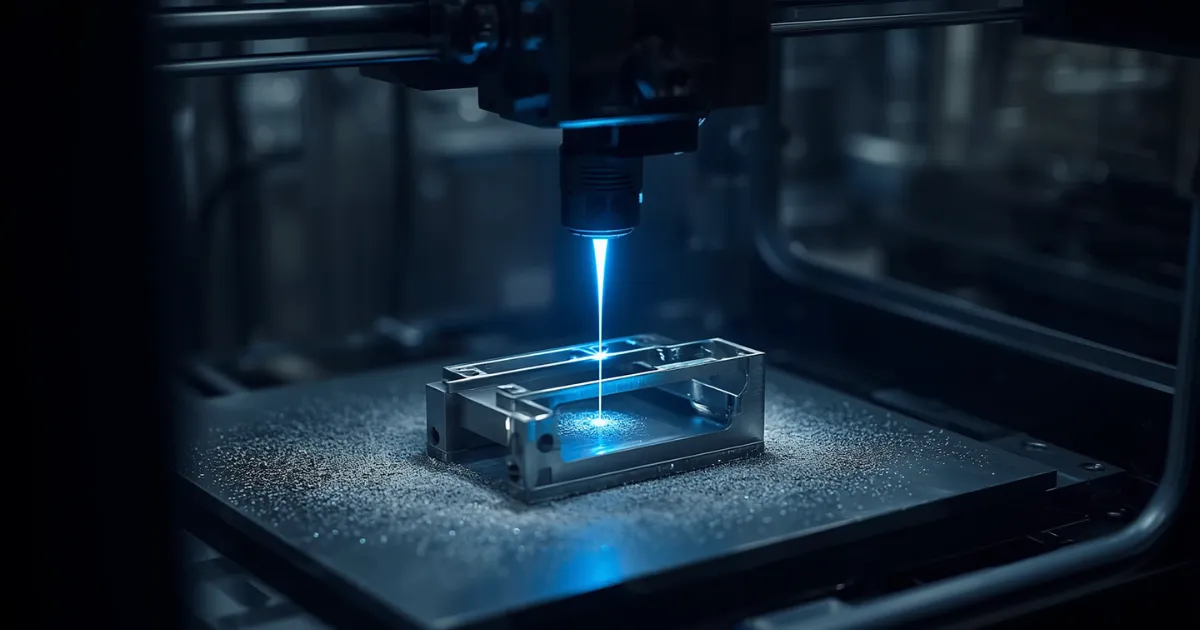
3D printing aerospace metal parts manufacturing now covers everything from a titanium bracket printed overnight to a fuel nozzle flying on tens of thousands of jet engines. It is not a replacement for machining or forging. It is a third option that wins when part complexity, material cost, or lead time punish the old methods hardest. This article covers where that’s true, where it isn’t, and the certification and quality-control questions most guides skip entirely.
How Metal 3D Printing Actually Builds an Aerospace Part
Metal additive manufacturing builds a part by fusing metal, layer by layer, directly from a CAD file rather than cutting it from a solid block. Two process families dominate aerospace: powder bed fusion for small, geometrically complex parts, and directed energy deposition or wire arc methods for large structural components.
The distinction matters more than most buyer’s guides admit, because the two families solve completely different problems.
Laser Powder Bed Fusion (L-PBF)
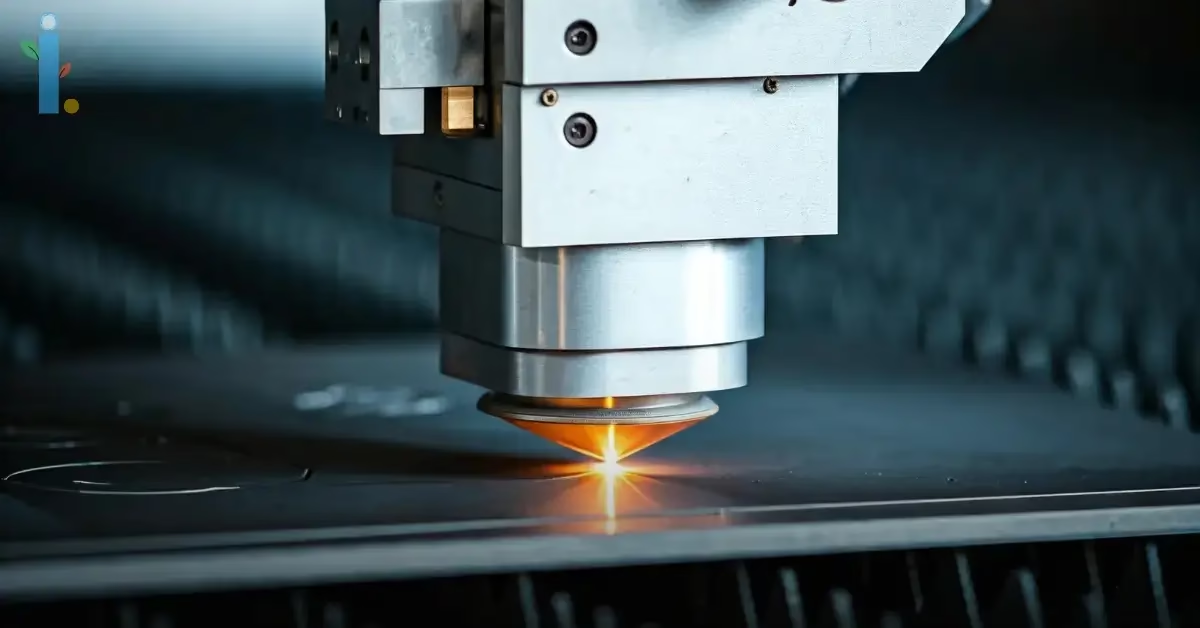
A laser selectively melts a thin layer of metal powder, typically 20 to 60 microns thick, across a build plate. The plate drops, a new layer of powder spreads, and the laser fuses the next cross-section. This is how GE Aerospace prints its LEAP engine fuel nozzles: fine detail, internal channels, and a build envelope usually under a meter in any direction.
Directed Energy Deposition and Wire Arc Manufacturing
DED and wire arc additive manufacturing (WAAM) feed wire or powder through a nozzle mounted on a robotic arm, melting it with a laser, plasma, or electron beam as it’s deposited. Airbus uses a wire-based version of this, called w-DED, to grow near-net-shape titanium structures for the A350’s cargo door surround, parts too large for a powder bed machine. According to Airbus, the approach avoids recycling the 80% to 95% of raw titanium that traditional forging typically machines away.
That waste number is the whole economic argument for additive in one sentence. Titanium sponge isn’t cheap, and neither is the machine time to cut most of it into chips. The same shift already reshaped 3D printing for automotive manufacturing, though aerospace’s certification burden and material costs push the economics in a different direction.
The Quality Control Gap Most Guides Never Mention
Regulators still don’t fully trust in-process machine data to qualify a flight-critical additive part on its own, and that gap shapes how every aerospace supplier actually runs a print job today. Most articles on this topic describe certification as a solved problem. It isn’t, not completely.
In-situ process monitoring, sensors and cameras that watch the melt pool and layer quality as the part is being printed, is the piece regulators keep circling back to. The 2025 Joint EASA-FAA Additive Manufacturing Workshop ran an entire working group on it. According to EASA, that group is still developing guidance on using in-situ monitoring to support qualification of metal AM parts, working toward standards like ARP7068 rather than treating the technology as ready to replace conventional inspection.
Here’s what that means in practice. A supplier can’t yet point to a green light on a monitoring dashboard and skip CT scanning or destructive testing on a critical part. Every flight-critical print still gets non-destructive inspection layered on top of whatever in-process data the machine captured. Budget for both, not one or the other, until that guidance changes.
Materials That Actually Fly
Three material families cover most aerospace additive work, and each earns its place for a different reason: strength-to-weight, high-temperature survival, or corrosion resistance in unpressurized structure.
| Material | Typical Use | Key Property | Post-Processing Needed |
|---|---|---|---|
| Ti-6Al-4V | Brackets, structural fittings, w-DED airframe parts | High strength-to-weight ratio | HIP, stress relief, machining to final tolerance |
| Inconel 625 / 718 | Turbine components, combustor parts, fuel nozzles | Retains strength above 650°C | Solution anneal, aging heat treatment |
| AlSi10Mg | Non-critical brackets, housings, tooling | Low density, good thermal conductivity | Stress relief, surface finishing |
Titanium dominates structural work because it pairs high strength with roughly half the density of steel. Inconel earns its spot near combustion and turbine sections because few printable alloys hold useful strength past 650°C. Aluminum alloys stay limited to lower-temperature, lower-criticality parts, where their weight advantage matters more than their heat tolerance.
None of these are drop-in replacements for their wrought equivalents straight off the printer. As-built microstructure is columnar and anisotropic. Hot isostatic pressing (HIP) closes internal porosity, and a proper heat treatment schedule rebalances the grain structure. Skip either step and fatigue life drops well below what the alloy’s data sheet promises.
Getting a Printed Part Certified
No aircraft part reaches an airplane without regulatory sign-off, and additive parts follow the same FAA and EASA frameworks as forged or machined ones, just with extra process documentation. The FAA’s design approval guidance for additive manufacturing sits alongside standard Part 33 engine certification and Part 25 structural rules. According to the FAA, applicants must define dimensions, materials, and processes that establish the same structural strength assumptions used in conventional part approval, which for AM means locking down powder chemistry, machine parameters, and post-processing as tightly as the geometry itself.
That documentation burden explains why qualifying a new AM part typically takes longer than qualifying the print itself. Powder lot variation, machine-to-machine differences, and even the operator’s build orientation choices all become traceable variables in the certification file. Change any one after qualification, and you’re often reopening the approval.
Honeywell’s #4/5 bearing housing became the first 3D-printed flight-critical engine part to win FAA certification in 2020. Lufthansa Technik and Premium AEROTEC followed in 2022 with EASA’s first certified load-bearing metal AM spare part. Both cases took years of process qualification, not months.
What Most Buyers Get Wrong About This Technology
The most persistent myth is that additive manufacturing is now cheaper than machining across the board. It isn’t. Cost only tips in favor of printing once the buy-to-fly ratio gets bad enough, once machining away 10, 15, even 20 kilograms of titanium to deliver 1 kilogram of finished part makes the raw material bill the dominant cost, not the labor.
A second myth: that a 3D printed part is automatically lighter-weight than its machined counterpart by default. Weight savings come from redesigning the part for additive, adding internal lattices, consolidating brazed assemblies, thinning walls where load allows, not from printing the original machined geometry unchanged. Print an unmodified bracket and you’ll often get a part that costs more and weighs the same.
A third: that printing eliminates machining entirely. It rarely does. Most flight-critical printed parts still need finish machining on mating surfaces, bolt holes, and sealing faces, because as-printed surface roughness and dimensional tolerance don’t meet aerospace fit requirements straight off the build plate.
The GE Fuel Nozzle Case, and What It Actually Proves
GE Aerospace’s LEAP fuel nozzle is the case study every article cites, and for good reason: it’s the clearest proof that additive redesign, not additive substitution, delivers the payoff. As GE described in a 2018 account of the program, the nozzle consolidated roughly 20 separately welded and brazed components into a single printed piece, cut weight by about 25%, and came out roughly five times more durable than the assembly it replaced.
The nozzle now prints at production scale, hundreds of units per week, across an engine platform with tens of thousands of units flying. That volume is the part of the story most competing articles skip. The nozzle didn’t stay a boutique demonstration part. It became a mass-production commodity, which is a different, harder engineering problem than making one good prototype.
What made this possible wasn’t the printer. It was redesigning a 20-piece assembly into a single geometry no casting or forging process could make. That’s the lesson worth taking, not the raw part count.
When Machining Still Wins
Additive manufacturing loses on cost and lead time for a large share of aerospace parts, and pretending otherwise sets buyers up for a bad first project. Simple geometries with a low buy-to-fly ratio, brackets close to their finished shape already, rarely justify printing. Machining a block of aluminum into a bracket that only needs modest material removal is fast, cheap, and well understood by every supplier on the vendor list.
High-volume, simple parts also favor traditional methods. Forging and casting amortize tooling cost across thousands of identical units; printing doesn’t get materially cheaper per part as volume climbs the way stamping or forging does. If you’re ordering 50,000 identical fasteners, a print farm is the wrong tool.
Certification history counts too. A part with decades of flight hours behind its forged or cast version carries a qualification cost to redesign for additive that often outweighs the weight or lead-time benefit, unless the original supply chain has genuinely broken down. That’s precisely the situation Satair solved in 2020, recreating a discontinued cast part in titanium because remaking the original tooling would have cost more and taken longer than requalifying a printed replacement.
Advanced: Designing Parts for Additive From the Start
Engineers who already understand the basics get the real payoff from designing for additive manufacturing (DfAM) from the first sketch, not from converting an existing drawing. Start by asking which separate, fastened, or welded components in an assembly could become one printed geometry. Part consolidation is where most of the cost and weight savings actually live, not in the printing process itself.
Run topology optimization before you finalize geometry. Tools built for this workflow strip material from low-stress regions and leave load paths intact, often cutting 20% to 40% of a bracket’s mass without a strength penalty. If your team already relies on finite element or multiphysics platforms for structural work, pairing that analysis with simulation and modeling tools in aerospace built for additive-specific constraints, thermal residual stress, support structure placement, build orientation, avoids redesign cycles after the first failed print.
Within 30 days, a practitioner with two or more years of AM experience can realistically re-scope one existing assembly: identify consolidation candidates, run a topology optimization pass, and produce a build-orientation study that flags which faces need post-machining. That’s a concrete deliverable, not a vague transformation roadmap.
Design for the finishing steps too. Decide which surfaces need machining before the print starts, and orient the part so those surfaces sit away from support structures. Support removal on a titanium part is slow and expensive; planning around it up front is nearly free.
People Also Ask
Is 3D printed titanium as strong as forged titanium?
After hot isostatic pressing and proper heat treatment, printed Ti-6Al-4V can match or exceed forged titanium’s static strength. Fatigue strength in the as-built state usually lags behind forged material because of surface roughness and internal porosity, which is why HIP and finish machining aren’t optional for flight-critical parts.
How much does 3D printing aerospace parts cost?
Titanium powder alone typically runs $250 to $600 per kilogram, before machine time, post-processing, and certification overhead. Whether that beats machining depends entirely on the buy-to-fly ratio: a part that wastes 90% of its raw material in machining often costs less to print, even at that powder price.
Can 3D printed parts be certified for flight?
Yes. The FAA and EASA both have established certification pathways, and multiple flight-critical printed parts, including GE’s LEAP fuel nozzle and Honeywell’s bearing housing, are certified and flying today. Certification requires locking down powder chemistry, machine parameters, and post-processing as documented, repeatable variables.
What metals are used in aerospace 3D printing?
Titanium alloys (mainly Ti-6Al-4V), nickel superalloys like Inconel 625 and 718, aluminum alloys such as AlSi10Mg, and increasingly cobalt-chrome and stainless steels like 17-4PH. The choice depends on the part’s temperature exposure, strength requirement, and criticality classification.
What is the buy-to-fly ratio and why does it matter?
It’s the ratio of raw material weight purchased to the finished part’s weight. Conventional titanium machining averages a buy-to-fly ratio of 10:1 to 20:1; additive processes can bring that down toward 2:1 or better. That difference drives most of the cost argument for printing over machining in aerospace.
FAQs
Is metal 3D printing actually cheaper than CNC machining for aerospace parts?
It depends entirely on the part. For simple geometries with a low buy-to-fly ratio, machining wins on both cost and speed, since printing carries fixed overhead in powder handling, support removal, and post-processing that a simple machined bracket never incurs. For complex parts made from expensive alloys like titanium or Inconel, where machining would waste 80% or more of the raw material, printing usually wins once you account for the full cost of the wasted stock, not just the machine-hour rate. Run both cost models before committing to a process, because the crossover point shifts with material price and part complexity.
How long does it take to qualify a new 3D printed part for flight?
Qualification timelines vary widely, but months rather than weeks is the realistic baseline for anything flight-critical, and multi-year programs aren’t unusual for new materials or processes. GE’s Catalyst turboprop engine certification, which included multiple additively manufactured components, involved more than 23 engines and 190 component tests before the FAA signed off under Part 33. Simpler, non-critical parts move faster because the criticality classification determines how much testing and documentation the certification process requires.
Do 3D printed aerospace parts need post-processing before they can fly?
Almost always, yes. As-printed metal parts typically have rougher surface finish, internal porosity, and residual stress that don’t meet aerospace tolerance or fatigue requirements straight off the build plate. Standard post-processing includes hot isostatic pressing to close internal voids, a heat treatment cycle to rebalance the microstructure, and CNC finish machining on any surface that mates with another component or needs a tight tolerance. Skipping these steps is one of the most common reasons a printed part fails qualification testing.
What’s the biggest limitation holding back wider adoption of metal 3D printing in aerospace?
Build volume and production speed remain real constraints, but the less-discussed limitation is qualification cost per part family. Every new alloy, machine model, and even significant process change can trigger a fresh qualification cycle, which makes AM economically attractive mainly for parts where the redesign, weight, or supply-chain benefit is large enough to absorb that overhead. This is also why in-process monitoring standards matter so much right now: once regulators trust that data enough to reduce redundant testing, qualification costs should drop meaningfully.
Can additive manufacturing replace traditional aerospace manufacturing entirely?
No, and treating it as an eventual full replacement misunderstands how the two approaches complement each other. High-volume, simple, low buy-to-fly parts will likely stay with forging, casting, and machining indefinitely, since those processes get cheaper per unit as volume scales in a way printing doesn’t. Additive manufacturing’s advantage is concentrated in complex, low-volume, high-material-cost parts, spare parts for discontinued tooling, and genuinely novel geometries that consolidation makes possible. Most aerospace supply chains are settling into a hybrid model where both methods run side by side, chosen part by part.


KEEP READING

Industrial IoT sensor deployment strategies are the backbone of modern Industry 4.0 systems, enabling real-time monitoring, predictive maintenance, and data-driven decision-making across factories, energy plants, and logistics networks. But successful [...]

Industrial IoT sensor deployment strategies are the backbone of every successful digital transformation project in factories, energy plants, logistics hubs, and large industrial environments. In this guide, we break down [...]

The benefits of automation in food processing go far beyond cost savings. From improving food safety and reducing waste to boosting efficiency, consistency, and sustainability, automation is reshaping how food [...]
3D printing in industrial manufacturing has emerged as a game‑changing technology, empowering companies to produce complex, high‑performance parts with unprecedented speed, customization, and cost efficiency. From aerospace brackets to hypercar [...]

In today’s competitive industrial landscape, improving energy efficiency isn’t just a green initiative—it’s a strategic advantage. From recapturing waste heat to deploying AI-driven predictive maintenance, modern energy efficiency technologies help [...]