

Industrial IoT sensor deployment strategies are the backbone of modern Industry 4.0 systems, enabling real-time monitoring, predictive maintenance, and data-driven decision-making across factories, energy plants, and logistics networks. But successful deployment isn’t just about installing sensors—it requires careful planning, secure connectivity, scalable architecture, and continuous optimization. In this guide, you’ll learn proven, real-world strategies to deploy industrial IoT (IIoT) sensors effectively, reduce costs, improve operational efficiency, and future-proof your infrastructure with practical, actionable insights.
Understanding Industrial IoT Sensor Deployment Strategies
What Is Industrial IoT (IIoT)?
Industrial IoT refers to interconnected sensors, devices, and systems used in industrial environments to collect, exchange, and analyze data. Unlike consumer IoT, IIoT prioritizes reliability, precision, and security in mission-critical operations.
Role of Sensors in Industrial IoT Ecosystems
Sensors act as the “eyes and ears” of IIoT systems. They capture real-time data such as temperature, vibration, pressure, and motion, which is then processed to generate insights.
Types of Industrial IoT Sensors
Common sensor types include:
- Temperature sensors (thermal monitoring)
- Pressure sensors (fluid systems)
- Vibration sensors (machine health)
- Proximity sensors (automation systems)
- Gas and humidity sensors (environment safety)
Why Industrial IoT Sensor Deployment Strategies Fail (And How to Avoid It)
Many deployments fail—not due to technology—but due to poor planning.
Common Mistakes
- Deploying sensors without clear objectives
- Ignoring harsh environmental conditions
- Using incompatible communication protocols
- Lack of cybersecurity planning
Hidden Costs and Risks
Poor deployment can lead to:
- Frequent sensor failures
- Data inaccuracies
- Increased downtime
- Expensive retrofitting
Real-World Insight
A manufacturing plant deployed vibration sensors without calibration—leading to false alerts and costly maintenance shutdowns. Proper planning could have avoided this.
Core Components of Effective Industrial IoT Sensor Deployment Strategies
Hardware Selection Criteria
Choose sensors based on:
- Accuracy and precision
- Environmental durability (IP ratings)
- Calibration requirements
Connectivity Options
Your connectivity choice impacts performance:
- Wi-Fi – high bandwidth, short range
- LoRaWAN – long range, low power
- NB-IoT – cellular-based, scalable
- 5G – ultra-low latency, high speed
Edge Computing vs Cloud Processing
- Edge computing processes data locally → reduces latency
- Cloud computing enables large-scale analytics
Best approach: Hybrid model
Data Management and Storage
Efficient strategies include:
- Data filtering at the edge
- Structured storage systems
- Real-time dashboards
Step-by-Step Industrial IoT Sensor Deployment Strategy
Step 1 – Define Business Objectives
Start with clear goals:
- Predictive maintenance
- Energy optimization
- Quality control
Step 2 – Site Assessment
Evaluate:
- Temperature extremes
- Electromagnetic interference
- Physical obstructions
Step 3 – Choose the Right Sensors
Match sensors to use cases. Avoid over-deployment.
Step 4 – Network Design
Plan for:
- Coverage
- Redundancy
- Latency requirements
Step 5 – Installation and Calibration
Ensure:
- Proper positioning
- Accurate calibration
- Testing before scaling
Step 6 – Data Integration
Integrate with platforms like:
- SCADA systems
- ERP solutions
- IoT dashboards
Step 7 – Continuous Monitoring
Track:
- Sensor health
- Data anomalies
- Performance metrics
Network Architecture for Industrial IoT Sensor Deployment Strategies
Centralized vs Distributed Systems
- Centralized: easier control
- Distributed: more resilient
Edge vs Cloud Hybrid Models
Combining both ensures:
- Faster decision-making
- Scalable analytics
Performance Considerations
Key metrics:
- Latency (delay in data transmission)
- Bandwidth (data capacity)
- Throughput (data processed per second)
Security Best Practices in Industrial IoT Sensor Deployment Strategies
Security is non-negotiable.
Device-Level Security
- Secure boot
- Firmware updates
- Device authentication
Network Security
- VPNs
- Firewalls
- Intrusion detection systems
Data Protection
- End-to-end encryption
- Role-based access control
Compliance Standards
Follow frameworks like:
- NIST
- ISO 27001
- IEC 62443
Scalability Considerations for Industrial IoT Sensor Deployment Strategies
Design for Growth
Avoid rebuilding systems later.
Modular Deployment
Deploy in phases:
- Pilot → Scale → Optimize
Handling Big Data
Use:
- Data compression
- Edge filtering
- AI analytics
Cost Optimization Strategies
CAPEX vs OPEX
- CAPEX: upfront hardware costs
- OPEX: maintenance and operations
ROI Measurement
Track:
- Reduced downtime
- Maintenance savings
- Efficiency improvements
Smart Cost Reduction
- Use low-power sensors
- Optimize data transmission
- Reduce manual inspections
Real-World Use Cases
Smart Manufacturing
Sensors monitor production lines in real-time.
Predictive Maintenance
Detect failures before they occur.
Energy Management
Optimize power consumption.
Logistics Tracking
Track goods across supply chains.
Technical Specifications That Matter
Sampling Rate
Defines how often data is collected.
Accuracy vs Precision
- Accuracy = correctness
- Precision = consistency
Power Consumption
Battery life impacts maintenance cycles.
Protocols
Common protocols:
- MQTT (lightweight messaging)
- CoAP (low-power devices)
- HTTP (standard communication)
Integration with AI and Analytics
Machine Learning
Predict failures using historical data.
Real-Time Analytics
Immediate decision-making.
Digital Twins
Virtual replicas of physical systems.
Challenges in Industrial IoT Sensor Deployment Strategies
Harsh Environments
Dust, heat, and vibration affect sensors.
Data Overload
Too much data can reduce efficiency.
Interoperability
Different vendors = compatibility issues.
Future Trends
5G Connectivity
Ultra-fast, low latency networks.
AI Automation
Self-optimizing systems.
Edge Intelligence
Smarter local processing.
People Also Ask
What are industrial IoT sensor deployment strategies?
They are structured methods for planning, installing, and managing sensors in industrial environments to ensure efficiency, scalability, and security.
How do you deploy IoT sensors in industrial environments?
By defining objectives, selecting sensors, designing networks, installing devices, and continuously monitoring performance.
What is the best network for industrial IoT sensors?
It depends on use case—LoRaWAN for long-range, 5G for high-speed, and NB-IoT for scalability.
FAQs
How many sensors are needed?
Depends on system complexity, but start small and scale strategically.
What is the lifespan of sensors?
Typically 5–10 years depending on environment and usage.
How secure are IIoT systems?
Highly secure when proper encryption and standards are followed.
Which industries benefit most?
Manufacturing, energy, logistics, and healthcare.
Can small businesses adopt IIoT?
Yes—starting with low-cost sensors and scalable solutions.
Conclusion: Building a Future-Proof Strategy
Successful industrial IoT sensor deployment strategies require more than technology—they demand planning, security, scalability, and continuous optimization. By following structured deployment steps, choosing the right architecture, and integrating AI-driven analytics, you can unlock the full potential of IIoT while minimizing risks and costs.


KEEP READING

3D printing aerospace metal parts manufacturing now covers everything from a titanium bracket printed overnight to a fuel nozzle flying on tens of thousands of jet engines. It is not [...]

Industrial IoT sensor deployment strategies are the backbone of every successful digital transformation project in factories, energy plants, logistics hubs, and large industrial environments. In this guide, we break down [...]

The benefits of automation in food processing go far beyond cost savings. From improving food safety and reducing waste to boosting efficiency, consistency, and sustainability, automation is reshaping how food [...]
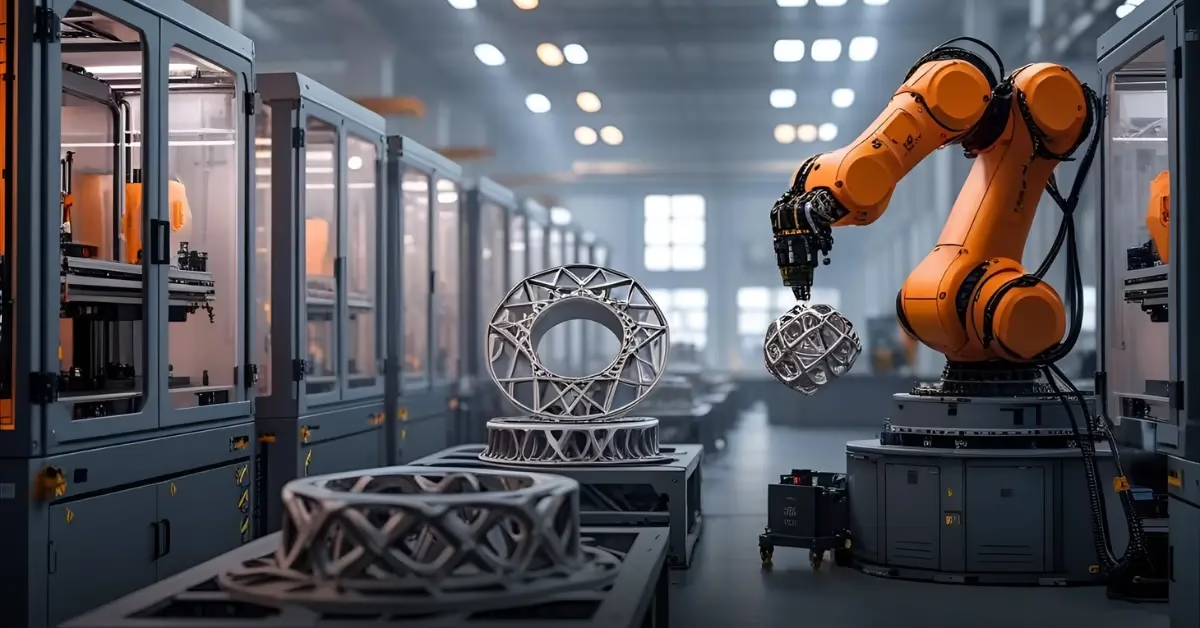
3D printing in industrial manufacturing has emerged as a game‑changing technology, empowering companies to produce complex, high‑performance parts with unprecedented speed, customization, and cost efficiency. From aerospace brackets to hypercar [...]

In today’s competitive industrial landscape, improving energy efficiency isn’t just a green initiative—it’s a strategic advantage. From recapturing waste heat to deploying AI-driven predictive maintenance, modern energy efficiency technologies help [...]