Types of residential solar power systems and their efficiency ratings matter because the panel label does not tell the full story. A grid-tied roof with modern monocrystalline modules can deliver more usable energy than an off-grid setup with batteries, even when the panel nameplate looks similar. DOE says grid-connected systems send extra power to the grid and avoid storage devices, while off-grid systems rely on batteries; NREL uses 85% as a representative battery round-trip efficiency, so storage adds real energy loss. NREL also reported a median module efficiency of 20.8% for U.S. residential PV systems in 2022, with most installs clustered near 20% to 21.5%.
What residential solar power systems are
A residential solar power system is a home energy setup that turns sunlight into electricity for household use. The core parts are solar modules, an inverter, wiring, and often monitoring gear; batteries may be added for backup or off-grid use. DOE’s grid-connected guide says the inverter converts DC from the panels into AC for the home, and the off-grid guide adds that a battery bank and charge controller are needed when the home is not connected to the grid.
How residential solar systems generate electricity
Solar cells convert sunlight into direct current. The inverter then changes that DC into alternating current that household appliances can use. Every conversion step trims a little energy, which is why the whole system matters, not just the panel. DOE’s inverter guidance explains the DC-to-AC conversion, and NREL’s battery work shows that stored solar power also loses energy on the way in and out of the battery.
Why efficiency ratings influence long-term savings
Higher efficiency means more electricity from the same roof area. That matters most when roof space is tight, shading is present, or a homeowner wants more production without adding more modules. NREL’s cost analysis found that residential systems using monocrystalline modules achieved a price reduction versus multicrystalline systems because the higher efficiency reduced system-level costs enough to outweigh the module premium.
Types of Residential Solar Power Systems and Their Efficiency Ratings
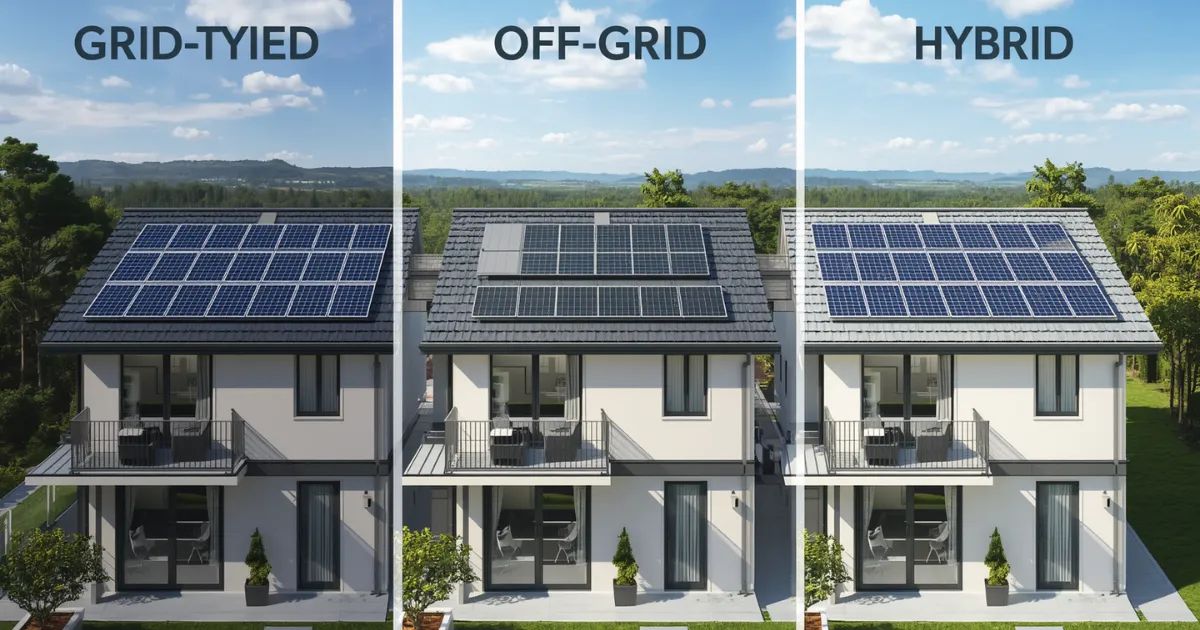
The three main residential system types are grid-tied, off-grid, and hybrid. Each one has a different efficiency profile because each one handles solar power differently after the panels make it. Grid-tied systems usually keep losses lower because they avoid battery cycling. Off-grid and hybrid systems add storage, which raises resilience but lowers delivered efficiency because storage is not free in energy terms.
Grid-Tied Solar Systems
Grid-tied solar systems connect directly to the utility grid. When the home needs more power than the panels are making, the grid supplies the rest. When the panels make extra, the surplus goes back to the grid. DOE says this setup eliminates the expense of batteries, which is why it usually has the cleanest energy path of the three main system types.
Efficiency rating profile of grid-tied systems
Grid-tied systems often deliver the best usable efficiency for a given roof because the solar energy goes from panel to inverter to home, with no battery cycle in between. That does not mean the panels themselves are more efficient; it means less energy gets lost after generation. NREL’s battery guidance gives 85% as a representative round-trip efficiency, so skipping storage avoids that hit entirely. That is an inference from the source data, not a direct DOE formula.
Best use case for grid-tied systems
A grid-tied system fits a home whose main goal is bill reduction, not complete energy independence. It is usually the most practical choice when the grid is stable and the utility rules make exports worthwhile. DOE’s description makes clear that grid-connected systems are built around day-to-day solar use, with the grid acting as the backup source when sunlight is not available.
Off-Grid Solar Systems
Off-grid solar systems run a home without a utility connection. DOE describes these as stand-alone systems and notes that they can make economic sense in remote areas where extending power lines is expensive. In one DOE example, a new line can cost $15,000 to $50,000 per mile, which is why off-grid solar can be practical in isolated locations.
Efficiency rating profile of off-grid systems
Off-grid systems usually have the lowest effective efficiency of the three main types because they must store energy. Storage adds battery losses, inverter losses, and sometimes charge-controller losses. NREL’s representative battery round-trip efficiency of 85% gives a useful benchmark for that storage penalty. In plain terms, every stored kilowatt-hour comes back with less than one kilowatt-hour of usable output.
Best use case for off-grid systems
Off-grid systems fit remote homes, cabins, and places where grid access is too costly or unavailable. They also fit owners who care more about independence than payback speed. The trade-off is clear: you need more equipment, more planning, and more installed capacity to cover winter, cloudy days, and battery aging. DOE’s stand-alone guide points to exactly that battery-heavy design.
Hybrid Solar Systems
Hybrid solar systems connect to the grid and also include battery storage. DOE’s older consumer guide already described this kind of setup as a grid-connected system with a battery bank, a charge controller, and a disconnect switch. In modern homes, the hybrid layout is the middle path: it keeps the grid for backup, but it also gives the house a battery for outages and peak-rate periods.
Efficiency rating profile of hybrid systems
Hybrid systems sit between grid-tied and off-grid systems in delivered efficiency. They lose some energy to battery cycling, but they avoid the deep autonomy penalty of a full off-grid design. NREL’s battery round-trip benchmark of 85% is the key number here, and DOE’s inverter explanation shows why the AC conversion step matters as well. The result is a system that gives up some efficiency to buy resilience.
Best use case for hybrid systems
A hybrid system suits a home that gets outages, has time-of-use pricing, or needs backup power for critical loads. It is also the right call when the homeowner wants solar savings but does not want to be fully dependent on the grid. NREL’s work on solar-plus-storage shows that the value of hybrid systems depends heavily on dispatch and forecast quality, which is another way of saying the battery only helps if the system is designed and managed well.
Solar panel technologies used in residential systems
The panel type often matters more than the system label when people talk about efficiency ratings. In the residential market, monocrystalline silicon dominates. Polycrystalline has faded, thin-film is still niche, and bifacial modules make sense only in some layouts. EnergySage says monocrystalline panels are the residential standard today and typically run at 20% to 23% efficiency.
Monocrystalline solar panels
Monocrystalline panels are made from a single silicon crystal. They are the most common residential choice because they pack more power into less roof space. EnergySage lists their typical efficiency at 20% to 23%, and NREL reported that the median module efficiency of U.S. residential PV systems reached 20.8% in 2022, with most systems clustered between 20% and 21.5%.
Polycrystalline solar panels
Polycrystalline panels use multiple silicon crystals. They have lower efficiency than monocrystalline panels, which is why they need more roof area for the same output. EnergySage says they were once the budget option but have largely been phased out of new residential installs as monocrystalline prices fell. NREL’s residential market data also show that multi c-Si systems averaged 17.5% module efficiency in 2022.
Thin-film solar panels
Thin-film panels use a different construction and are usually chosen for niche situations rather than standard rooftops. EnergySage says they are better suited to portable systems, RVs, and commercial roofs with weight limits. DOE says thin film PV most often refers to cadmium telluride, and DOE’s cadmium telluride page says CdTe cell efficiency has been pushed toward 24% by 2025 and 26% by 2030 as a development goal. That is about future direction, not the everyday residential install.
Bifacial solar panels
Bifacial panels can collect light from both sides, but that does not automatically make them a better residential choice. NREL’s 2024 solar industry update says the bifacial module share stayed at 5% or less for systems from 2.5 kWdc to 100 kWdc, and it also notes that typical sloped residential rooftops usually do not provide bifacial gain. That is an important correction because many buyers hear “bifacial” and assume extra output everywhere.
Efficiency ratings explained
Solar efficiency is the share of sunlight a panel converts into electricity. Module efficiency is the number you see on a product sheet, but system efficiency is lower because of inverter conversion, wiring, temperature, shade, and, in some cases, batteries. DOE explains the inverter step, and NREL explains the storage loss. That difference is why a 22% panel on a bad roof can perform worse than a 20% panel on a good one.
Module efficiency vs system efficiency
Module efficiency tells you how much sunlight the panel converts under test conditions. System efficiency tells you what the home actually gets after all losses. NREL’s rooftop studies model shading, tilt, and azimuth at the roof-plane level, which shows how fast real-world output can move away from the nameplate number. So the panel rating matters, but it is only one part of the answer.
What counts as a good residential efficiency rating
For homes today, roughly 20% to 23% is a strong monocrystalline panel range, and NREL’s residential data show that most installed systems cluster near 20% to 21.5%. Polycrystalline systems sit lower, and thin-film sits lower still in most residential use cases. Those ranges give a better buying frame than chasing the single highest record number.
Efficiency comparison at a glance
These are practical residential ranges, not lab records. The numbers below come from DOE and NREL market data, plus current residential panel guidance from EnergySage.
| Category | Typical efficiency | Main advantage | Main trade-off |
|---|---|---|---|
| Grid-tied system | Highest usable delivery | No battery losses | No power during outage unless backup is added |
| Off-grid system | Lower delivered efficiency | Full independence | Battery and storage losses |
| Hybrid system | Middle ground | Backup plus grid support | More hardware and more loss than grid-tied |
| Monocrystalline panel | 20%–23% | Best roof-area use | Higher upfront cost |
| Polycrystalline panel | Below mono; older installs often ~17%–18% | Lower module cost | Needs more roof space |
| Thin-film panel | Lower in most homes | Light weight, niche layouts | Low output per square foot |
| Bifacial panel | Site-dependent | Can add rear-side gain | Usually limited on sloped roofs |
The ignored angle: roof conditions matter more than the panel sticker
Most buying guides stop at the panel efficiency number. That misses the roof. NREL’s rooftop research uses shading, tilt, and azimuth to identify usable roof planes, and its solar deployment models simulate performance across many roof orientations. That tells you the real bottleneck is often not the module, but the roof geometry, nearby trees, and heat buildup. A 23% panel on a shaded roof can lose far more value than a 20% panel on a clean, cool surface.
The “it depends” situation: when higher efficiency is not the best buy
Higher efficiency helps most when roof space is limited. It matters less when the roof is large and unshaded, because a homeowner can simply add more lower-cost modules. NREL’s cost benchmark work found that residential systems using monocrystalline modules achieved a lower system price than multicrystalline systems because the module premium was outweighed by system-level savings. That is the key point: the best panel is not always the cheapest panel, and the cheapest panel is not always the best value.
Insider knowledge from residential installers
Experienced installers think in losses, not brochure numbers. They look at roof slope, string layout, inverter choice, and whether the roof can handle a future battery. DOE’s inverter basics and NREL’s storage work show why: every conversion step trims energy, and battery cycling adds another layer of loss. Another practical detail is bifacial use. NREL says typical sloped residential rooftops usually do not give bifacial gain, so a bifacial module can be wasted money unless the mounting setup is right.
Myth vs reality
Myth: the highest efficiency panel always gives the best result. Reality: the roof and system design decide how much of that rating survives in the field. NREL’s residential data show a narrow band of actual installed efficiency, which means small gains matter, but only after the rest of the system is sound.
Myth: off-grid systems are more efficient because they use all the solar power locally. Reality: off-grid systems usually lose more energy because battery storage is part of the design. NREL’s 85% round-trip benchmark is the giveaway. Stored energy comes back with a loss.
Myth: bifacial panels are always better. Reality: NREL’s 2024 update says typical sloped residential roofs usually do not give bifacial gain. In other words, the panel can be capable of more than the roof can use.
Myth: monocrystalline and polycrystalline are equally good now. Reality: EnergySage says polycrystalline has largely been phased out of new residential installs, while monocrystalline is the residential standard. NREL’s residential market data show the same shift in actual installed systems.
Advanced only: getting more energy from an existing home system
Homeowners who already have solar should focus on measurement, not guesswork. NREL’s system-performance work and rooftop modeling show that shading, orientation, and equipment design drive real output more than marketing terms do. If a system underperforms, the first check is often a string, inverter, or shade issue, not a “bad panel.” A second step is to review whether the roof could support a different layout or a battery-backed hybrid setup.
Advanced action that can be done in 30 days
Within a month, a homeowner can review monitoring data, compare sunny-day production against expected output, and check for shading from trees, vents, or nearby structures. If the roof is suitable and the system is grid-tied, the next question is whether a battery adds value or just adds losses. NREL’s solar-plus-storage research shows that storage value depends heavily on dispatch and forecast quality, so the battery decision should be tied to usage, outages, and tariff structure.
Information gain most buyers miss
Here is the part many guides skip: residential bifacial gain is often weak or absent on typical sloped roofs, so bifacial modules can be a poor buy for standard homes even when the spec sheet looks better. NREL also reports that residential systems using monocrystalline modules can lower total system price because fewer modules and less hardware offset the higher module cost. Those two points change the buying decision more than the raw panel efficiency number does.
People Also Ask
Which residential solar system is most efficient?
Grid-tied systems are usually the most efficient in practice because they avoid battery cycling losses. The panels themselves may be the same as other systems, but the energy path is shorter. DOE says grid-connected systems send extra power to the grid and do not require storage, which is why they tend to waste less energy than off-grid or hybrid setups.
What is a good solar panel efficiency rating for a home?
A good residential efficiency rating is usually around 20% or higher, and 20% to 23% is a strong monocrystalline range. NREL’s U.S. residential data put the median installed module efficiency at 20.8% in 2022, with most systems between 20% and 21.5%. That makes the low-20s a healthy target, not an outlier.
Are hybrid solar systems worth the extra cost?
They can be worth it when outages, time-of-use prices, or backup needs matter. The battery adds cost and some energy loss, but it also gives flexibility and resilience. NREL’s storage benchmark of 85% round-trip efficiency shows the efficiency trade-off, while DOE’s system descriptions explain why hybrid setups are chosen for homes that need both grid support and backup power.
Frequently Asked Questions
Do solar panels lose efficiency over time?
Yes. Solar modules age, and performance drops gradually over the years. That decline is normal and is one reason warranty terms matter. NREL’s degradation research notes that beginning-of-life measurements can differ from nameplate ratings and that long-term degradation studies can be affected by stabilization periods and measurement detail. For a homeowner, the key point is that a panel’s first-year output is not the same as its tenth-year output.
Why do some homes get less solar output than the panel rating suggests?
Because the roof and the rest of the system matter. Shading, roof tilt, azimuth, heat, inverter losses, and wiring all change the final result. NREL’s rooftop studies model these factors directly, which is why two houses with the same panel can produce different energy. A clean roof with good orientation can beat a higher-rated panel on a poor roof.
Is thin-film solar a good choice for homes?
Usually not for standard rooftops. Thin-film is better for portable systems, RVs, and some weight-limited roofs. DOE says thin-film PV most often refers to cadmium telluride, and EnergySage says the technology is better suited to niche residential use than to the usual suburban roof. Its lower power density means it often needs more area for the same output.
Does a battery make solar more efficient?
No. A battery makes solar more useful during outages and at night, but it does not make the energy path more efficient. NREL uses 85% as a representative battery round-trip efficiency, so some energy is lost when power is stored and later returned. The battery adds flexibility, not free energy.
What should I choose if roof space is limited?
Monocrystalline panels are usually the best fit when roof space is tight. They deliver more power per square foot than polycrystalline or thin-film panels. NREL’s residential market data and EnergySage’s current guidance both point to monocrystalline as the standard home choice, which is why it leads most limited-space installs.
Conclusion
The best residential solar choice depends on both system type and panel type. For most homes, grid-tied solar with modern monocrystalline panels gives the strongest mix of usable efficiency, cost control, and simplicity. Hybrid systems make sense when outages matter. Off-grid systems make sense where the grid is missing or too costly. The biggest mistake is chasing the highest efficiency label without checking roof shading, inverter losses, and whether the home actually needs batteries. DOE and NREL data both point to the same lesson: the roof and the full system design decide the real result.


KEEP READING

Resilient infrastructure technology developments are transforming how cities, industries, and governments design systems that can survive disruption, cyber threats, and climate events. Traditional infrastructure was built mainly for efficiency, but [...]
Green Hydrogen: Production via Electrolysis is at the forefront of the clean‑energy revolution, offering a zero‑carbon fuel that can decarbonize industries, power grids, and transportation. By using renewable electricity to [...]

Climate technology encompasses innovative solutions that mitigate or adapt to climate change, from renewable energy and energy storage to carbon management and sustainable agriculture. In 2025, these technologies are pivotal: [...]

Renewable energy integration with climate tech refers to using advanced technologies—like smart grids, energy storage, AI, and electrification—to overcome the challenges of adding wind and solar power to modern energy [...]