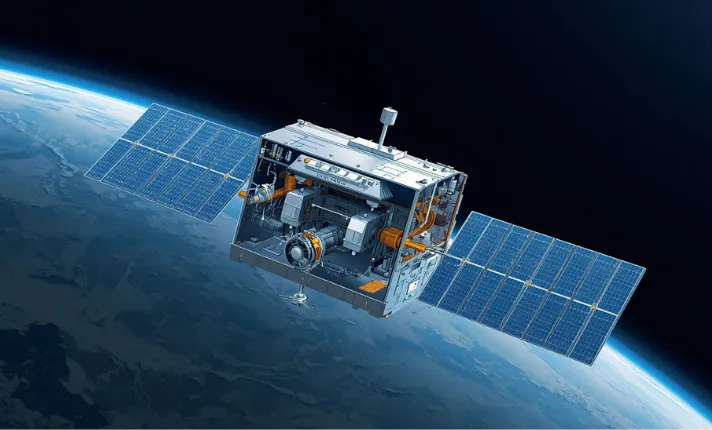
Small satellites — spacecraft under 500 kg, including CubeSats as light as a few hundred grams — have fundamentally changed who can operate in orbit. Development timelines that once stretched a decade now run 18 months. Launch costs that once exceeded $500,000 for a single CubeSat now start at $5,000 per kilogram on a rideshare. This article covers small satellite design from subsystem selection through propulsion options, and deployment from rideshare economics to orbital transfer vehicles and constellation strategies — giving engineers, mission planners, and new entrants a complete picture of what the field looks like in 2026.
What Is a Small Satellite? Size Classes and Form Factors
The term “small satellite” covers a wide range. The industry uses mass-based categories to set expectations around cost, capability, and launch options.
| Class | Mass | Examples |
|---|---|---|
| Femtosatellite | < 0.1 kg | PocketQube 1P |
| Nanosatellite | 1–10 kg | 1U–6U CubeSat |
| Microsatellite | 10–100 kg | 12U–27U, custom buses |
| Minisatellite | 100–500 kg | ESPA-class, Surrey-type |
CubeSat Units (1U to 16U) — Specs and Constraints
The CubeSat standard defines a 1U unit as a 10 × 10 × 10 cm cube with a maximum mass of 1.33 kg. Units stack: a 3U satellite is 10 × 10 × 30 cm. Most commercial CubeSats today fly in 3U, 6U, or 12U form factors.
The 3U format gives you roughly 1 liter of volume for payload. That sounds like very little — and it is. A 3U Earth-observation satellite must decide between carrying a decent imager or adequate propulsion; rarely both. The 6U has become a practical sweet spot for missions needing a meaningful payload and a cold-gas or electric thruster.
A 12U or 16U CubeSat begins to approach microsatellite capability. Planet’s Dove constellation runs primarily on 3U platforms. Spire’s Lemur satellites use 3U for radio occultation and AIS. When Tomorrow.io launched its first weather-sensing satellites in 2024, it used a 6U-class form factor to fit microwave sounders with meaningful sensitivity.
Power is a hard constraint at any CubeSat size. A 3U satellite in a standard deployed configuration produces roughly 5–10W from deployable solar panels. A 6U can reach 15–25W. High-power instruments — synthetic aperture radar, hyperspectral imagers — are impractical below about 50W average, which pushes missions toward 12U+ or microsatellite buses.
Most CubeSats in low Earth orbit deorbit within 5–10 years due to atmospheric drag. Regulations in most jurisdictions require spacecraft to deorbit within 5 years of end of mission, which directly drives propulsion and orbit altitude decisions.
ESPA-Class and Microsatellites (100–500 kg)
The Evolved Expendable Launch Vehicle Secondary Payload Adapter (ESPA) ring accommodates payloads up to 181 kg on six attachment points. Satellites designed to fit this envelope — roughly 100–200 kg — get a dedicated structural interface without paying for a primary launch slot. SpaceX’s Transporter program covers ESPA-class payloads for as low as $300,000 per mission, including up to 50 kg of payload mass.
Microsatellites in the 100–500 kg range offer real payload capacity: multi-spectral imagers with sub-meter resolution, larger radar apertures, multi-band communications payloads. Surrey Satellite Technology’s Tyche, a 150 kg imaging satellite with sub-meter resolution flown for UK Space Command on Transporter-11, represents what this class can do when properly resourced.
Core Subsystems Every Small Satellite Needs
Every satellite, regardless of size, requires six core subsystems. The trade-offs in each are sharper on small platforms — there’s less room to throw hardware at a problem.
Power Systems: Solar Arrays and Battery Sizing
The power budget drives almost every other design decision. Solar arrays — whether body-mounted or deployable — supply energy during sunlight. Batteries store it for eclipse periods.
A satellite in a 550 km sun-synchronous orbit spends roughly 35% of each 96-minute orbit in eclipse. That means a satellite consuming 10W continuous needs about 22 Wh of battery capacity with 80% depth-of-discharge and 85% charging efficiency accounted for — so roughly a 30 Wh battery in practice.
Body-mounted cells on a 3U CubeSat generate 2–4W peak. Deployable panels typically double or triple that. The trade-off is deployment risk: any stuck panel means a power shortfall for the rest of the mission. This is why deployable mechanism reliability has become a field unto itself.
Common battery chemistries are lithium-ion and lithium-polymer. Li-ion offers better energy density at the cost of slightly more complex protection electronics. Most small satellite teams now use commercial-off-the-shelf (COTS) battery modules from vendors like GomSpace or Clyde Space with built-in protection circuits.
Attitude Determination and Control (ADCS)
ADCS determines where the satellite is pointing (determination) and then adjusts it (control). For nadir-pointing Earth observation, you need both. For a technology demonstration that just needs to communicate, you might get away with passive magnetic stabilization.
The ADCS chain typically consists of:
- Sensors: sun sensors, magnetometers, star trackers, gyroscopes
- Actuators: reaction wheels, magnetorquers, thrusters (if propulsion is available)
A star tracker gives pointing knowledge to better than 0.01°. A sun sensor with magnetometer gives 1–3°. For a 3U imaging satellite, star trackers were once considered out of reach — now vendors like Sinclair Interplanetary and Nano-Avionics sell 1U-compatible units under 100g.
Reaction wheels control attitude by exchanging angular momentum with the spacecraft. They saturate over time and need to be “desaturated” by magnetorquers (coils that push against Earth’s magnetic field). On a 3U satellite, three reaction wheels and three magnetorquers constitute a full attitude control system with no propellant cost.
Command and Data Handling (CDH)
The CDH system is the satellite’s central processor: it runs the flight software, routes commands from the ground, stores telemetry, and manages the rest of the subsystems. Most small satellite CDH systems now run on ARM-based microcontrollers or FPGAs, with radiation tolerance achieved either through component selection or software-level fault detection.
On-board storage has grown substantially. Modern 6U missions typically carry 32–128 GB of flash memory — enough to buffer several passes of high-resolution imagery before downlinking. Data compression (lossless for scientific data, lossy acceptable for commercial imagery) is now handled on-board on more capable platforms.
Communications: UHF, S-Band, and Optical Links
Ground contact windows are short — typically 5–15 minutes per pass for a single ground station. Everything the satellite does needs to fit within what it can downlink.
UHF (430–440 MHz): Low data rates (1–9.6 kbps), but simpler link budgets and cheaper hardware. Good for telemetry-only or low-bandwidth IoT missions. Most 1U–3U satellites use UHF for commanding and housekeeping.
S-Band (2–4 GHz): 1–10 Mbps with a decent antenna on both ends. Standard for most CubeSat science missions. Planet’s Dove constellation downlinks at S-band to a global network of ground stations.
X-Band (8–12 GHz): 50–150 Mbps. Used by commercial imaging satellites where large data volumes need to come down quickly. Requires more precise pointing.
Optical / Laser links: Emerging for very high throughput (Gbps+). Still expensive and requires precise pointing, but viable on 6U+ platforms with a capable ADCS.
Ground station access is its own logistics problem. Most missions use commercial ground station networks — AWS Ground Station, Kongsberg Satellite Services, or Leaf Space — rather than owning infrastructure. Pricing runs $5–25 per contact pass depending on antenna size and frequency band.
Propulsion Options for Small Satellites
Propulsion is where small satellite design gets genuinely hard. The options span three orders of magnitude in thrust and specific impulse, and the right choice depends on orbit, mission lifetime, attitude control needs, and whether you’re on a rideshare (where some propellants are prohibited).
Cold Gas and Warm Gas Systems
Cold gas thrusters store an inert gas (nitrogen, argon, or CO₂) under pressure and release it through a nozzle. Specific impulse (Isp) is below 70 seconds — very low. That means large tanks for even modest delta-V. They’re simple, safe, and rideshare-compatible, but they occupy volume fast.
Warm gas systems heat the propellant before expulsion, improving Isp to around 100–150 seconds. They require power for heating, adding to the electrical budget.
Both are suitable for attitude control and small orbit maintenance maneuvers on 3U–6U platforms where the delta-V requirement is under 20–30 m/s.
Electric Propulsion: Ion and Hall-Effect Thrusters
Electric propulsion trades thrust (very low, typically 0.001–0.1 N) for efficiency (Isp of 1,000–3,000+ seconds). The result: the same propellant mass delivers 10–30× more delta-V than chemical options.
Gridded ion thrusters ionize propellant (usually xenon or iodine) and accelerate it electrostatically. They’re efficient but require high voltage and significant power — often 50–200W. Challenging below 12U.
Hall-effect thrusters are more compact and operate at lower power than gridded ion engines, making them more viable in the 50–150W range accessible to larger nanosatellites. Busek, ThrustMe, and Enpulsion sell Hall-effect thrusters in CubeSat-compatible form factors.
Electrospray thrusters are small enough to embed in a single face of a CubeSat structure. They use ionic liquids and emit charged droplets. Thrust is in the micronewton range — mostly useful for precision attitude control and very slow orbit changes. MIT’s research on this architecture led to products now flying on several commercial nanosatellites.
The limitation of electric propulsion: large power requirements and low thrust result in long orbit-change times. A mission needing a 100 km altitude change might spend weeks burning. This makes electric propulsion unsuitable for fast-response orbital maneuvering but excellent for station-keeping and gradual constellation phasing.
Green Monopropellant and Hybrid Systems
Traditional monopropellant thrusters burn hydrazine, which delivers Isp around 220 seconds at acceptable thrust levels. The problem: hydrazine is highly toxic, requires special handling, and is restricted or prohibited on most rideshare launches.
Green alternatives — HPGP (high-performance green propellant, used in products like ECAPS HPGP) and AF-M315E (used in NASA’s GPIM demonstration) — deliver Isp of 240–260 seconds with far lower toxicity. They’re rideshare-compatible and increasingly available from vendors at small scales.
Hybrid systems combine solid fuel with a gaseous or liquid oxidizer. They fill a technology gap: higher thrust than electric propulsion, safer than hydrazine, better Isp than cold gas. Cubesat-scale hybrids remain development-stage for most vendors, but the Space Dynamics Laboratory and others are advancing end-burning hybrid designs specifically for small satellite form factors.
Propulsion-Free Missions: When You Don’t Need a Thruster
Many successful missions fly without propulsion at all. 3U–6U missions in 400–550 km orbits with 2–5 year design lives can meet deorbit requirements purely through atmospheric drag — Earth’s atmosphere at these altitudes will pull the satellite down within the regulatory window without any thruster firing.
Drag sails and deorbit devices (like the D-Orbit D3 or Planetary Systems Deorbit Module) provide controlled deorbit on demand without a propulsion system. They add mass and volume but far less than a propellant-loaded thruster system.
For missions where constellation phasing doesn’t matter and orbit maintenance isn’t required — tech demos, one-pass scientific measurements, educational satellites — propulsion adds cost and complexity without proportional benefit.
Deployable Structures: Antennas, Solar Panels, and Booms
Most small satellites have something that needs to unfold after launch. Solar panels, antennas, gravity-gradient booms, drag augmentation devices — deployables are one of the most common sources of on-orbit failures.
The Four Deployment Stages: Stow, Restrain, Actuate, Locate
A 2024 review paper published in Communications Engineering (Nature Portfolio) by Schwartz et al. provides the clearest framework for thinking about deployable design: every deployment goes through four distinct stages, and each is a potential failure point.
1. Stow: The structure is compacted to fit within launch volume. The design question here is which folding or rolling mechanism achieves the needed compact factor without damaging the mechanism itself.
2. Restrain: A restraint holds the structure in its stowed state against launch vibration loads — typically 20–100g RMS depending on the launch vehicle. Burn wire (a wire heated to melt through a restraint), spring-loaded pins, and shape memory alloy actuators are all used. Failures here are usually either premature release (the structure deploys during launch) or no release at all (the restraint doesn’t fire).
3. Actuate: The stored energy — spring force, residual stress in a rolled structure, motor drive — pushes the structure from stowed toward deployed. Tape springs, constant-force springs, and motor-driven hinges are the main mechanisms. This stage is where velocity matters: deploy too fast and the structure can bounce back and jam; too slow and it may stop short.
4. Locate: The structure arrives at its final position and is locked there, either by a latch, by reaching a hard stop, or simply by the structure’s own stiffness. Missing this stage — reaching 95% deployed but not latching — is a common failure mode that telemetry sometimes misses.
Common Failure Modes and How to Design Against Them
Small satellite teams often underinvest in deployable testing. The professional space industry’s increased acceptance of small satellite missions (and decreased tolerance for failures) has made this more visible.
Key failure modes and mitigations:
- Cold welding in vacuum: Metal-on-metal contact in vacuum can bond surfaces. Mitigate with dissimilar materials, coatings, or non-metallic contact surfaces at sliding interfaces.
- Burn wire failure: A redundant second wire costs almost nothing in mass and volume. It should be standard.
- Thermal binding: A structure that fits fine at room temperature may bind when one side is 80°C and the other is -80°C. Thermal vacuum testing of the full deployment sequence is the only reliable check.
- Resonance during launch: A partially stiffened deployable can have a resonant frequency that matches the launch vehicle’s forcing frequencies. Modal analysis early, testing against the actual launch vehicle’s acoustic and vibration environment before integration.
The Schwartz et al. framework recommends selecting the lowest-complexity mechanism that meets the functional requirement — not the most elegant one. Complexity on a constrained budget with an inexperienced team is the leading risk factor for deployable failures.
Launch Strategy: Rideshare vs. Dedicated Launch
Getting to orbit is still the biggest decision a small satellite team makes, and the economics changed dramatically between 2021 and 2026.
SpaceX Transporter and Bandwagon: Pricing and Orbit Options
SpaceX operates two rideshare programs:
Transporter: Falcon 9 missions to sun-synchronous orbit (SSO), approximately 97° inclination. Launches from Vandenberg Space Force Base in California. As of 2025, pricing starts at $300,000 for up to 50 kg to SSO, with per-kilogram rates around $6,000–6,500/kg above that. Missions run approximately every 3–4 months. Transporter-15, in November 2025, carried 140 payloads from over 30 customers across 16 countries.
Bandwagon: Introduced in 2024, Bandwagon missions go to mid-inclination orbits around 45° from Cape Canaveral. They run roughly every 6 months. This opens access to equatorial coverage that SSO doesn’t provide — useful for tropical monitoring, maritime applications, and equatorial communications missions.
SpaceX captured roughly 57% of Western smallsat launch demand (excluding Starlink and OneWeb) between the program’s 2019 launch and 2023. That market position is now a near-monopoly on rideshare with heavy launchers, with the lowest price point on the market and the most frequent cadence.
The constraints of rideshare are real: you fly when the bus leaves, you go where it’s going, and your deployment timing isn’t customizable without an add-on service. If your mission requires a specific inclination, precise insertion altitude, or a particular right ascension of the ascending node — rideshare may not fit. That’s when dedicated launch or an orbital transfer vehicle becomes relevant.
Launch Aggregators: Exolaunch, ISISpace, SEOPS, Maverick
Most small satellite customers don’t book directly with SpaceX. Aggregators handle integration, documentation, compliance, and manifest management:
- Exolaunch (Germany/USA): Over 475 satellites across 32 missions as of early 2025. Deployed 34 satellites on Transporter-12 in January 2025. Provides turn-key integration from customer delivery to on-orbit deployment.
- ISISpace (Netherlands): Strong in CubeSat integration and deployment hardware (ISIPOD deployers). Works across multiple launch vehicles.
- SEOPS (USA): Manages NASA’s VADR (Venture-class Acquisition of Dedicated and Rideshare) contract, giving government customers a procurement path. Also works commercial missions.
- Maverick Space Systems (USA): Specializes in smaller payloads and has a strong presence on SpaceX Transporter missions.
Aggregators add a margin — typically 10–25% on top of the launch cost — but they absorb significant logistics work. For a small team with no launch experience, an aggregator is usually worth the cost.
Dedicated Small Launchers: When Rideshare Isn’t Enough
Dedicated small launchers charge 5–10× more per kilogram than SpaceX rideshare. That premium buys orbit flexibility, schedule control, and a launch tailored entirely to your mission.
Rocket Lab’s Electron consistently delivers to precise orbits on short schedules. Exolaunch’s aggregation on rideshare and Rocket Lab’s Electron serve different parts of the same market — teams that can be flexible go rideshare, teams with specific requirements go dedicated.
Other small launchers are in various stages of commercial operation: RocketLab’s Neutron (in development), ABL Space Systems (operational testing), HyImpulse SL1 (development). The market remains challenging — nearly all dedicated small launch providers face the pressure of SpaceX Transporter’s pricing and cadence, pushing several toward heavier-lift vehicles to address markets SpaceX doesn’t directly serve.
Orbital Transfer Vehicles (OTVs): The Last-Mile Solution
One capability rideshare fundamentally can’t provide is placement into a specific orbit that’s different from the primary payload’s destination. OTVs solve this: they’re self-propelled “space taxis” that board a rideshare as a passenger, deploy from the rocket in a common orbit, and then individually deliver each customer’s satellite to its required altitude, inclination, and phase.
Key OTV providers:
- D-Orbit ION: Flies regularly on SpaceX Transporter missions. Customers deliver satellites to D-Orbit pre-launch; ION deploys them at specific velocities and altitudes on-orbit.
- Impulse Space Mira: Provides orbital transport, constellation deployment, payload hosting, and deorbit maneuvers.
- Exotrail SpaceVan: Electric propulsion-based OTV. The GEO version is planned to debut in 2026 aboard an Ariane 64 mission.
- UARX Space OSSIE: Modular, scalable design using green propellant thrusters from Dawn Aerospace. The first OSSIE qualification mission, carrying 12 customers including PocketQubes, CubeSats, and hosted payloads, was planned for mid-2025.
OTVs add cost — typically $20,000–$150,000 per satellite delivered, depending on delta-V required and operator — but the cost is often smaller than the mission cost difference between an acceptable orbit and the right orbit. For constellation deployment specifically, OTVs can replace the need for on-board propulsion entirely, dramatically simplifying and reducing the cost of each satellite bus.
The OTV market is growing fast. The electric propulsion OTV segment is projected at 14.9% CAGR through 2034, driven by constellation deployments and satellite servicing demand.
Constellation Deployment Strategies
A single satellite proves a technology. A constellation changes a business model. Getting from one to many is a distinct engineering challenge.
Natural Perturbation Methods (Nodal Precession)
Earth isn’t a perfect sphere — its equatorial bulge (J2 perturbation) causes the orbital plane to precess over time. The precession rate depends on altitude and inclination. Two satellites launched into the same orbital plane but slightly different altitudes will precess at different rates, naturally drifting apart in right ascension until they reach the desired plane separation.
This costs almost no propellant. It does cost time — weeks to months depending on the altitude difference and desired separation. A 2015 ScienceDirect analysis of distributed small satellite deployment found that nodal precession is sensitive to orbital decay from drag; at low altitudes, the drag-induced decay can disrupt the planned separation, resulting in longer or imprecise deployment timelines.
Staged Deployment and On-Orbit Maneuvers
For constellations where time-to-coverage matters, staged deployment — launching satellites in groups and using on-board propulsion or OTVs to rapidly spread them across orbital planes — is more direct.
A multiobjective genetic algorithm approach to constellation design, developed at the University of Manchester, uses three competing objectives: time-to-deploy, system mass, and system cost. The key finding: optimal solutions depend heavily on whether you’re deploying a few planes with many satellites or many planes with few satellites. The lunar L1 staging approach (using the Moon’s gravity to change orbital planes cheaply) is more efficient when several satellites need to be present in each plane; direct propulsive maneuvers work better for sparse constellations.
Reconfigurable constellations — designs that account for J2 drift from the start and plan fuel-efficient maneuvers to shift ground tracks — reduce propellant costs over the mission lifetime by 20–40% compared to naive maneuvering, based on AIAA studies of ReCon-style architectures.
The Piece Most Teams Get Wrong: Orbit Selection Up Front
Most early-stage small satellite teams focus intensely on the satellite hardware — bus design, payload, comms — and treat orbit selection as something to finalize later. This is the wrong order.
Orbit determines nearly everything else:
- Altitude: Lower altitude means more drag (faster deorbit, smaller propulsion requirement), more ground contacts per day, and more atmospheric disturbance. Higher altitude means longer lifetime, fewer revisits, and more delta-V to deorbit within regulations.
- Inclination: SSO gives global coverage including poles. Low-inclination orbits give better revisit over populated areas but miss high latitudes. Equatorial orbits maximize coverage of tropical regions.
- RAAN at epoch: For time-critical missions (disaster response, agriculture), the right ascending node — where the satellite crosses the equator going north — determines what time of day the satellite passes over target regions.
Rideshare economics push almost everyone toward SSO because that’s where SpaceX Transporter goes. If your mission actually needs a different inclination, discovering this after booking a Transporter slot is expensive. The right sequence is: define the mission coverage requirement, derive the orbit requirement from that, and then evaluate launch options — not the reverse.
Altitude selection also has a compounding effect on power and thermal design. Below 500 km in SSO, atmospheric drag is significant enough that propulsion is required to maintain altitude if the mission exceeds 2–3 years. Above 600 km, the radiation environment becomes harsher, requiring more radiation-hardened components and reducing solar cell efficiency over time.
Regulatory and Licensing Requirements
Operating a satellite requires at least two regulatory approvals in most jurisdictions: a launch license (or coordination with a licensed launch provider) and a frequency license from the national telecommunications authority, coordinated through the ITU.
ITU frequency coordination can take 3–7 years for new frequency bands if there are coordination conflicts. Most small satellite operators use frequency bands with pre-existing coordination agreements or fly on “experimental” licenses. The FCC processes U.S. experimental licenses in 60–120 days; Part 25 licenses (for commercial operation) take 6–12 months. Non-U.S. operators need their own national process.
Orbital debris mitigation requirements are tightening. The FCC adopted a 5-year deorbit rule in the U.S. in 2022. ESA’s ESSB-ST-U-007 standard, adopted as the Space Debris Mitigation Standard, is being referenced by an increasing number of national regulators. Designs that cannot demonstrate compliant deorbit capability are facing increased scrutiny in licensing proceedings.
Export control: U.S.-developed satellite components are subject to EAR (Export Administration Regulations) or ITAR (International Traffic in Arms Regulations). The satellite bus itself is typically EAR-controlled; active sensors, high-performance encryption, and certain propulsion technologies may be ITAR-controlled. International teams building with U.S. COTS components need to verify export classification early.
People Also Ask
What is the difference between a CubeSat and a small satellite?
A CubeSat is a specific standardized format — a 10×10×10 cm unit (1U) or multiples thereof — within the broader small satellite category. All CubeSats are small satellites, but not all small satellites are CubeSats. A 150 kg microsatellite is a small satellite but has no connection to the CubeSat standard. CubeSat standardization reduces cost by enabling COTS component reuse and standardized deployers like the ISIPOD.
How much does it cost to build and launch a small satellite?
A 3U CubeSat from an experienced team costs $150,000–$500,000 to build, depending on payload complexity and whether it uses fully COTS or custom components. Launch on SpaceX Transporter costs approximately $15,000–$30,000 for a 3U at $5,000–6,500/kg. A 6U with a commercial payload and solid ground support runs $500,000–$1.5M all-in. University missions can go lower with donated components and existing ground infrastructure, but $250,000 is a realistic floor for anything that works reliably.
How are small satellites deployed from a launch vehicle?
Most small satellites are held inside a deployment container — a spring-loaded box mounted to the launch vehicle or dispenser ring. After reaching the target orbit, a door opens and a compressed spring ejects the satellite at a controlled velocity, typically 1–2 m/s. Larger satellites are released by a motorized deployer or ejected from a dispenser ring. Timing is coordinated by the launch operator; satellites exit sequentially to avoid collisions within the dispenser.
FAQs
What propulsion system is best for a 3U CubeSat?
It depends on the delta-V requirement and what the rideshare provider allows. For missions needing less than 50 m/s, a green monopropellant system like Aerojet’s MPS-120 or Bradford ECAPS HPGP is well-matched to 3U. For missions that just need deorbit capability, a drag sail or passive device is simpler and cheaper. Cold gas is simpler still but burns through propellant mass quickly. Electric propulsion is almost always too power-hungry below 6U.
Can a university team realistically build a satellite that works on orbit?
Yes, though more rarely than press releases suggest. The failure rate for first-time CubeSat teams is high — many satellites reach orbit and never check in, due to antenna deployment failures, software bugs, or power system problems. The teams that succeed typically: test deployable mechanisms in thermal vacuum, write and run hardware-in-the-loop simulations of the full mission sequence, and plan for fault modes explicitly. Using a heritage bus from a vendor like GomSpace, Endurosat, or Pumpkin rather than building from scratch significantly improves odds.
How does orbital debris regulation affect small satellite design?
The FCC’s 5-year post-mission deorbit rule, adopted in 2022 and applied to U.S.-licensed missions, requires satellites to deorbit within 5 years of end of mission. At altitudes below 550 km, atmospheric drag alone typically meets this requirement. Above 600 km, a dedicated deorbit capability — propulsion system, drag augmentation device, or planned passivation — is generally required to demonstrate compliance. The ITU also requires passivation (venting residual propellants, discharging batteries) to reduce breakup risk.
What is the lead time for a small satellite rideshare launch?
SpaceX Transporter bookings typically require 12–18 months of lead time for a standard manifest slot. Aggregators like Exolaunch and ISISpace can sometimes accommodate 6–9 month timelines for smaller payloads if a slot is available. Dedicated small launchers like Rocket Lab offer faster scheduling in some cases but at higher cost. The hardware delivery deadline — when the satellite must be physically at the launch facility — is typically 30 days before launch (L-30).
What is an orbital transfer vehicle and do I need one?
An OTV is a spacecraft that boards a rideshare, separates from the rocket at a common deployment orbit, and then delivers each customer satellite to its individual target orbit using on-board propulsion. You need one if your required orbit is significantly different from the rideshare’s destination — different altitude by more than 50 km, different inclination, or a specific phase position in a constellation. For straightforward SSO missions without tight orbital requirements, an OTV adds cost without clear benefit. For constellation deployment or missions requiring a specific local time of ascending node, an OTV may eliminate the need for on-board satellite propulsion entirely, which is often a net cost reduction.


KEEP READING

Technology used in Starlink communication satellites for low latency internet has transformed how the world thinks about satellite broadband. Instead of the slow, lag-heavy connections people once associated with satellite [...]
Aerospace technology advanced propulsion systems are at the heart of humanity’s push for faster, safer, and more sustainable flight. From hypersonic passenger jets to deep-space missions, propulsion is the make-or-break [...]
Simulation and modeling tools in aerospace are the engines that power today’s most advanced aircraft and spacecraft designs. From predicting airflow over a wing to simulating the thermal stresses inside [...]
Processing satellite imagery is a cornerstone of modern Earth observation, defense, and scientific exploration. Whether you are a remote-sensing engineer, a geospatial analyst, or simply curious about how satellites turn [...]
Imagine a world where high-speed internet reaches the most remote villages, ships at sea, and airplanes mid-flight. This is the promise of satellite mega-constellations—networks of thousands of low-Earth orbit (LEO) satellites [...]