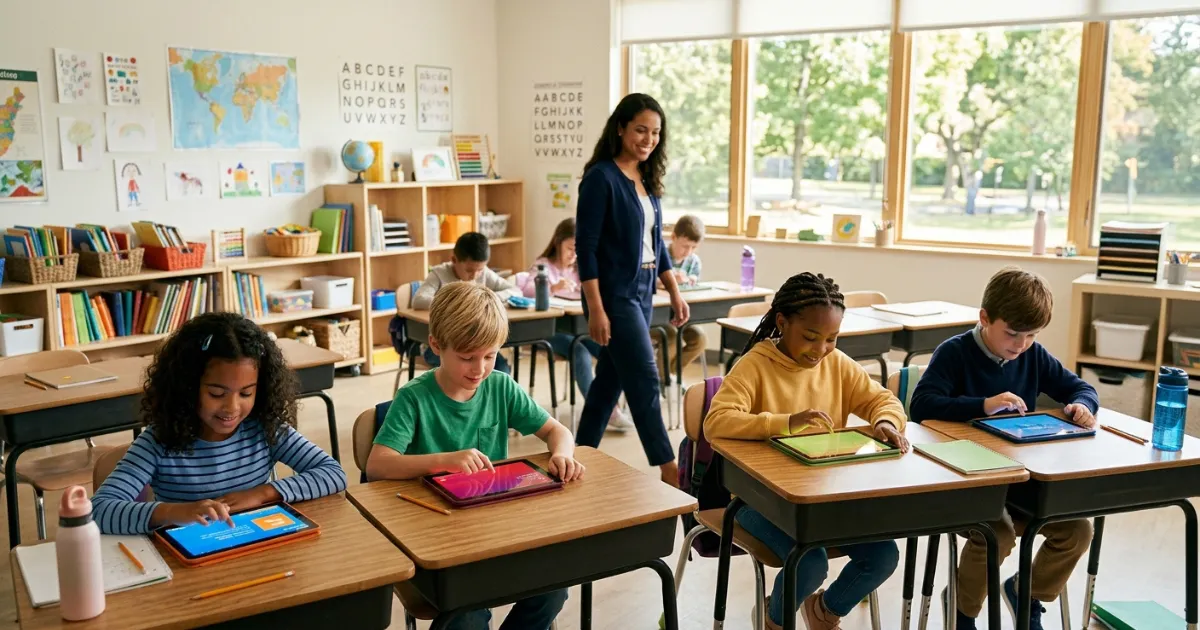
AI personalized learning in K-12 EdTech means software that changes what a student sees next based on how they just answered, not a fixed chapter everyone works through at the same pace. Teachers in 49 states now use tools like Google Gemini and Microsoft Copilot to rebuild lesson plans in minutes instead of hours, according to a 2025 Carnegie Learning survey. But the label gets stretched further than the technology behind it. Some platforms genuinely adapt to one student’s gaps. Others just reorder a shared question bank and call it personalization. Here’s what changes in a real classroom, and where the term overpromises.
What AI Personalized Learning Means for a K-12 Classroom
AI personalized learning is software, like Khan Academy’s Khanmigo or Century Tech’s platform, that adjusts a lesson’s pace or difficulty using a student’s live performance data instead of one fixed curriculum for the whole class.
That’s different from differentiation, which is a teacher manually creating three versions of a worksheet. It’s also different from plain adaptive software, which reacts to right and wrong answers but doesn’t track a student’s broader learning history across weeks.
Real personalization does both: it reads performance in the moment, and it carries that profile forward. A student who struggled with fractions in September should see that reflected in October’s word problems, not just today’s quiz.
Districts building this out often start with off-the-shelf adaptive learning technology solutions before layering on anything custom, because the integration work with an existing LMS is where most projects actually stall.
How the Software Decides What a Student Sees Next
An adaptive engine assigns each skill a difficulty score, then raises or lowers it based on a student’s last few answers, not just the most recent one.
At Albuquerque Public Schools, teachers use Google Gemini to spot learning gaps and route students toward specific reteaching material, according to a March 2026 EdTech Magazine report. At Wichita Public Schools in Kansas, Microsoft 365 Copilot Chat supports differentiated instruction for students with individualized education programs, the same report found.
The pattern underneath both examples is the same. A model watches response time, accuracy, and hint usage, then recommends the next item from a bank tagged by skill and difficulty. It isn’t writing new content on the fly most of the time. It’s selecting from what already exists, in a smarter order.
That distinction matters more than most articles admit, and it shapes everything else in this piece.
The Numbers Behind the 2026 Rollout
Student use of AI for schoolwork rose 26% year over year, while educator use climbed 21% over the same period, according to a February 2026 Coursera survey covered by Engageli. K-12 teacher AI adoption specifically doubled, from 25% to 53%, in one year.
Governance hasn’t kept pace with any of that. As of December 2024, only 31% of U.S. public schools had a written AI policy, per U.S. Department of Education data cited in the same report.
That gap is what shows up in the next two sections: schools running AI tools faster than they can write rules for them.
Why “Personalized” Often Means “Standardized You Didn’t Notice”
Most coverage of AI in K-12 skips a structural problem: recommendation engines trained on aggregate student data can quietly favor the response patterns of the majority group in that dataset.
A 2025 case study from SoftServe researchers built a hybrid recommendation system for K-12 students and found that without active bias monitoring, the system could unintentionally limit fair access to learning resources across different student groups, according to the study published on arXiv.
Here’s the mechanism. A model learns “what works” by watching what worked for students already in its training data. If a district’s early adopters skew toward one demographic, or one reading level, the model’s idea of a “typical” learning path skews the same way. A student who learns differently doesn’t get a personalized path. They get nudged toward the average one, dressed up as personal.
The SoftServe team’s fix was continuous fairness auditing across protected student groups, not a one-time bias check before launch. Few vendor contracts require that. Ask about it before signing one.
When AI Personalization Backfires in the Classroom
Standard advice says more AI-driven adaptation always helps. It doesn’t, and the exceptions follow a pattern worth knowing before rollout.
For early elementary students, adaptive software built for older grades can misread slow, careful reading as a comprehension gap and route a child into remedial content they don’t need. The system optimizes for speed and pattern-matching, not the developmental reality of a 7-year-old sounding out words.
For students with IEPs, a generic adaptive engine can also misfire, which is exactly why Wichita’s teachers pair Copilot with human judgment rather than letting the tool run unsupervised, per the EdTech Magazine reporting above. The software proposes; a teacher who knows the student still decides.
And in classrooms where teachers received no AI training, the tools tend to get used for lesson-plan generation only, never for the deeper personalization they’re capable of. More than 68% of urban teachers hadn’t received any AI training as of spring 2025, per Engageli’s data. Untrained use isn’t dangerous. It’s just wasted spend.
What Teachers and IT Directors Need Before Rollout
Three things determine whether an AI personalization pilot survives past one semester: LMS integration, teacher training hours, and a written data policy.
Integration comes first because a tool that doesn’t sync with the district’s gradebook or roster system creates duplicate data entry, and teachers abandon anything that adds work. Districts evaluating AI powered learning management systems should confirm single sign-on and roster syncing before piloting any personalization layer on top.
Training hours matter more than the tool’s feature list. A district that buys a capable platform and gives teachers one afternoon of onboarding will see the tool used for summaries and lesson plans, the shallow end of what it can do, and nothing deeper.
A written data policy protects the district under FERPA and gives parents a real answer when they ask where their child’s performance data goes. Only 10% of schools and universities worldwide have formal AI guidelines, according to a UNESCO survey of more than 450 institutions. That’s the gap a rollout plan has to close on its own.
Tools Schools Are Actually Using Right Now
Real classroom adoption looks narrower than the marketing suggests, concentrated in a handful of platforms doing specific jobs well.
Brisk Teaching, deployed through a free Chrome extension, lets teachers build activities and scaffolds tied to specific instructional goals, then track which students are struggling with which concepts. Century Tech combines learning science and real-time assessment to recommend a next step for each student. For math and adjacent subjects, districts increasingly look at personalized learning paths built around continuous skill tracking rather than a single end-of-unit test
A 2025 Harvard study found AI tutors produced learning gains roughly twice those of standard active-learning classrooms, but only when the tools were built with pedagogical guardrails, not deployed as an unsupervised chatbot. That qualifier does most of the work in that sentence.
Where This Connects to STEM Instruction Specifically
Math and science classrooms show the clearest gains because skill progressions in those subjects are easier for a model to map than open-ended writing or discussion-based history.
A student moving through algebra hits discrete, ordered checkpoints: solving for one variable, then two, then systems of equations. An adaptive engine can track that progression precisely and flag exactly where it breaks down. Reading comprehension and essay writing don’t decompose the same way, which is why most STEM curriculum enhancements with EdTech tools outperform their humanities equivalents right now. Districts piloting AI personalization for the first time get faster, clearer wins starting in math departments, then expanding once teachers trust the data.
People Also Ask
How does AI personalize learning for K-12 students?
AI personalization works by tracking a student’s answers, response time, and hint usage on each skill, then adjusting the difficulty and order of future content to match. It’s built on the same adaptive engines used in math and reading platforms, refined with each new response a student submits.
Is AI in K-12 classrooms safe for student data?
Safety depends entirely on the district’s data policy, not the tool itself. Only 31% of U.S. public schools had a written AI policy as of December 2024, per Department of Education data. Parents should ask specifically where performance data is stored and whether it’s shared with third parties.
Can AI replace teachers in personalized learning?
No current K-12 platform replaces a teacher’s role in personalization; it narrows what a teacher has to do manually. AI proposes a next lesson or flags a gap, but teachers still decide whether that recommendation fits a specific student, especially those with IEPs or unique learning needs.
What’s the difference between adaptive learning and personalized learning?
Adaptive learning reacts to a student’s most recent answers within one session. Personalized learning carries that profile forward across weeks or months, building a fuller picture of a student’s strengths and gaps over time. Many platforms marketed as “personalized” are really only adaptive.
Do AI tutoring tools actually improve test scores?
Early results are promising but tool-dependent. A 2025 Harvard study found AI tutors produced roughly double the learning gains of standard classrooms, but only when built with pedagogical guardrails and teacher oversight, not as a standalone chatbot students use unsupervised.
Frequently Asked Questions
What grade levels benefit most from AI personalized learning?
Math and early literacy show the strongest current results because those subjects have clear, ordered skill progressions that adaptive engines can track precisely. Elementary reading comprehension and middle school algebra are common starting points for districts. High school humanities and project-based courses see smaller measured gains right now, since discussion-based work doesn’t reduce to a clean skill sequence the way solving equations does. That doesn’t mean AI has no role there, just that the gains show up differently, often in feedback speed on writing drafts rather than in a personalized skill path.
How much does it cost a district to roll out AI personalized learning?
Costs vary widely by platform and scale, and most vendors don’t publish flat pricing. Beyond the licensing fee, districts should budget for LMS integration work, teacher training hours, and ongoing IT support, since a tool that doesn’t sync with existing systems creates extra work rather than saving it. The AI-in-education market overall is projected to grow from roughly $7 billion in 2025 to well over $100 billion by 2035, which signals real investment activity but says nothing about what a single district should expect to pay for a specific tool.
What training do teachers need before using these tools?
More than an afternoon session. More than 68% of urban teachers had received no AI training as of spring 2025, and districts that skip structured training tend to see tools used only for lesson-plan generation, not the deeper personalization they’re built for. Effective training covers how to read the platform’s recommendation logic, when to override a suggested learning path, and how to talk to parents about what data the tool collects. Ongoing coaching, not a single onboarding session, is what separates districts that see real gains from ones that don’t.
Is AI personalized learning biased against certain student groups?
It can be, if the underlying model was trained without fairness monitoring. A 2025 study from SoftServe researchers found that recommendation systems for K-12 students can unintentionally limit fair access to resources across protected student groups without continuous bias auditing. Districts evaluating a platform should ask the vendor directly whether the system is audited for fairness across demographic and learning-need groups, not just accuracy on average. A tool that performs well in aggregate can still underserve specific students.
What happens to a student’s data when they use these AI tools?
That depends on the vendor contract and the district’s own policy, both of which vary widely and often aren’t well understood by parents or even by teachers using the tool daily. FERPA sets a legal floor for how student education records can be shared, but AI platforms that process live performance data sit in a gray area many older policies never anticipated. Parents concerned about this should ask their district specifically whether the AI vendor can sell or share performance data with third parties, and whether data is deleted when a student leaves the district.


KEEP READING
Machine translation catches the same three words wrong every time a contract crosses a language line. That pattern, not a general definition of language AI, is where natural language [...]

Best online courses for machine learning beginners using Python fall into two real categories: courses built for people who already code, and courses built for people who don't. Most ranking [...]
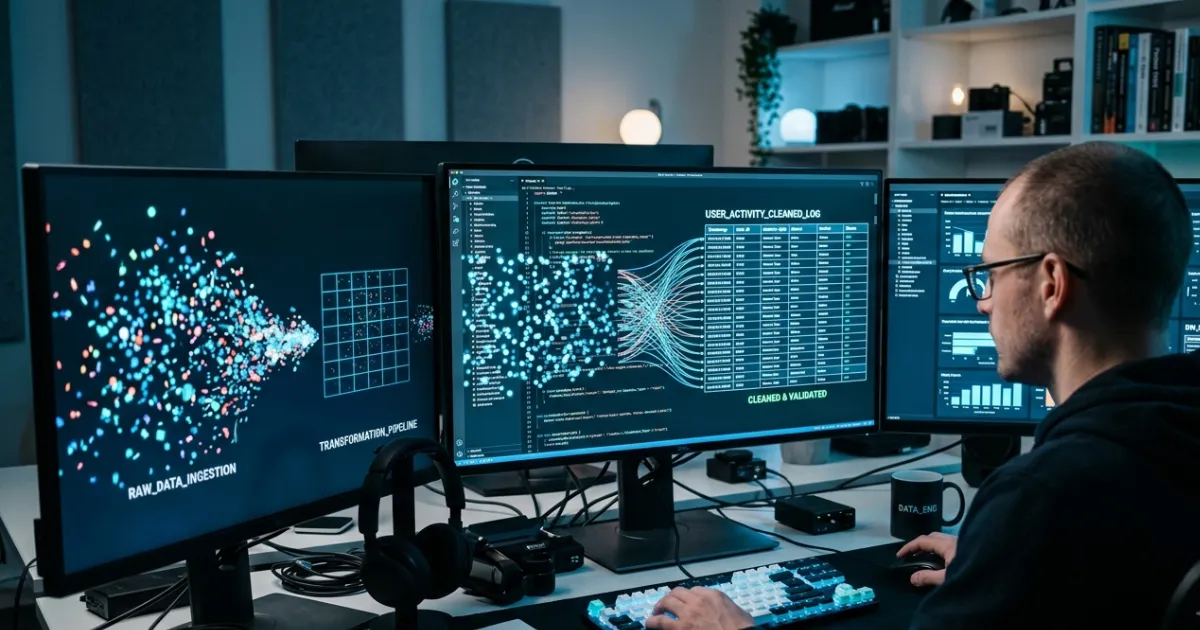
Big data preprocessing techniques for AI models turn raw, inconsistent inputs into something a model can actually learn from before training starts. Skip this step, or rush it, and you [...]

A deepfake is synthetic audio, video, or image content generated by AI to make a real person appear to say or do something they never did. AI deepfakes create ethical [...]

Generative AI content creation workflows are changing publishing timelines across marketing teams, but most available guidance describes tool capabilities rather than what the stages look like in production. This article [...]