
AI Agents vs. Chatbots: Avoid the Costly Mismatch
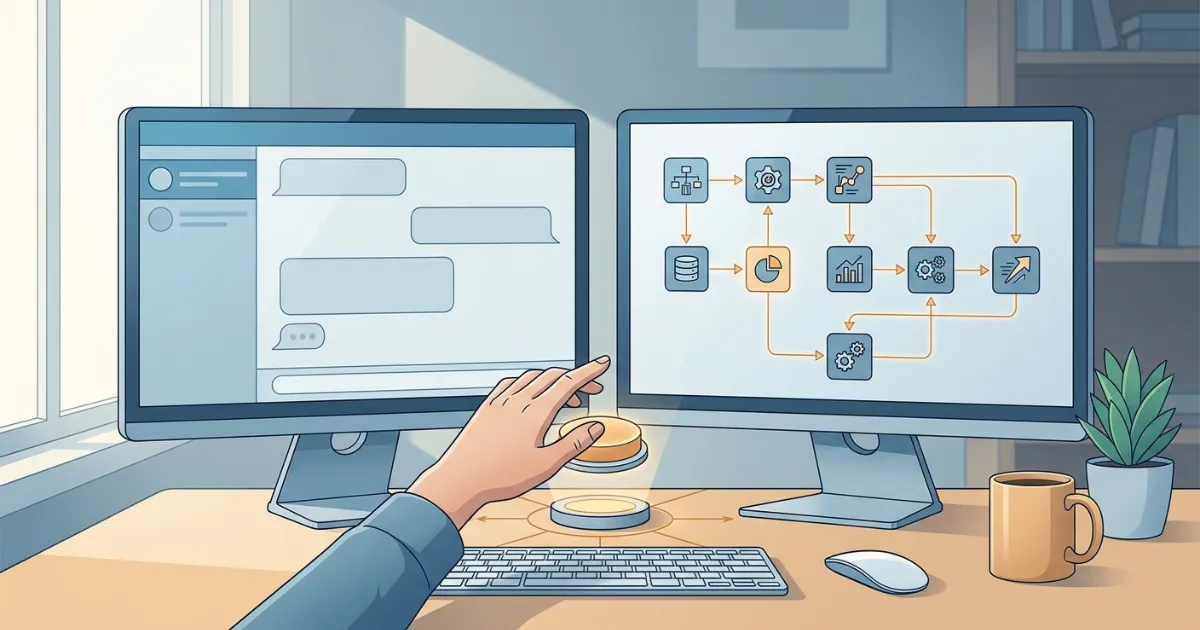
AI agents vs. chatbots comes down to who chooses the next step. A chatbot returns one reply per input. An AI agent runs a model in a loop, picks its own tools, and writes to live systems until the goal is met. The choice carries a price tag: Gartner’s June 2025 forecast says more than 40% of agentic AI projects will be canceled by the end of 2027, citing cost, unclear value, and weak risk controls. The practical way to choose is to rank each action by how hard it is to undo. Lookups suit a chatbot, drafts need a human sender, and refunds need an approval gate.
What Is the Difference Between AI Agents and Chatbots?
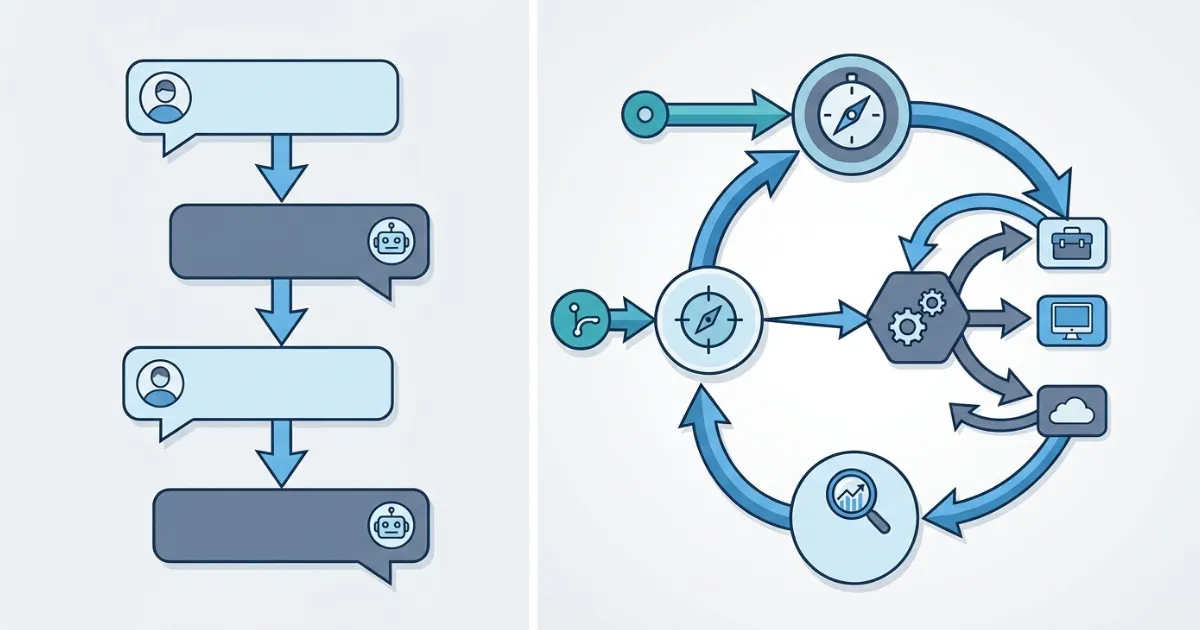
According to IBM’s AI agents explainer, first published in July 2024, an agent plans steps, calls tools, and checks results in a loop, while a chatbot returns one reply per input.
IBM defines a nonagentic chatbot as one with no tools, no memory, and no reasoning, so it needs a user prompt before every response. An agent splits a goal into subtasks, stores what it learned, and corrects its plan after each tool result. IBM calls this cycle Think-Act-Observe.
IBM also separates the interface from the framework. A chatbot is a modality, meaning a chat window, and agency is a technological framework. The same chat box can sit on top of a scripted bot or a tool-using agent, which is why two vendor demos can look identical.
The permissions behind the chat window, such as which systems it can write to, are what tell you which one you are buying.
AI Agents vs. Chatbots Comparison Table
The table below compares a nonagentic chatbot and an AI agent on eight concrete points, using IBM’s July 2024 definitions and OWASP’s December 2025 agentic risk list.
| Comparison point | Chatbot | AI agent |
|---|---|---|
| Who picks the next step | Developer script or one model reply | The model, after each tool result |
| Tool calls per task | 0 for a nonagentic chatbot | 1 or more, chosen by the model |
| Memory | Current session only | Past interactions stored across sessions |
| Unit of work | 1 question, 1 reply | 1 goal, split into subtasks |
| System access | Read-only in most deployments | Read and write on named systems |
| Typical failure | Wrong or outdated answer | Wrong action or repeated tool-call loop |
| Security reference | OWASP Top 10 for LLM Applications | OWASP Top 10 for Agentic Applications, published December 9, 2025 |
| Human checkpoint | Handoff to a person | Approval before high-impact actions (IBM guidance) |
The Undo Test: Choose by Reversibility, Not Intelligence
The undo test sorts every action a bot might take into four tiers by how hard it is to reverse, and the tier picks the right tool.
- Read. Look up an order status or quote a return policy. A chatbot handles this.
- Draft. Write a reply that a person reads and sends. A chatbot with a human sender handles this.
- Reversible write. Tag a ticket, move an appointment, reopen a case. An agent fits here, with every action logged.
- Irreversible write. Issue a refund, send a mass email, delete a record, place a trade. An agent belongs here only behind a human approval step.
IBM’s explainer recommends human approval before highly impactful actions and names mass emails and financial trading as examples. The ladder above is a working rule from this article, and no standards body publishes it.
Capability is the usual selection criterion, and it expires fast because models keep changing. A refund stays a refund. The tier of an action does not move when the model improves, so a decision made today still holds next year.
Run your last month of support tickets through the four tiers and count how many land in tier 4. That number is your approval workload, and it shows whether an agent saves time or only moves the work to a reviewer. Write the approval gate into your AI governance framework before the pilot starts.
When a Chatbot Is the Better Choice
Gartner’s June 2025 guidance assigns simple retrieval to assistants, which points to a chatbot for store hours, password-reset links, and order-status lookups.
A chatbot with read-only access gives an attacker almost nothing to take over. Intent matching and entity extraction are long-established NLP applications in business, and they fit this job well.
Cost favors the chatbot for scripted traffic too. If you send every conversation to an agent, you pay for a planning loop on questions a script already answers.
Many teams split the work. A chatbot answers the scripted majority and hands multi-step cases to an agent. The router at the front only has to classify a message, so a small model can do the job, and our guide to small language models covers where those fit. The weak point is the router itself. A misrouted refund request lands in a chatbot that cannot act on it, so test the handoff with real transcripts.
Where Plain Automation Beats AI Agents and Chatbots
Gartner’s June 2025 guidance says to use automation for routine workflows, so a fixed script with no model call can beat both an agent and a chatbot.
Take a task that runs the same six steps every time, such as copying a signed form into a records system and emailing a confirmation. No judgment is needed, so a model adds cost and a new way to fail. Gartner analyst Anushree Verma said in the same release that many use cases positioned as agentic today do not require an agentic implementation.
Plain automation also sits well on the undo ladder. Its behavior is fixed, so you can test every path before it reaches a tier 4 action. An agent can reach the same action by a path nobody tested.
The buying decision has three options: chatbot, agent, and plain automation. Ask which steps in the workflow need judgment, put an agent only there, and leave the rest as a script.
AI Agents vs. Chatbots: Three Myths Worth Dropping
Three popular claims about agents and chatbots conflict with published guidance from IBM, Gartner, and OWASP.
“An agent is a smarter chatbot.” IBM calls a chatbot a modality and agency a technological framework. A chat window can sit on top of either a scripted bot or a tool-using agent, so fluent replies say nothing about agency.
“More autonomy always means more value.” Gartner’s June 2025 forecast ties the expected cancellations to escalating costs, unclear business value, and inadequate risk controls. Gartner recommends pursuing agentic AI only where it delivers clear value or ROI.
“Agent security is chatbot security with extra steps.” OWASP published a separate Top 10 for Agentic Applications on December 9, 2025, because systems that plan, act, and decide across workflows carry risks that a text-only bot does not.
AI Agents vs. Chatbots Security Checks Before Production
The OWASP Top 10 for Agentic Applications, published December 9, 2025, is a peer-reviewed list built with more than 100 experts for systems that plan, act, and decide across workflows.
A chatbot that only reads a FAQ page exposes little. An agent holding API keys to a CRM, a billing system, and an inbox exposes all three. IBM’s explainer lists the controls that follow: activity logs of every tool call, a way to interrupt a running agent, unique agent identifiers for traceability, and human approval before high-impact actions.
IBM also names infinite feedback loops as a failure mode. An agent that cannot finish a plan may call the same tool repeatedly, and every call costs money. Set an iteration cap and a stopping condition before launch.
Give each agent its own identity and the narrowest permissions the task needs, the same logic behind zero trust network security. Treat every email, document, and web page the agent reads as untrusted input, since text it reads can contain instructions.
Before you sign a vendor contract, ask for the list of systems the agent can write to. That list is your real attack surface.
How to Spot Agent Washing and Judge ROI
Gartner’s June 2025 forecast estimates that only about 130 of the thousands of agentic AI vendors are real.
In the AI agents vs. chatbots market, agent washing is the rebranding of chatbots, assistants, and robotic process automation as agents without real agentic capability. Four questions expose it:
- Does the model decide whether to call a tool, or does a script decide?
- Does it keep state across more than one turn?
- Can it change approach after a failed step without a human re-prompting it?
- Which systems can it write to, and at which undo tier?
The money side is split. In a January 2025 Gartner poll of 3,412 webinar attendees, 19% reported significant agentic AI investment, 42% conservative investment, and 8% none, while 31% were waiting or unsure. On the upside, Gartner’s March 2025 customer service forecast expects agentic AI to resolve 80% of common service issues without human intervention by 2029, with a 30% cut in operational costs.
Both numbers are forecasts, so treat them as direction. Your pilot needs a measured cost per resolved task before it ends, or it joins the group Gartner expects to cancel.
People Also Ask
Is an AI agent just a smarter chatbot?
An AI agent is not just a smarter chatbot, because an agent chooses its own next step and a chatbot returns a reply. IBM describes agents as systems that plan subtasks, call tools, and adjust after each result. A chatbot, even a fluent one, answers and then waits for the next input.
Should you replace your chatbot with an AI agent?
Replace a chatbot with an AI agent only when the work needs decisions or writes to other systems. Gartner’s June 2025 guidance says to use agents when decisions are needed, automation for routine workflows, and assistants for simple retrieval. If your chatbot answers FAQ-shaped questions correctly, keeping it costs less and exposes less.
What are the key differences between AI agents and chatbots?
The key differences are control, tools, memory, and access. A chatbot follows a script or returns one reply, uses no tools, and keeps context for one session. An AI agent chooses its next step, calls tools, stores past interactions, and can write to systems such as billing or email, which is why it needs approval gates and tighter permissions.
Are AI agents more expensive than chatbots?
AI agents usually cost more per task, because each loop step is another model call and a stuck agent can repeat calls. IBM’s explainer names infinite feedback loops as a known risk and recommends interruptibility. Cap iterations, log every tool call, and track cost per resolved task.
How can AI agents help small businesses?
AI agents help small businesses most on repeatable multi-step work, such as qualifying leads, rescheduling appointments, or updating records across two or three tools. Start with reversible actions, keep a person approving refunds and mass emails, and let a chatbot cover the FAQ layer at lower risk.
FAQs
What is the quickest test to tell an AI agent from a chatbot?
In any AI agents vs. chatbots comparison, ask who decides the next step. If a developer’s script or a single model reply decides, you have a chatbot or a workflow. If the model chooses which tool to call after reading the last result, and can try a different approach after a failure, you have an agent. Then ask two follow-ups: does it keep state across turns, and which systems can it write to? A product that fails the first two questions is a chatbot with agent branding, which Gartner calls agent washing.
Can a chatbot and an AI agent run in the same support flow?
Yes, and many teams run them that way. A chatbot answers the scripted majority, and a router hands multi-step cases to an agent. The trade-off is a new failure point: a misrouted request lands in the wrong tool, and the customer repeats themselves. Test the handoff with real transcripts, and give the agent the full chat history so nobody asks the same question twice. Keep refunds and other tier 4 actions behind a human approval step even after the handoff works.
What security checks should an AI agent pass before it touches billing or email?
Start with the OWASP Top 10 for Agentic Applications from December 2025 as a test checklist. Then add the controls IBM recommends: activity logs for every tool call, interruptibility, unique agent identifiers, and human approval for high-impact actions. Scope the agent’s permissions to the task, cap iterations so a stuck loop cannot run up cost, and treat any text the agent reads as untrusted input. Before launch, run a red-team test where a planted instruction in an email tries to trigger a refund.
When does plain automation beat both a chatbot and an agent?
Plain automation wins when a task runs the same steps every time and needs no judgment, such as copying a signed form into a records system. Gartner’s June 2025 guidance points automation at routine workflows and agents at decisions. A script costs nothing per run beyond the platform, behaves the same on every run, and can be tested end to end. Add an agent only to the steps that need a decision, and leave the rest scripted.
How do you judge whether an AI agent project is worth funding?
Gartner’s June 2025 forecast names three causes of expected cancellations: escalating costs, unclear business value, and inadequate risk controls. Test your project against each one. Measure cost per resolved task in a pilot, define the business outcome in a number before launch, and list every system the agent can write to along with its undo tier. If the pilot cannot produce those three items, pause before scaling, because Gartner advises pursuing agentic AI only where it delivers clear value or ROI.


KEEP READING

Small language models (SLMs) are AI text models with roughly 1 million to 10 billion parameters, according to Hugging Face's 2025 overview, small enough to run on a phone, a [...]

AI ethics and bias mitigation mean defining fair outcomes, testing for gaps, and fixing them across the three stages in NIST's 2022 SP 1270. Those stages are pre-design, design and [...]

An AI governance framework is the set of policies, risk tiers, and approval gates that decides which AI systems your organization can ship and which ones need a human sign-off [...]
AI agents and chatbots get sold as the same thing, and that's costing companies money before they've deployed anything. A chatbot matches what you type to a pre-written answer and [...]

Generative AI tools for content creation now range from a general chatbot that drafts an email in ten seconds to a specialized platform that holds a brand's tone across a [...]