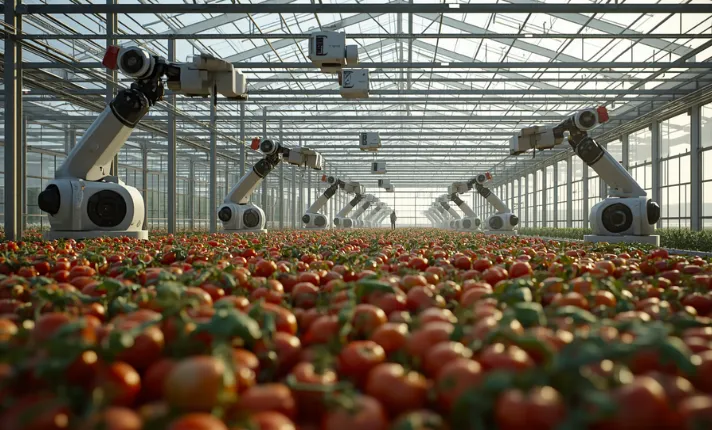
Robotics technology for automated harvesting is changing commercial farming faster than most growers expected. AI vision systems, robotic arms, autonomous tractors, and crop-scanning sensors now handle harvesting tasks that once required hundreds of seasonal workers. The shift is driven by labor shortages, rising operating costs, and pressure to reduce crop waste. Modern harvesting robots already pick tomatoes, strawberries, apples, and peppers in commercial greenhouses and orchards. The hard part is no longer building a robot that can pick fruit once in a lab. The hard part is building one that survives dust, heat, uneven lighting, mud, damaged crops, and nonstop harvest cycles in real farms.
Why Farms Are Investing in Harvesting Robots
Labor shortages pushed agricultural robotics from research projects into commercial deployment. In fruit farming, harvesting labor can account for more than 40% of total production costs in some regions.
Growers face three problems at the same time:
- Seasonal labor shortages
- Rising hourly wages
- Short harvest windows before crops spoil
Tomatoes, strawberries, and apples cannot wait several extra days for workers. Delayed harvesting directly reduces market value.
Modern robotic harvesting systems aim to solve four specific problems:
- Reduce dependency on seasonal labor
- Increase harvesting consistency
- Operate longer than human shifts
- Collect crop data during harvesting
Companies now deploy autonomous harvesting robots in greenhouse operations across Europe, Japan, and North America.
How Automated Harvesting Robots Actually Work
A harvesting robot combines several systems working together in real time.
Machine Vision Systems
Machine vision identifies crops using RGB cameras, depth cameras, infrared imaging, and AI models.
The robot must answer three questions instantly:
- Where is the fruit?
- Is it ripe?
- Can the robot reach it safely?
Tomato harvesting robots now use deep-learning models trained on thousands of crop images to detect ripeness and stem position.
Robotic Arms and End Effectors
The robotic arm moves toward the crop after the AI system identifies a target.
The end effector — usually called the gripper — performs the actual picking.
Common gripper designs include:
- Soft silicone finger grippers
- Vacuum suction systems
- Scissor-cutting mechanisms
- Hybrid gripping systems
Fruit damage remains one of the biggest engineering problems in robotic harvesting.
Navigation Systems
Outdoor harvesting robots use:
- GPS
- LiDAR
- SLAM mapping
- Stereo cameras
- Ultrasonic sensors
Greenhouse robots operate differently because the environment is controlled and structured.
Systems like Artemy navigate greenhouse lanes automatically while avoiding obstacles during harvesting cycles.
Crops Currently Harvested by Robots
Not every crop works well with automation.
The easiest crops for robots usually grow in predictable positions and controlled environments.
Crops With Commercial Robotic Harvesting
| Crop | Automation Difficulty | Main Challenge |
|---|---|---|
| Tomatoes | Medium | Stem cutting accuracy |
| Strawberries | High | Fruit bruising |
| Apples | High | Occlusion from leaves |
| Peppers | High | Irregular shape |
| Cucumbers | Medium | Vine navigation |
| Lettuce | Low | Uniform growth |
Tomatoes currently dominate commercial harvesting robotics because greenhouse layouts simplify navigation and crop visibility.
Core Technologies Behind Automated Harvesting
Computer Vision
Computer vision identifies fruit location, ripeness, disease, and picking angle.
Modern systems often use YOLO-based object detection models because they operate fast enough for real-time harvesting.
Research robots now combine semantic segmentation with keypoint detection to locate tomato stems more accurately.
Deep Learning Models
Harvesting robots continuously improve through AI training.
The system learns:
- Fruit shape variation
- Ripeness patterns
- Lighting changes
- Leaf obstruction behavior
One major issue is retraining costs. AI models trained on one tomato variety often lose accuracy when farms switch cultivars.
Most public articles barely mention this operational problem.
Edge Computing in Agriculture
Many farms still lack reliable high-speed internet.
Because of this, harvesting robots increasingly use onboard edge AI systems instead of cloud-only processing.
This reduces latency and prevents harvesting interruptions during weak connectivity periods.
Why Fruit Harvesting Is Harder Than Most People Think
Harvesting fruit sounds simple until a robot enters a real orchard.
Agricultural environments are messy.
Lighting changes every hour. Wind moves branches constantly. Mud blocks wheels. Dust damages sensors. Fruit grows behind leaves.
Humans adapt instantly to these conditions. Robots do not.
Occlusion Problems
Occlusion happens when leaves or branches partially hide fruit.
A robot may detect only 40% of an apple while trying to estimate its exact position.
This becomes a major problem for robotic arms because a few centimeters of positioning error can bruise the crop or miss the stem entirely.
Soft Fruit Damage
Strawberries and raspberries create another challenge.
Picking too softly causes slippage. Picking too hard damages the fruit.
Some advanced grippers now use adaptive force control systems that change gripping pressure dynamically during harvesting.
Weather and Sensor Failure
Outdoor systems struggle during:
- Rain
- Dust storms
- Fog
- Extreme sunlight
- Mud accumulation
This is one reason greenhouse automation has progressed faster than open-field harvesting.
The Ignored Problem: Crop Variety Changes Break AI Accuracy
Most articles discuss AI harvesting accuracy as if the model works forever after training.
That is not how commercial deployments operate.
A robot trained on one strawberry variety may lose detection performance after farms switch cultivars next season.
The reasons include:
- Different fruit color
- Different leaf density
- Different stem orientation
- Different cluster structure
Commercial operators often retrain AI systems several times per year.
That creates hidden operational costs:
- New image collection
- Manual labeling
- AI retraining
- Validation testing
Smaller farms frequently underestimate this expense during automation planning.
Robotic Grippers Decide Whether Harvesting Works
Most public discussions focus on AI software.
Experienced agricultural robotics engineers usually focus on grippers first.
Because harvesting success often depends more on physical handling than crop detection.
Vacuum Grippers
Vacuum systems work well for firm crops but struggle with porous or irregular fruit surfaces.
Soft Finger Grippers
Soft robotic fingers reduce bruising but slow harvesting speed.
That tradeoff matters commercially.
A robot that damages only 1% less fruit but harvests 40% slower may still lose money for growers.
Hybrid Grippers
New hybrid systems combine suction and flexible gripping mechanisms.
Research papers published during 2024 and 2025 showed better tomato handling performance using adaptive hybrid grippers with semantic segmentation systems.
Greenhouse Harvesting vs Open-Field Harvesting
Greenhouses dominate current commercial robotic harvesting for one reason: predictability.
Why Greenhouses Work Better
Greenhouses provide:
- Stable lighting
- Controlled crop spacing
- Flat surfaces
- Predictable rows
- Lower weather disruption
Robots can navigate more reliably in these environments.
Open Fields Remain Difficult
Outdoor farms create major complications:
- Uneven terrain
- Weather shifts
- Random plant growth
- Dust interference
- GPS drift under tree cover
Research systems for outdoor pepper harvesting still report relatively modest harvesting success rates compared to greenhouse systems.
Real Companies Building Harvesting Robots
Several companies now deploy commercial harvesting systems.
DENSO and Certhon
Artemy is one of the most advanced tomato harvesting robots currently deployed commercially.
The system performs:
- Ripeness detection
- Autonomous navigation
- Stem cutting
- Crate transfer
- Lane changing
The robot operates continuously inside greenhouse environments.
TTA-ISO
HarvAI focuses on greenhouse tomato harvesting.
The system reportedly handles up to 450 vines per hour with one operator supervising multiple robots.
ioCrops
HERMAI uses modular agricultural robotics for:
- Harvesting
- Crop scouting
- Spraying
- Transportation
The system integrates LiDAR SLAM navigation and AI vision systems.
The “It Depends” Problem: When Harvesting Robots Fail Financially
Automation does not guarantee profit.
Some harvesting robot deployments fail economically even when the technology works.
Small Farms Often Struggle With ROI
Large commercial greenhouses spread robot costs across massive production volumes.
Smaller farms cannot.
A harvesting robot may cost hundreds of thousands of dollars including:
- Hardware
- Software licensing
- Maintenance
- AI retraining
- Technical support
For smaller growers, seasonal labor may still remain cheaper.
Crop Density Changes Everything
Robots perform best in highly organized growing systems.
Sparse crop layouts reduce harvesting efficiency because robots spend too much time moving between targets.
Humans adapt better in inconsistent fields.
Insider Knowledge: What Farmers Actually Ask About
Most public articles focus on AI accuracy percentages.
Commercial growers usually ask different questions.
How Long Does Repair Take?
If a robot fails during a short harvest window, downtime becomes expensive immediately.
Replacement parts availability matters more than impressive demo videos.
Can the Robot Harvest at Night?
Night harvesting creates major operational advantages because temperatures remain lower and electricity costs may drop during off-peak periods.
Systems like Artemy specifically promote continuous day-and-night operation.
Who Cleans the Sensors?
Dust, humidity, and plant residue regularly interfere with agricultural cameras and LiDAR systems.
Maintenance labor never disappears completely after automation.
Myth vs Reality in Automated Harvesting
Robots Will Replace All Farm Workers
Most commercial systems still require human supervision.
Humans currently handle:
- Exception cases
- Maintenance
- System calibration
- Crop quality checks
- Remote teleoperation
The industry is moving toward hybrid human-robot operations instead of fully worker-free farms.
AI Can Detect Every Ripe Fruit Perfectly
Even advanced systems struggle with:
- Heavy leaf coverage
- Fruit overlap
- Irregular ripening
- Harsh lighting
Some field systems still show harvesting success limitations in outdoor environments.
Demo Videos Represent Real Commercial Speed
Many robotics demos operate under ideal conditions.
Real farms introduce:
- Damaged crops
- Mud
- Weather
- Dense foliage
- Sensor contamination
Reddit discussions from agricultural robotics communities repeatedly mention this gap between lab demonstrations and field reliability.
Advanced Multi-Arm Harvesting Systems
Single-arm robots limit harvesting speed.
New systems increasingly test multi-arm architectures.
Why Multi-Arm Systems Matter
Multiple robotic arms allow:
- Simultaneous harvesting
- Reduced idle movement
- Better crop throughput
- Parallel picking operations
Collision Avoidance
The software challenge becomes much harder.
The robot must coordinate:
- Arm trajectories
- Crop positions
- Obstacle movement
- Human worker proximity
Real-time path planning becomes computationally expensive in dense crop environments.
The Hidden Infrastructure Problem Most Articles Ignore
Rural infrastructure still limits large-scale agricultural robotics adoption.
Weak Internet Connectivity
Many farms still operate with poor internet access.
Cloud-dependent systems may fail during unstable connectivity periods.
Edge AI Is Becoming Mandatory
Because of connectivity limitations, many robots now process data locally instead of sending everything to cloud servers.
This increases hardware costs but improves reliability.
Teleoperation Is More Common Than Public Marketing Suggests
Some advanced systems still rely on remote human intervention during difficult harvesting situations.
The robot handles normal operations autonomously while humans assist during edge cases.
Battery Life and Energy Constraints
Battery endurance limits harvesting operations more than most articles mention.
High Power Consumption Sources
Harvesting robots consume energy through:
- Robotic arm movement
- GPU AI processing
- Sensor systems
- Cooling systems
- Autonomous navigation
Swappable Battery Systems
Some manufacturers now use modular battery packs to reduce downtime.
Instead of charging robots for several hours, workers replace battery modules directly in the field.
Advanced Optimization for Experienced Operators
Farms with multiple years of robotic harvesting experience focus on optimization layers beginners rarely discuss.
Throughput Per Meter Matters More Than Raw Speed
A fast robot becomes inefficient if navigation delays waste time between crops.
Experienced operators optimize:
- Greenhouse row spacing
- Crop arrangement
- Lane width
- Harvest scheduling
to improve throughput per meter traveled.
Data Collection Creates Secondary Value
Harvesting robots continuously generate farm data.
Growers now use harvesting systems for:
- Yield forecasting
- Disease detection
- Ripeness mapping
- Labor planning
- Future planting decisions
This secondary data value may eventually become as important as labor reduction itself.
What Automated Harvesting Will Look Like by 2030
The next phase of agricultural robotics will probably focus on semi-autonomous systems instead of fully autonomous farms.
Expected developments include:
- Smaller modular robots
- AI-assisted human harvesting
- Swarm robotics
- Better soft-fruit grippers
- Faster onboard AI chips
- Autonomous fleet coordination
Human workers will likely remain part of harvesting operations for years, especially in difficult outdoor crops.
The biggest change will be fewer workers managing larger robotic fleets.
People Also Ask
Q: Can robots fully replace human fruit pickers?
No. Current harvesting robots still struggle with irregular crops, changing weather, leaf occlusion, and damaged fruit. Most commercial systems require human supervision, maintenance, and intervention during edge cases.
Q: Which crops are easiest to harvest with robots?
Greenhouse tomatoes and lettuce currently work best because they grow in predictable environments with controlled spacing and stable lighting. Strawberries and apples remain harder because they bruise easily and grow in dense foliage.
Q: How accurate are AI harvesting robots?
Accuracy varies heavily by crop and environment. Controlled greenhouse systems perform far better than outdoor orchards. Some advanced tomato systems now report high harvesting success rates under commercial greenhouse conditions.
FAQ
Q: Why are greenhouse farms adopting harvesting robots faster than outdoor farms?
A: Greenhouses provide stable lighting, organized crop rows, predictable spacing, and fewer weather disruptions. These conditions make navigation and AI crop detection far easier. Outdoor farms introduce mud, wind, uneven terrain, heavy sunlight variation, and unpredictable plant growth patterns that reduce robotic efficiency.
Q: What is the biggest technical problem in robotic harvesting today?
A: Fruit handling remains one of the hardest problems. Detecting fruit with AI is improving quickly, but physically gripping and removing delicate produce without bruising or tearing stems remains difficult. Gripper design now receives major research attention because poor handling directly reduces crop value.
Q: Do harvesting robots work continuously without breaks?
A: Some greenhouse systems now operate nearly 24/7, but maintenance interruptions still happen regularly. Cameras require cleaning, robotic arms need calibration, and batteries must be replaced or charged. Commercial systems still involve human oversight during long harvesting cycles.
Q: Are harvesting robots affordable for small farms?
A: Often no. Large farms recover automation costs faster because robots operate across bigger production volumes. Smaller growers may struggle to justify hardware, maintenance, AI retraining, and technical support costs unless labor shortages become severe.
Q: What role does AI play in automated harvesting?
A: AI handles crop detection, ripeness estimation, obstacle recognition, navigation, and robotic movement planning. Deep-learning models allow robots to adapt to changing crop conditions, but these systems still require retraining when crop varieties or growing environments change significantly.

KEEP READING
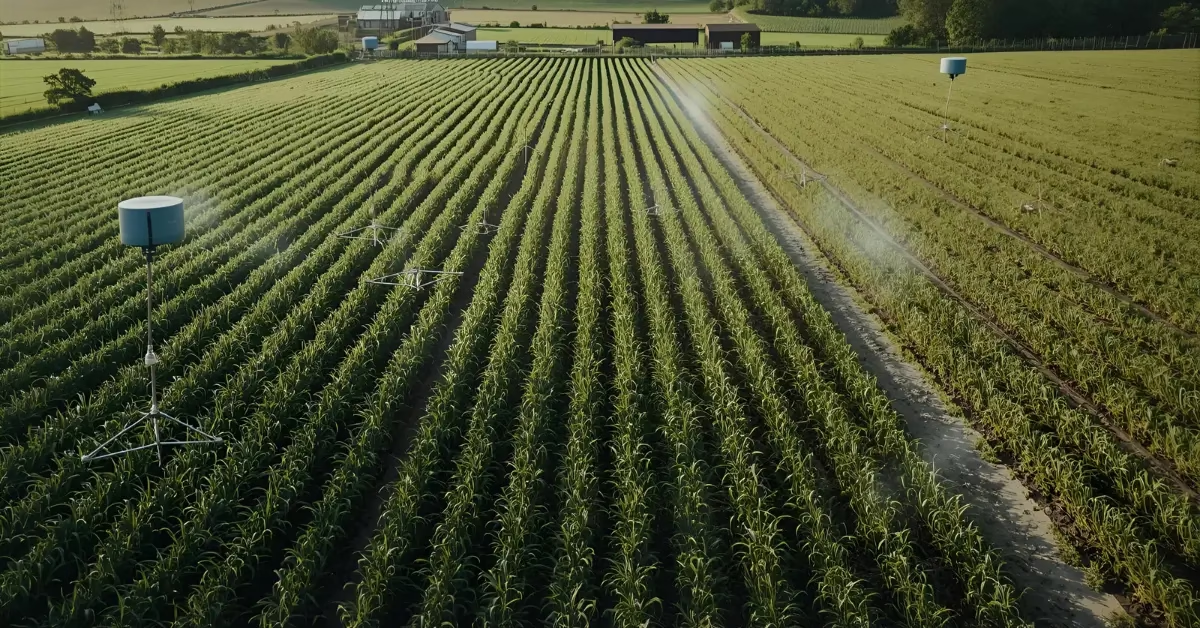
Pest control technology for modern farming has changed the way growers protect their crops. New tools use sensors, smart systems, and gentle methods that help reduce loss without harming soil [...]
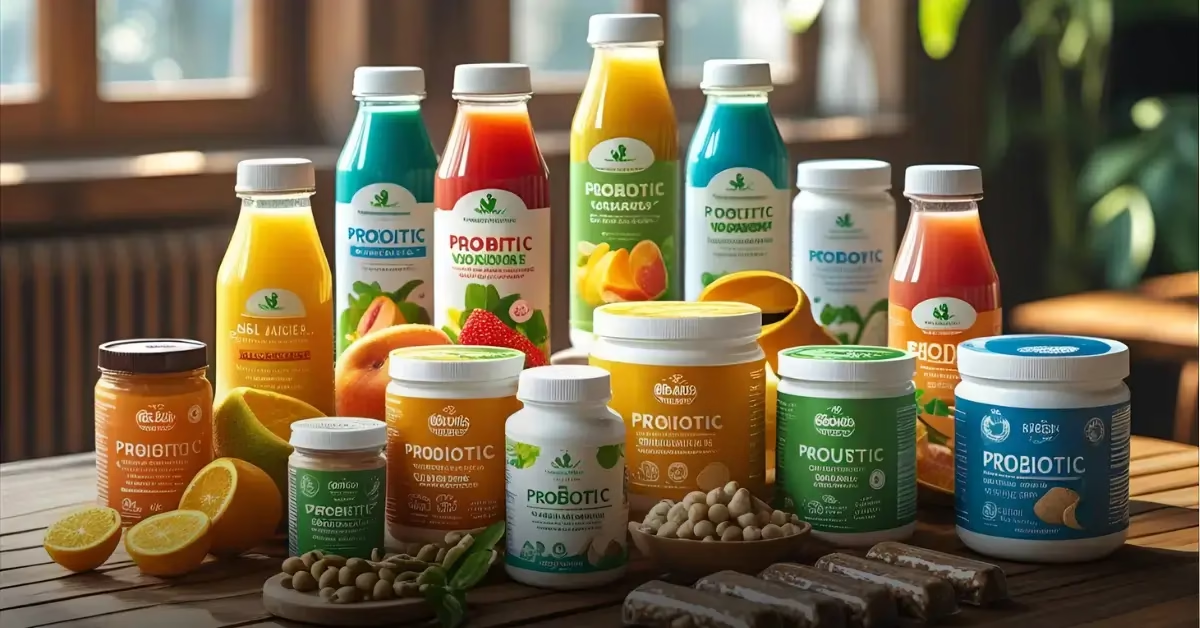
Functional foods market growth in Asia‑Pacific is surging as health‑conscious consumers seek products that deliver added nutritional benefits beyond basic sustenance. From immunity‑boosting beverages in China to fortified snacks in [...]
Healthy soil is the foundation of productive agriculture. From nutrient cycling to water retention, soil health dictates crop vigor and yield. In recent years, soil health monitoring sensor technology has [...]
Imagine a world where skyscrapers aren’t just for people—they’re for plants. By 2025, vertical farming will produce 30% of urban leafy greens, slashing water use by 95% compared to traditional farms. This [...]