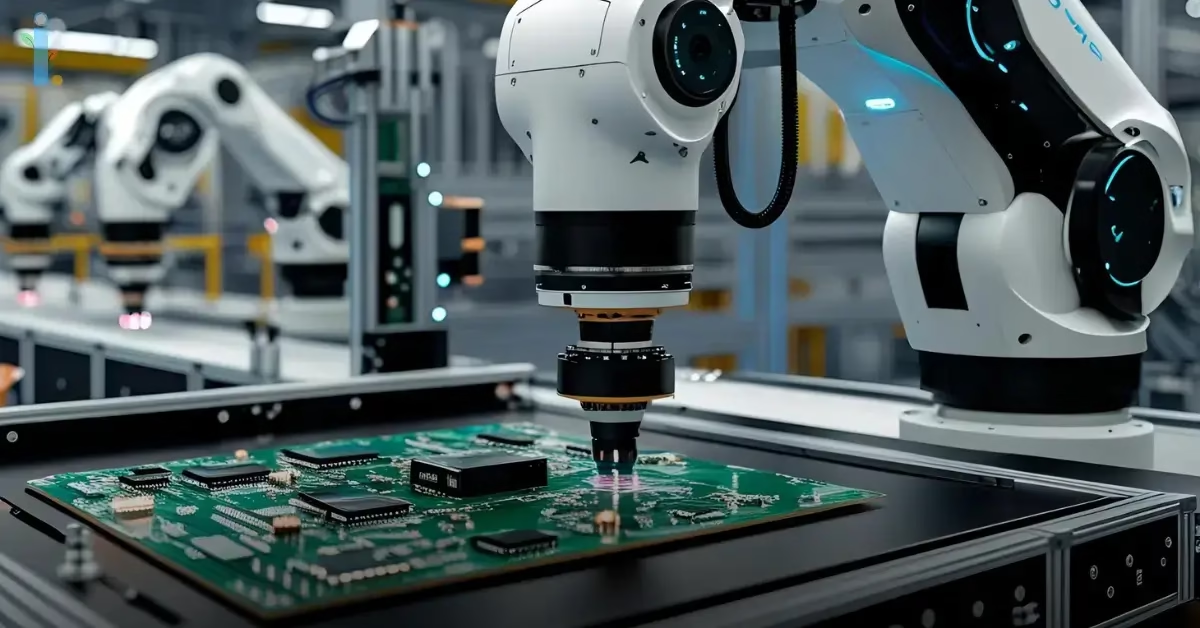
Robots no longer operate blindly. With vision system technology, they perceive, analyze, and react to their environment—transforming factories, hospitals, and homes. This guide dives deep into how robotic “eyes” and “brains” merge to create unprecedented precision.
Fun fact: Vision-equipped robots can detect defects 0.05mm wide—finer than a human hair!

What Exactly Is Vision System Technology in Robotics?
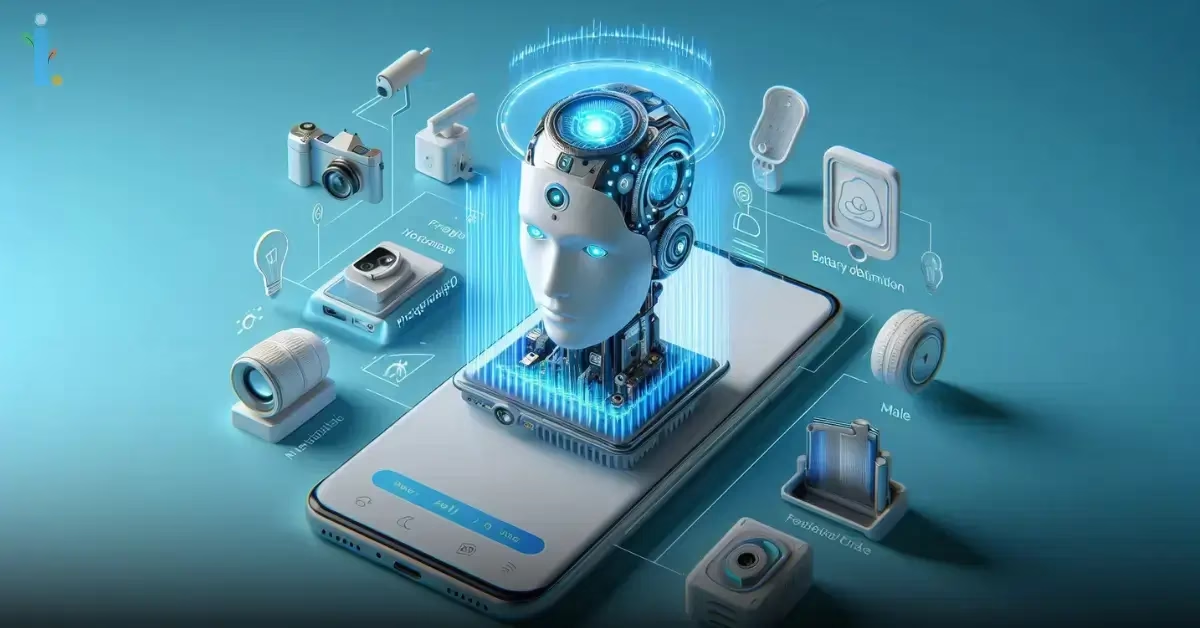
Robotic vision systems combine hardware (cameras, sensors) and software (AI algorithms) to:
-
Replicate human visual perception
-
Interpret complex environments in real-time
-
Make autonomous decisions
Key differentiator vs. traditional sensors:
While proximity sensors detect presence, vision systems identify what an object is, its orientation, and defects.
Industries transformed:
-
Manufacturing (76% adoption for quality control)
-
Logistics (Amazon’s Kiva robots)
-
Precision agriculture (automated crop scanning)
How Robotic Vision Systems Work: A 5-Step Breakdown
Core Components Powering Robotic Vision
-
Cameras
-
2D: Low-cost, ideal for barcode reading (e.g., Cognex)
-
3D: Uses structured light or time-of-flight (ToF) for depth mapping
-
Specialized: Thermal (fire inspection), hyperspectral (food sorting)
-
-
Lighting Systems
-
LED strobes freeze motion (critical for conveyor speeds >1m/s)
-
Polarized filters reduce glare on metallic surfaces
-
-
Lenses & Optics
-
Key specs: Focal length (e.g., 12mm for close inspection), F-number (light intake)
-
Distortion correction via software (OpenCV calibration)
-
-
Processors
-
Edge computing: NVIDIA Jetson for low-latency inference
-
FPGAs: Process 4K video at <2ms latency
-
-
Software Stack
-
OpenCV: Open-source library for real-time image processing
-
YOLO/CNN models: Object detection at 60 FPS
-
The Vision Processing Workflow
-
Image Acquisition
-
Capturing frames under controlled lighting
-
-
Pre-processing
-
Noise reduction, contrast enhancement
-
-
Feature Extraction
-
Edge detection (Canny algorithm), blob analysis
-
-
Decision-Making
-
AI classifies objects (e.g., “defective gear” vs. “pass”)
-
-
Execution
-
Robotic arm adjusts grip force based on material recognition
-
3 Types of Vision Systems Dominating Robotics
2D Vision Systems: Speed Over Depth
-
Best for: Surface inspection, OCR, barcode reading
-
Limitation: Struggles with reflective surfaces
-
Use case: PCB manufacturing defect detection (accuracy: 99.2%)
3D Vision Systems: Seeing the World in Depth
| Technology | How It Works | Accuracy |
|---|---|---|
| Stereo Vision | Dual cameras (human eye mimic) | ±0.1mm |
| Structured Light | Projected laser patterns | ±0.01mm |
| Time-of-Flight (ToF) | Measures light pulse travel time | ±1cm |
Real-world application: Bin picking—Fanuc’s 3DV/600 identifies unordered parts in 0.4 seconds.
Hyperspectral Imaging: Beyond Visible Light
-
Scans 100+ spectral bands (vs. RGB’s 3)
-
Detects chemical composition (e.g., rotten produce)
-
Breakthrough: John Deere harvesters identifying crop diseases
Game-Changing Applications Across Industries
Industrial Automation
-
Quality Control: BMW’s vision systems inspect 5,000 weld points/car in 45 seconds
-
Packaging: Cobots with vision adapt to irregularly shaped items
Autonomous Mobile Robots (AMRs)
-
Warehousing: LIDAR + vision fusion for obstacle avoidance
-
Agricultural Drones: Multispectral cameras map crop health (NDVI analysis)
Medical Robotics
-
Surgery: Da Vinci’s 3D endoscopic vision enables sub-millimeter incisions
-
Lab Automation: Vision-guided pipettes handle micro-liter samples
Consumer Robotics
-
Vacuum Bots: iRobot’s vSLAM navigates using camera landmarks
-
Social Robots: SoftBank’s Pepper uses facial recognition for engagement
Why Vision Systems Are Non-Negotiable in Modern Robotics
-
Precision: Achieves tolerances of ±0.02mm (impossible manually)
-
Speed: Processes decisions in <50ms
-
Cost Savings: Reduces waste by 30% in manufacturing
-
Safety: Handles toxic/hazardous environments (e.g., nuclear inspections)
H2: Critical Challenges & Solutions
| Challenge | Cutting-Edge Solution |
|---|---|
| Variable lighting | Adaptive HDR imaging |
| Computational load | Edge AI processors (Google Coral) |
| Real-time latency | FPGA-accelerated inference |
| Occlusions | Multi-camera sensor fusion |
Example: Tesla’s Optimus robot uses neural radiance fields (NeRFs) to “imagine” hidden object parts.
The Future: 5 Trends Reshaping Robotic Vision
-
Neuromorphic Vision Sensors:
-
Event-based cameras (like Prophesee) consuming 1,000x less power
-
-
AI-Integrated Edge Chips:
-
Qualcomm’s RB5 platform enabling on-device transformer models
-
-
5G-Powered Swarm Vision:
-
Drone fleets sharing real-time 3D maps (construction sites)
-
-
Generative AI for Training:
-
Synthesizing defect images to train vision models faster
-
-
Quantum Imaging:
-
Detecting objects beyond line-of-sight (DARPA research)
-
How to Choose Your Vision System: A Buyer’s Checklist
-
Accuracy Needs: Sub-millimeter? Structured light. Object detection? 2D.
-
Environment: Dusty? IP67-rated cameras. Low-light? IR illumination.
-
Budget: $5K (basic 2D) to $100K (AI-3D hybrid systems)
-
Integration: ROS-compatible systems simplify deployment
People Also Ask
Can vision systems work without AI?
Yes—for simple tasks like barcode scanning. Complex tasks (defect detection) require machine learning.
What’s the lifespan of robotic vision hardware?
Industrial-grade cameras last 5–8 years; software updates extend relevance.
How do vision systems handle fast-moving objects?
Global shutter cameras (vs. rolling shutter) capture 1,000+ FPS without motion blur.
FAQs
Do vision systems replace human workers?
They handle repetitive tasks, freeing humans for complex problem-solving—boosting productivity 40%.
What’s the ROI for implementing robotic vision?
Typical payback: 6–18 months via reduced scrap and faster throughput.
Can I retrofit vision onto existing robots?
Yes—vendors like Keyence offer bolt-on vision kits compatible with ABB/Fanuc arms.
Which programming languages dominate robotic vision?
Python (OpenCV), C++, and ROS frameworks.
Are there ethical concerns?
Privacy (surveillance) and bias (training data) require proactive governance.
Conclusion
Vision system technology is robotics’ critical sensory upgrade—enabling machines to interpret our world with superhuman precision. As AI, 5G, and neuromorphic hardware converge, expect vision-powered robots to enter surgery rooms, farms, and homes with unprecedented autonomy.


KEEP READING

Robotic process automation in business operations uses software bots to do repetitive, rule-based work inside digital systems, such as data entry, file moves, transaction updates, and screen-to-screen transfers. IBM, Microsoft, [...]
Human robot interaction challenges and solutions for seamless collaboration are becoming central to modern automation. As robots move out of isolated cages and into shared human spaces, the focus has [...]
Human‑robot collaboration safety features for cobots have never been more crucial as industries adopt collaborative robots to boost productivity. This comprehensive guide explains how cobots use power‑and‑force limiting, advanced sensing, [...]
Imagine a fleet of drones working together like a colony of ants—each tiny robot making decisions based on its environment, yet collectively achieving monumental tasks. This is swarm robotics: a system [...]