Table of Contents
Technology used in Starlink communication satellites for low latency internet has transformed how the world thinks about satellite broadband. Instead of the slow, lag-heavy connections people once associated with satellite internet, Starlink delivers near-fiber latency and high-speed internet even in the most remote places on Earth. This article breaks down the exact technologies that make that possible—LEO satellites, phased-array antennas, laser links, dynamic routing, advanced frequency bands, and more. If you want to understand why Starlink performs better than traditional satellite systems and how it achieves such low latency, this guide covers everything in clear, simple, actionable insights.
Why Traditional Satellite Internet Was Always Slow
Before we understand Starlink’s innovation, we must look at the problem it set out to solve.
Distance = Latency
Traditional satellite internet relied on geostationary satellites (GEO) placed 35,786 km above Earth. The long distance meant signals had to travel over 70,000 km round trip, causing:
-
500–700+ ms latency
-
Laggy video calls
-
Slow web browsing
-
Nearly impossible online gaming
-
High jitter and packet loss
This was the Problem. Most users felt frustration (the Agitation) because GEO systems simply couldn’t handle real-time applications.
Starlink answers this with a system engineered from scratch for speed.
The Core Shift — Low Earth Orbit (LEO) Satellites
What is LEO and Why It Changes Everything
Starlink’s satellites orbit at around 540–560 km above Earth, dramatically closer than GEO satellites.
How This Reduces Latency
Shorter distance = faster signal travel.
-
GEO: ~35,786 km
-
LEO: ~550 km
This reduces the signal trip from 70,000 km to just about 1,000 km, cutting latency from 600 ms → 20–40 ms.
The Answer: cut the distance.
The Solution: put satellites where signals can reach them quickly.
The Constellation Architecture
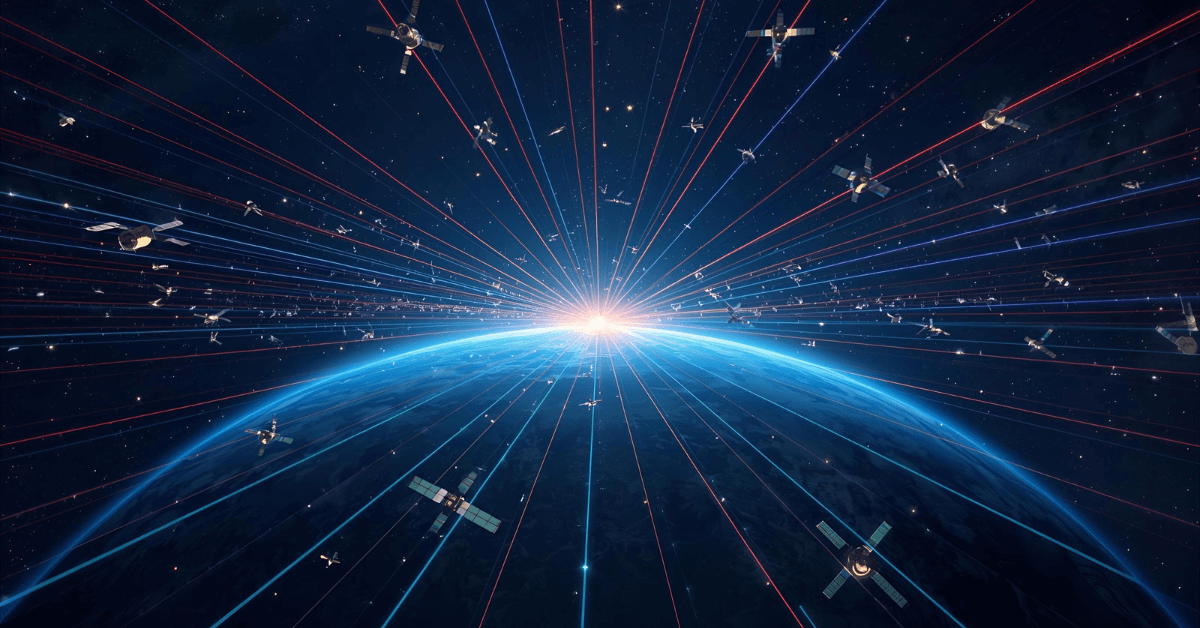
Unlike older systems using 1–3 satellites, Starlink deploys thousands in coordinated orbital shells.
Benefits of a Mega-Constellation
-
Full global coverage
-
Continuous hand-offs between satellites
-
Redundancy—if one satellite fails, others take its place
-
No single point of failure
Starlink behaves more like a cellular network in space than a traditional satellite network.
Core Technology Used in Starlink Communication Satellites for Low Latency Internet
This is the heart of the article—each subtopic below is a technology Starlink uses to achieve low latency internet.
hased-Array Antennas (Beamforming Technology)
Starlink satellites and user terminals (“Dishy”) use phased-array antennas, which differ from traditional mechanical dishes.
How Phased Arrays Work
-
Made of many small antennas
-
Electronically steer beams by adjusting phase
-
No moving parts
-
Can instantly lock onto fast-moving satellites
-
Maintain a steady connection during satellite switching
Why This Matters for Latency
Instant beam steering ensures no delay due to mechanical movement.
Faster tracking = less packet loss = smoother performance.
Electronically Steered User Terminals
Your Starlink dish is not “just a dish”.
It includes:
-
A full phased-array system
-
GPS-based sky scanning
-
Auto-tracking for satellite switching
-
AI-assisted beam selection
This keeps latency consistent even as satellites zip overhead at 27,000 km/h.
Advanced Radio Frequency Bands (Ku & Ka Band)
Starlink uses:
-
Ku-band (12–18 GHz) for user uplink/downlink
-
Ka-band (26–40 GHz) for interconnection and gateways
Why These Bands Matter
-
Wider bandwidth
-
Lower interference
-
Higher data rates
-
More directional beams (less noise)
Using these high-frequency bands allows faster data transmission with reduced delay.
Optical Inter-Satellite Links (Laser Links)
This is one of Starlink’s biggest breakthroughs.
What Are Laser Links?
-
Satellites connect to each other using lasers
-
Data travels between satellites at near light speed
-
No need for ground stations for long-distance routes
Why Laser Links Reduce Latency
Example:
Sending data from the US to Europe via fiber requires traveling thousands of kilometers in the ocean, with slower speeds due to glass fiber constraints.
Laser links:
-
Create a mesh network in space
-
Send data in a straight line
-
Reduce the number of hops
-
Lower overall latency
Starlink’s laser mesh is faster than many fiber routes.
Smart Routing Algorithms & Network Automation
Starlink satellites use dynamic routing:
-
Automatically choosing fastest path
-
Avoiding congestion
-
Minimizing distance and hops
-
Reducing packet retransmission
This is similar to how modern routers pick the best route—but in orbit.
Real-World Performance — What Starlink Users Actually Experience
Latency Numbers
Typical Starlink results from real users:
-
20–40 ms latency
-
50–300+ Mbps download
-
Up to 40 Mbps upload
These results vary based on:
-
Location
-
Satellite density overhead
-
Weather
-
Dish obstructions
Even with variations, performance is drastically better than traditional satellite internet.
What Low Latency Enables
With Starlink, users in remote areas can now do:
1. Smooth video conferencing
Zoom, Teams, Google Meet—no major delays.
2. Online gaming
FPS games become playable due to sub-50 ms ping.
3. Remote work
Cloud tools, VPN, and file transfers all operate normally.
4. 4K streaming
Low jitter ensures stable streaming.
5. Maritime, aviation & rescue communications
Fast connectivity anywhere on Earth.
Technical Challenges & Limitations
Starlink is advanced, but not perfect.
Handover Challenges
Satellites whiz overhead quickly.
Each dish must hand off to a new satellite every few minutes.
Handoffs can cause:
-
Momentary packet loss
-
Minor jitter
-
Occasional latency spikes
Network Congestion
As more users sign up, satellites must share bandwidth.
Starlink mitigates this using:
-
More satellites
-
Higher capacity next-generation satellites
-
Smarter beam allocation
Weather & Obstructions
Rain, snow, or trees can reduce performance.
Gateway Limitations
Without laser links, satellites must use ground stations.
If no station is nearby, routing distance increases.
Future Technologies Starlink Is Developing
Starlink V2 & V2 Mini
Next-gen satellites include:
-
Higher throughput
-
Stronger lasers
-
More powerful antennas
-
Better error correction
-
Direct-to-cell capability
Global Optical Backbone
SpaceX is building a global laser-connected backbone in space to rival undersea fiber.
Large-Scale Automation
More AI-driven satellite routing → better latency, fewer dropouts.
Integration With Mobile Networks
Direct-to-smartphone satellite service is in development.
People Also Ask
How do Starlink satellites avoid high latency?
By using LEO satellites, laser links, and phased-array antennas that reduce signal travel distance and optimize routing.
Can Starlink beat fiber internet?
Fiber is still slightly faster (5–10 ms latency), but Starlink comes close and beats fiber in remote regions where fiber isn’t available.
What is the average Starlink latency?
Most users experience 20–40 ms, much lower than traditional satellite internet.
FAQ
Does Starlink work in bad weather?
Light rain is manageable, but heavy storms or snow can reduce speed and increase latency due to signal absorption.
Why does Starlink require a clear view of the sky?
Obstructions block the line-of-sight path between the dish and satellites, causing dropouts.
How does Starlink connect long distances without fiber?
Using optical inter-satellite laser links, satellites relay data to each other until reaching a ground station near the destination.
Is Starlink good for gaming?
Yes—thanks to low latency (20–40 ms), gaming is far better than any past satellite internet.
Will Starlink replace fiber internet?
Not everywhere.
But in remote, rural, maritime, and aviation sectors, Starlink already outperforms traditional options.
Why Starlink’s Technology Matters
The technology used in Starlink communication satellites for low latency internet represents a major leap forward in global connectivity. By combining low-earth orbit satellites, phased-array antennas, dynamic beamforming, high-frequency radio bands, and optical laser links, Starlink delivers internet performance once thought impossible over satellite networks. It enables real-time communication, gaming, remote work, and high-speed browsing anywhere on Earth—something traditional networks could never achieve.
As more satellites launch and technology evolves, Starlink is set to redefine global internet access, bridging the digital divide and bringing modern connectivity to every corner of the world.

Author: Ahmed UA.
With over 13 years of experience in the Tech Industry, I have become a trusted voice in Technology News. As a seasoned tech journalist, I have covered a wide range of topics, from cutting-edge gadgets to industry trends. My work has been featured in top tech publications such as TechCrunch, Digital Trends, and Wired. Follow Website, Facebook & LinkedIn.

KEEP READING

Aerospace technology advanced propulsion systems are at the heart of humanity’s push for faster, safer, and more sustainable flight. From hypersonic passenger jets to deep-space missions, propulsion is the make-or-break [...]

Simulation and modeling tools in aerospace are the engines that power today’s most advanced aircraft and spacecraft designs. From predicting airflow over a wing to simulating the thermal stresses inside [...]
Processing satellite imagery is a cornerstone of modern Earth observation, defense, and scientific exploration. Whether you are a remote-sensing engineer, a geospatial analyst, or simply curious about how satellites turn [...]
Imagine a world where high-speed internet reaches the most remote villages, ships at sea, and airplanes mid-flight. This is the promise of satellite mega-constellations—networks of thousands of low-Earth orbit (LEO) satellites [...]