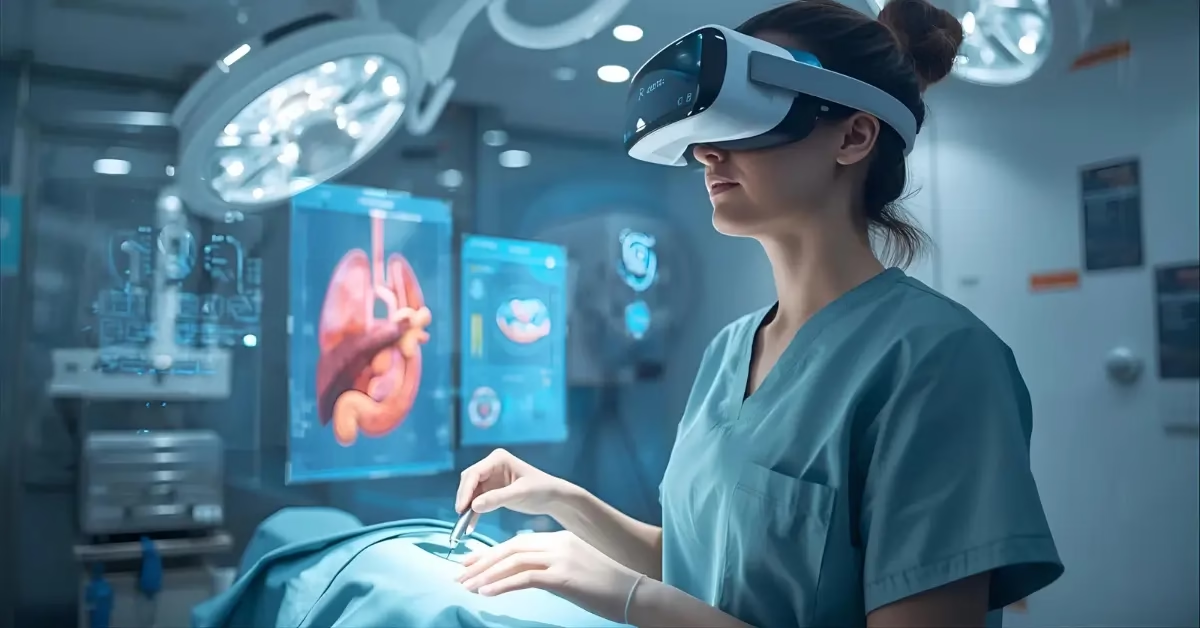
VR and AR applications in medical training and therapy are transforming how doctors learn, patients heal, and healthcare systems operate. These immersive technologies simulate real-life scenarios where medical students can practice surgeries without risk, and patients can undergo rehabilitation or anxiety therapy in engaging, controlled environments. With rapid advancements in AI, haptic feedback, and spatial computing, VR and AR are bridging the gap between theory and practice, creating a safer, smarter, and more effective healthcare ecosystem.
Understanding VR and AR in Modern Medicine
What Is Virtual Reality (VR)?
Virtual Reality immerses users in a fully digital 3D environment through a headset, replacing the physical world entirely. In medicine, VR lets learners perform surgeries or explore anatomy interactively, without needing a live patient.
What Is Augmented Reality (AR)?
AR overlays digital elements (like 3D organs or guidance markers) onto the real world through devices such as Microsoft HoloLens. It enhances rather than replaces reality; surgeons can see both the patient and real-time data during operations.
Why It Matters Now
The pandemic accelerated virtual adoption in healthcare. Studies show that VR-based medical training improves knowledge retention by up to 80%, while AR-assisted surgeries have shown 20% faster completion times with reduced errors. These stats explain the global VR/AR healthcare market, which is projected to exceed $19 billion by 2030 (source: Fortune Business Insights).
Medical Training: Transforming Learning through Immersion
Anatomy and Physiology in 3D
Gone are the days when medical students depended solely on cadavers. VR offers lifelike anatomical models that can be dissected infinitely without damage. AR overlays 3D organs on physical models, allowing learners to see live functionality like blood flow or muscle contractions.
Example:
Platforms like 3D Organon and Human Anatomy VR help students manipulate organs in real time, observe systems interact, and repeat lessons as often as needed, leading to deeper understanding.
Surgical Simulation and Preoperative Planning
VR allows surgeons to rehearse operations before entering the OR. Using patient scans, they can practice complex procedures in a safe, simulated space. AR complements this by projecting guidance lines and vitals onto the surgical field during actual operations.
Technical Insight:
Modern headsets like Meta Quest 3 and HTC Vive Pro deliver resolutions above 2K per eye with 90–120 Hz refresh rates, reducing motion sickness and enhancing realism.
Real-World Example:
The Osso VR platform reports that trainees who practiced in VR performed surgeries 29% faster and made six times fewer errors than traditional trainees.
Emergency & Rare-Case Training
In emergencies, quick decisions save lives. VR replicates trauma scenes — heart attacks, car accidents, or code blue situations, letting doctors and nurses practice responses collaboratively. Such simulation-based training builds confidence for rare, high-pressure scenarios.
Evidence of Effectiveness
Meta-analyses (such as those in JMIR Medical Education, 2023) conclude that VR training improves procedural accuracy and self-efficacy. However, researchers also note the need for standardized assessment tools and long-term outcome studies, gaps we’ll explore later.
VR and AR in Therapy and Rehabilitation
Physical Rehabilitation
VR turns rehabilitation into engaging “serious games.” Stroke survivors, for example, can relearn limb movements by interacting with virtual objects. Motion sensors and haptic gloves record progress and provide instant feedback.
Case Example:
A Stanford University study found that patients using VR-based rehabilitation recovered 30% faster than those following traditional exercises.
AR in Action:
AR apps display virtual footsteps for gait training, guiding patients in real space with visual cues, particularly helpful for Parkinson’s patients.
Mental Health & Pain Management
VR exposure therapy safely recreates triggering environments (like flying or public speaking) to help treat phobias and PTSD. Patients practice coping mechanisms until anxiety subsides.
Pain Therapy:
Hospitals use VR headsets during burn dressing changes or childbirth, diverting attention from pain. Studies in Nature Digital Medicine show up to 25% lower perceived pain scores.
Pediatric & Geriatric Care
For children, colorful VR games make hospital visits less frightening. For seniors, VR offers cognitive stimulation and virtual travel experiences, reducing depression and loneliness.
AR for Patient Education
Explaining a heart surgery becomes easier when patients can see their own heart in 3D using AR. This improves understanding, reduces anxiety, and boosts treatment compliance.
Technical Foundations: What Makes It Work
Hardware Essentials
-
Headsets: Meta Quest 3, HTC Vive XR Elite, Apple Vision Pro
-
Resolution: 2160×2160 per eye or higher
-
Refresh Rate: 90–120 Hz for smooth rendering
-
Tracking: 6DoF (six degrees of freedom) motion tracking for realism
-
Haptics: Tactile gloves (e.g., HaptX) for physical feedback
Software & Simulation Engines
-
Unity and Unreal Engine for 3D modeling
-
Cloud XR for remote rendering
-
AI analytics track precision and performance
-
Real-time feedback improves retention and motivation
Integration with Hospital Systems
Modern VR/AR systems integrate with electronic medical records (EMRs) and PACS (imaging archives) for data-driven personalization. Security and encryption protocols (HIPAA/GDPR compliant) ensure patient data safety.
Benefits Beyond Traditional Methods
-
Higher Engagement: Learners actively participate instead of passively watching.
-
Faster Learning: Studies show VR learners complete courses 4x faster than classroom learners.
-
Risk-Free Practice: No harm to real patients.
-
Scalability: One VR system can train hundreds of students.
-
Cost Efficiency: Fewer consumables (cadavers, labs, physical models).
-
Accessibility: Remote access via cloud-based VR for rural or low-resource settings.
Key Challenges and Risks
Technical Barriers
-
High initial setup cost
-
Motion sickness from poor frame rates
-
Limited tactile feedback
Data Security and Ethics
VR systems collect motion and biometric data, requiring strict encryption. Compliance with FDA medical device guidelines and local ethics boards is essential.
Accessibility Issues
Not every institution can afford full VR labs. Cloud-based and mobile AR apps may reduce this gap.
Research Gaps
Long-term therapeutic outcomes and standard metrics for VR-based training still need more robust, peer-reviewed evidence.
Implementation Roadmap for Institutions
-
Assess Needs: Identify training gaps or therapy opportunities.
-
Select Platform: Choose VR/AR systems based on curriculum or patient goals.
-
Pilot Program: Start with small cohorts for feedback.
-
Train Users: Provide onboarding for instructors, clinicians, and patients.
-
Measure Success: Track metrics such as procedure accuracy, recovery rate, and patient satisfaction.
-
Scale Gradually: Expand to more departments once ROI and outcomes are clear.
Future of VR and AR in Medicine
AI Integration
AI will personalize training, adjusting difficulty based on performance data — and optimize therapy progress using predictive analytics.
Mixed Reality & Spatial Computing
Devices like Apple Vision Pro blur the lines between VR and AR, allowing surgeons to view 3D holographic anatomy while operating.
Telepresence and Remote Collaboration
Specialists can join operations virtually, mentoring junior doctors from across the world in real time.
Research Outlook
Expect more randomized clinical trials validating long-term outcomes, critical for regulatory approvals and insurance integration.
People Also Ask
What is the difference between VR and AR in medical training?
VR immerses you completely in a simulated 3D environment, while AR overlays digital visuals on real surroundings, allowing hands-on interaction with real patients or models.
Can patients use VR/AR therapy at home?
Yes. Many rehab and anxiety therapy apps are now available for home use with affordable headsets, enabling remote supervision by therapists.
How much does a VR medical training system cost?
Entry-level setups start around $5,000–$10,000, while advanced institutional systems with haptics can exceed $100,000 depending on features.
FAQs
How effective are VR and AR tools compared to traditional medical training?
Research consistently shows that VR/AR-based learning enhances procedural accuracy, engagement, and retention over textbook or lecture-based learning.
What conditions benefit most from VR/AR therapy?
Stroke, spinal cord injury, chronic pain, phobias, PTSD, and cognitive decline are among the most responsive areas.
Are there safety risks?
Minor issues include motion sickness or eye strain; otherwise, VR/AR is considered safe under professional supervision.
Do healthcare providers need special certification?
While not mandatory globally, many institutions offer VR/AR facilitation training to ensure ethical and effective use.
What hardware specs should institutions consider?
Look for at least 2K per eye resolution, >90 Hz refresh rate, haptic support, and spatial tracking for realistic experiences.
Conclusion
The fusion of VR and AR applications in medical training and therapy marks one of healthcare’s most revolutionary shifts. It empowers doctors to train more effectively, helps patients heal faster, and democratizes medical expertise globally.
As devices become lighter and AI adds intelligence to simulations, these tools will soon become essential — not optional, in medical education and patient care. The future of medicine is immersive, interactive, and profoundly human-centered.


KEEP READING

mRNA vaccine technology works by handing your own cells a temporary instruction sheet, not a piece of the virus itself. Once inside a muscle cell, that instruction sheet directs ribosomes [...]
3D Bioprinting: Organ transplants and tissue engineering are rapidly transforming modern medicine by offering a groundbreaking solution to one of healthcare’s biggest challenges, organ shortages. Imagine a future where doctors [...]
Medical imaging technology advances in diagnostics are transforming healthcare in 2025, delivering faster, more accurate, and patient-friendly solutions than ever before. From AI-powered image analysis to photon-counting CT and real-time [...]

As artificial intelligence (AI) reshapes modern healthcare—driving diagnostics, treatment planning, and operational efficiency—the privacy of patient data has never been more critical. This article dives into the ethical considerations of [...]

Biotechnology innovation stands at the forefront of a new industrial revolution, merging biology with engineering, data science, and automation. From CRISPR-based gene therapies to AI-accelerated drug discovery, the future of [...]